We provide 156-215.80 Exam Questions which are the best for clearing 156-215.80 test, and to get certified by Check Point Certified Security Administrator. The 156-215.80 Exam Dumps covers all the knowledge points of the real 156-215.80 exam. Crack your 156-215.80 Exam with latest dumps, guaranteed!
Check 156-215.80 free dumps before getting the full version:
NEW QUESTION 1
Which pre-defined Permission Profile should be assigned to an administrator that requires full access to audit all configurations without modifying them?
- A. Auditor
- B. Read Only All
- C. Super User
- D. Full Access
Answer: B
Explanation: To create a new permission profile:
In SmartConsole, go to Manage & Settings > Permissions and Administrators > Permission Profiles.
Click New Profile.
The New Profile window opens.
Enter a unique name for the profile.
Select a profile type:
Read/Write All - Administrators can make changes
Auditor (Read Only All) - Administrators can see information but cannot make changes
Customized - Configure custom settings
Click OK.
NEW QUESTION 2
Which of the following is NOT a valid option when configuring access for Captive Portal?
- A. From the Internet
- B. Through internal interfaces
- C. Through all interfaces
- D. According to the Firewall Policy
Answer: A
NEW QUESTION 3
Of all the Check Point components in your network, which one changes most often and should be backed up most frequently?
- A. SmartManager
- B. SmartConsole
- C. Security Gateway
- D. Security Management Server
Answer: C
NEW QUESTION 4
WeBControl Layer has been set up using the settings in the following dialogue: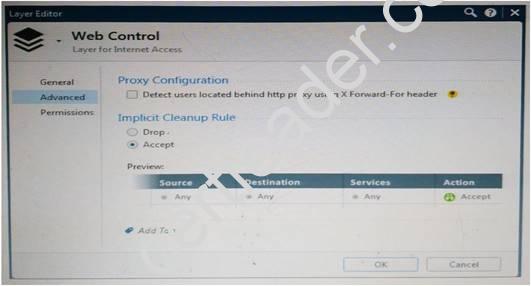
Consider the following policy and select the BEST answer.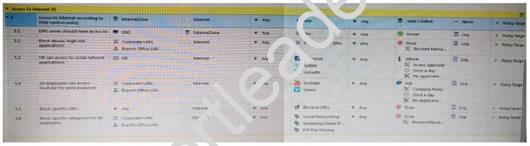
- A. Traffic that does not match any rule in the subpolicy is dropped.
- B. All employees can access only Youtube and Vimeo.
- C. Access to Youtube and Vimeo is allowed only once a day.
- D. Anyone from internal network can access the internet, expect the traffic defined in drop rules 5.2, 5.5 and 5.6.
Answer: D
Explanation: Policy Layers and Sub-Policies
R80 introduces the concept of layers and sub-policies, allowing you to segment your policy according to your network segments or business units/functions. In addition, you can also assign granular privileges by layer or sub-policy to distribute workload and tasks to the most qualified administrators
With layers, the rule base is organized into a set of security rules. These set of rules or layers, are inspected in the order in which they are defined, allowing control over the rule base flow and the security functionalities that take precedence. If an “accept” action is performed across a layer, the inspection will continue to the next layer. For example, a compliance layer can be created to overlay across a cross-section of rules.
Sub-policies are sets of rules that are created for a specific network segment, branch office or business unit, so if a rule is matched, inspection will continue through this subset of rules before it moves on to the next rule.
Sub-policies and layers can be managed by specific administrators, according to their permissions profiles. This facilitates task delegation and workload distribution.
NEW QUESTION 5
Message digests use which of the following?
- A. DES and RC4
- B. IDEA and RC4
- C. SSL and MD4
- D. SHA-1 and MD5
Answer: D
NEW QUESTION 6
Which Check Point software blade prevents malicious files from entering a network using virus signatures and anomaly-based protections from ThreatCloud?
- A. Firewall
- B. Application Control
- C. Anti-spam and Email Security
- D. Antivirus
Answer: D
Explanation: The enhanced Check Point Antivirus Software Blade uses real-time virus signatures and anomaly-based protections from ThreatCloud™, the first collaborative network to fight cybercrime, to detect and block malware at the gateway before users are affected.
NEW QUESTION 7
Which SmartConsole component can Administrators use to track changes to the Rule Base?
- A. WebUI
- B. SmartView Tracker
- C. SmartView Monitor
- D. SmartReporter
Answer: B
NEW QUESTION 8
Jennifer McHanry is CEO of ACME. She recently bought her own personal iPad. She wants use her iPad to access the internal Finance Web server. Because the iPad is not a member of the Active Directory domain, she cannot identify seamlessly with AD Query. However, she can enter her AD credentials in the Captive Portal and then get the same access as on her office computer. Her access to resources is based on rules in the R77 Firewall Rule Base.
To make this scenario work, the IT administrator must:
1) Enable Identity Awareness on a gateway and select Captive Portal as one of the Identity Sources.
2) In the Portal Settings window in the User Access section, make sure that Name and password login is selected.
3) Create a new rule in the Firewall Rule Base to let Jennifer McHanry access network destinations. Select accept as the Action.
4) Install policy.
Ms McHanry tries to access the resource but is unable. What should she do?
- A. Have the security administrator select the Action field of the Firewall Rule “Redirect HTTP connections to an authentication (captive) portal”.
- B. Have the security administrator reboot the firewall.
- C. Have the security administrator select Any for the Machines tab in the appropriate Access Role.
- D. Install the Identity Awareness agent on her iPad.
Answer: A
NEW QUESTION 9
Fill in the blanks: A security Policy is created in ______, stored in the ______, and Distributed to the various ______.
- A. Rule base, Security Management Server, Security Gateways
- B. SmartConsole, Security Gateway, Security Management Servers
- C. SmartConsole, Security Management Server, Security Gateways
- D. The Check Point database, SmartConsole, Security Gateways
Answer: C
NEW QUESTION 10
Which policy type has its own Exceptions section?
- A. Thread Prevention
- B. Access Control
- C. Threat Emulation
- D. Desktop Security
Answer: A
Explanation: The Exceptions Groups pane lets you define exception groups. When necessary, you can create exception groups to use in the Rule Base. An exception group contains one or more defined exceptions. This option facilitates ease-of-use so you do not have to manually define exceptions in multiple rules for commonly required exceptions. You can choose to which rules you want to add exception groups. This means they can be added to some rules and not to others, depending on necessity.
NEW QUESTION 11
Which tool provides a list of trusted files to the administrator so they can specify to the Threat Prevention blade that these files do not need to be scanned or analyzed?
- A. ThreatWiki
- B. Whitelist Files
- C. AppWiki
- D. IPS Protections
Answer: A
NEW QUESTION 12
Which of the completed statements is NOT true? The WebUI can be used to manage user accounts and:
- A. assign privileges to users.
- B. edit the home directory of the user.
- C. add users to your Gaia system.
- D. assign user rights to their home directory in the Security Management Server
Answer: D
Explanation: Users
Use the WebUI and CLI to manage user accounts. You can:
Add users to your Gaia system.
Edit the home directory of the user.
Edit the default shell for a user.
Give a password to a user.
Give privileges to users.
NEW QUESTION 13
Which Threat Prevention Profile is not included by default in R80 Management?
- A. Basic – Provides reliable protection on a range of non-HTTP protocols for servers, with minimal impact on network performance
- B. Optimized – Provides excellent protection for common network products and protocols against recent or popular attacks
- C. Strict – Provides a wide coverage for all products and protocols, with impact on network performance
- D. Recommended – Provides all protection for all common network products and servers, with impact on network performance
Answer: D
NEW QUESTION 14
The following graphic shows: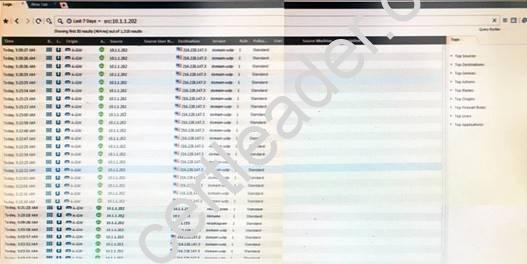
- A. View from SmartLog for logs initiated from source address 10.1.1.202
- B. View from SmartView Tracker for logs of destination address 10.1.1.202
- C. View from SmartView Tracker for logs initiated from source address 10.1.1.202
- D. View from SmartView Monitor for logs initiated from source address 10.1.1.202
Answer: C
NEW QUESTION 15
Fill in the blank: RADIUS Accounting gets _____ data from requests generated by the accounting client
- A. Destination
- B. Identity
- C. Payload
- D. Location
Answer: B
Explanation: How RADIUS Accounting Works with Identity Awareness
RADIUS Accounting gets identity data from RADIUS Accounting Requests generated by the RADIUS accounting client.
NEW QUESTION 16
You want to reset SIC between smberlin and sgosaka.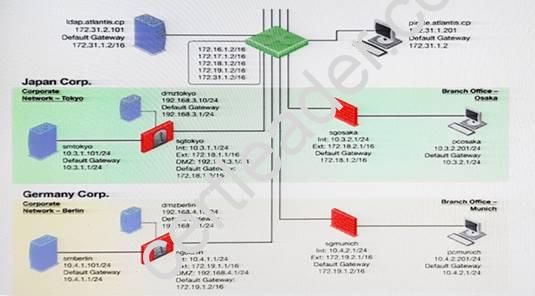
In SmartDashboard, you choose sgosaka, Communication, Reset. On sgosaka, you start cpconfig, choose Secure Internal Communication and enter the new SIC Activation Key. The screen reads The SIC was successfully initialized and jumps back to the menu. When trying to establish a connection, instead of a working connection, you receive this error message: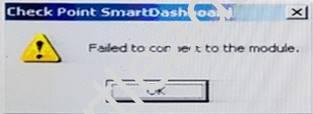
What is the reason for this behavior?
- A. The Gateway was not rebooted, which is necessary to change the SIC key.
- B. You must first initialize the Gateway object in SmartDashboard (i.e., right-click on the object, choose Basic Setup > Initialize).
- C. The check Point services on the Gateway were not restarted because you are still in the cpconfig utility.
- D. The activation key contains letters that are on different keys on localized keyboard
- E. Therefore, the activation can not be typed in a matching fashion.
Answer: C
Recommend!! Get the Full 156-215.80 dumps in VCE and PDF From Certleader, Welcome to Download: https://www.certleader.com/156-215.80-dumps.html (New 440 Q&As Version)