It is impossible to pass Oracle 1Z0-060 exam without any help in the short term. Come to us soon and find the most advanced, correct and guaranteed 1z0 060 dumps. You will get a surprising result by our 1z0 060 dumps.
Online 1Z0-060 free questions and answers of New Version:
NEW QUESTION 1
Your are the DBA supporting an Oracle 11g Release 2 database and wish to move a table containing several DATE, CHAR, VARCHAR2, and NUMBER data types, and the table’s indexes, to another tablespace.
The table does not have a primary key and is used by an OLTP application.
Which technique will move the table and indexes while maintaining the highest level of availability to the application?
- A. Oracle Data Pump.
- B. An ALTER TABLE MOVE to move the table and ALTER INDEX REBUILD to move the indexes.
- C. An ALTER TABLE MOVE to move the table and ALTER INDEX REBUILD ONLINE to move the indexes.
- D. Online Table Redefinition.
- E. Edition-Based Table Redefinition.
Answer: D
NEW QUESTION 2
Which two statements are true about the RMAN validate database command?
- A. It checks the database for intrablock corruptions.
- B. It can detect corrupt pfiles.
- C. It can detect corrupt spfiles.
- D. It checks the database for interblock corruptions.
- E. It can detect corrupt block change tracking files.
Answer: AC
NEW QUESTION 3
Examine the following parameters for a database instance:
MEMORY_MAX_TARGET=0
MEMORY_TARGET=0
SGA_TARGET=0
PGA_AGGREGATE_TARGET=500m
Which three initialization parameters are not controlled by Automatic Shared Memory Management (ASMM)?
- A. LOG_BUFFER
- B. SORT_AREA_SIZE
- C. JAVA_POOL_SIZE
- D. STREAMS_POOL_SIZE
- E. DB_16K_CACHE_SZIE
- F. DB_KEEP_CACHE_SIZE
Answer: AEF
NEW QUESTION 4
Your database supports a DSS workload that involves the execution of complex queries: Currently, the library cache contains the ideal workload for analysis. You want to analyze some of the queries for an application that are cached in the library cache.
What must you do to receive recommendations about the efficient use of indexes and materialized views to improve query performance?
- A. Create a SQL Tuning Set (STS) that contains the queries cached in the library cache and run the SQL Tuning Advisor (STA) on the workload captured in the STS.
- B. Run the Automatic Workload Repository Monitor (ADDM).
- C. Create an STS that contains the queries cached in the library cache and run the SQL Performance Analyzer (SPA) on the workload captured in the STS.
- D. Create an STS that contains the queries cached in the library cache and run the SQL Access Advisor on the workload captured in the STS.
Answer: D
NEW QUESTION 5
Which two statements are true about the use of the procedures listed in the v$sysaux_occupants.move_procedure column?
- A. The procedure may be used for some components to relocate component data to the SYSAUX tablespace from its current tablespace.
- B. The procedure may be used for some components to relocate component data from the SYSAUX tablespace to another tablespace.
- C. All the components may be moved into SYSAUX tablespace.
- D. All the components may be moved from the SYSAUX tablespace.
Answer: AB
NEW QUESTION 6
Your multitenant container database, CDB1, is running in ARCHIVELOG mode and has two pluggable databases, HR_PDB and ACCOUNTS_PDB. An RMAN backup exists for the database.
You issue the command to open ACCOUNTS_PDB and find that the USERDATA. DBF data file for the default permanent tablespace USERDATA belonging to ACCOUNTS_PDB is corrupteD.
What should you do before executing the commands to restore and recover the data file in ACCOUNTS_PDB?
- A. Place CDB1 in the mount stage and then the USERDATA tablespace offline in ACCOUNTS_PD
- B. Place CDB1 in the mount stage and issue the ALTER PLUGGABLE DATABASE accounts_pdb CLOSE IMMEDIATE comman
- C. Issue the ALTER PLUGGABLE DATABASE accounts_pdb RESTRICTED comman
- D. Take the USERDATA tablespace offline in ACCOUNTS_PD
Answer: D
NEW QUESTION 7
A warehouse fact table in your Oracle 12c Database is range-partitioned by month and accessed frequently with queries that span multiple partitions
The table has a local prefixed, range partitioned index.
Some of these queries access very few rows in some partitions and all the rows in other partitions, but these queries still perform a full scan for all accessed partitions.
This commonly occurs when the range of dates begins at the end of a month or ends close to the start of a month.
You want an execution plan to be generated that uses indexed access when only a few rows are accessed from a segment, while still allowing full scans for segments where many rows are returned.
Which three methods could transparently help to achieve this result?
- A. Using a partial local Index on the warehouse fact table month column with indexing disabled to the table partitions that return most of their rows to the queries.
- B. Using a partial local Index on the warehouse fact table month column with indexing disabled for the table partitions that return a few rows to the queries.
- C. Using a partitioned view that does a UNION ALL query on the partitions of the warehouse fact table, which retains the existing local partitioned column.
- D. Converting the partitioned table to a partitioned view that does a UNION ALL query on the monthly tables, which retains the existing local partitioned column.
- E. Using a partial global index on the warehouse fact table month column with indexing disabling for the table partitions that return most of their rows to the queries.
- F. Using a partial global index on the warehouse fact table month column with indexing disabled for the table partitions that return a few rows to the queries.
Answer: ACE
NEW QUESTION 8
You notice that the elapsed time for an important database scheduler Job is unacceptably long.
The job belongs to a scheduler job class and window. Which two actions would reduce the job's elapsed time?
- A. Increasing the priority of the job class to which the job belongs
- B. Increasing the job's relative priority within the Job class to which it belongs
- C. Increasing the resource allocation for the consumer group mapped to the scheduler job's job class within the plan mapped to the scheduler window
- D. Moving the job to an existing higher priority scheduler window with the same schedule and duration
- E. Increasing the value of the JOB_QUEUE_PROCESSES parameter
- F. Increasing the priority of the scheduler window to which the job belongs
Answer: CF
NEW QUESTION 9
In your multitenant container database (CDB) with two pluggable database (PDBs). You want to create a new PDB by using SQL Developer.
Which statement is true?
- A. The CDB must be open.
- B. The CDB must be in the mount stage.
- C. The CDB must be in the nomount stage.
- D. Alt existing PDBs must be close
Answer: A
NEW QUESTION 10
You are about to plug a multi-terabyte non-CDB into an existing multitenant container database (CDB).
The characteristics of the non-CDB are as follows:
✑ Version: Oracle Database 11g Release 2 (11.2.0.2.0) 64-bit
✑ Character set: AL32UTF8
✑ National character set: AL16UTF16
✑ O/S: Oracle Linux 6 64-bit
The characteristics of the CDB are as follows:
✑ Version: Oracle Database 12c Release 1 64-bit
✑ Character Set: AL32UTF8
✑ National character set: AL16UTF16
✑ O/S: Oracle Linux 6 64-bit
Which technique should you use to minimize down time while plugging this non-CDB into the CDB?
- A. Transportable database
- B. Transportable tablespace
- C. Data Pump full export/import
- D. The DBMS_PDB packageE.RMAN
Answer: B
NEW QUESTION 11
Examine these two statements:
Which three are true about the MRKT tablespace?
- A. The MRKT tablespace is created as a small file tablespace, because the file size is less than the minimum required for big file files.
- B. The MRKT tablespace may be dropped if it has no contents.
- C. Users who were using the old default tablespace will have their default tablespaces changed to the MRKT tablespace.
- D. No more data files can be added to the tablespace.
- E. The relative file number of the tablespace is not stored in rowids for the table rows that are stored in the MRKT tablespace.
Answer: CDE
NEW QUESTION 12
You run a script that completes successfully using SQL*Plus that performs these actions:
1.Creates a multitenant container database (CDB)
2.Plugs in three pluggable databases (PDBs)
3.Shuts down the CDB instance
4.Starts up the CDB instance using STARTUP OPEN READ WRITE Which two statements are true about the outcome after running the script?
- A. The seed will be in mount state.
- B. The seed will be opened read-only.
- C. The seed will be opened read/write.
- D. The other PDBs will be in mount state.
- E. The other PDBs will be opened read-only.
- F. The PDBs will be opened read/write.
Answer: BD
NEW QUESTION 13
Your multitenant container database (CDB) is running in ARCHIVELOG mode. You connect to the CDB RMAN.
Examine the following command and its output:
You execute the following command:
RMAN > BACKUP DATABASE PLUS ARCHIVELOG;
Which data files will be backed up?
- A. Data files that belong to only the root container
- B. Data files that belong to the root container and all the pluggable databases (PDBs)
- C. Data files that belong to only the root container and PDB$SEED
- D. Data files that belong to the root container and all the PDBs excluding PDB$SEED
Answer: B
NEW QUESTION 14
What are three purposes of the RMAN “FROM” clause?
- A. to support PUSH-based active database duplication
- B. to support synchronization of a standby database with the primary database in a Data environment
- C. To support PULL-based active database duplication
- D. To support file restores over the network in a Data Guard environment
- E. To support file recovery over the network in a Data Guard environment
Answer: BDE
NEW QUESTION 15
You are administering a database and you receive a requirement to apply the following restrictions:
1.A connection must be terminated after four unsuccessful login attempts by user.
2.A user should not be able to create more than four simultaneous sessions.
3.User session must be terminated after 15 minutes of inactivity.
4.Users must be prompted to change their passwords every 15 days. How would you accomplish these requirements?
- A. by granting a secure application role to the users
- B. by creating and assigning a profile to the users and setting the REMOTE_OS_AUTHENT parameter to FALSE
- C. By creating and assigning a profile to the users and setting the SEC_MAX_FAILED_LOGIN_ATTEMPTS parameter to 4
- D. By Implementing Fine-Grained Auditing (FGA) and setting the REMOTE_LOGIN_PASSWORD_FILE parameter to NONE.
- E. By implementing the database resource Manager plan and setting the SEC_MAX_FAILED_LOGIN_ATTEMPTS parameters to 4.
Answer: C
NEW QUESTION 16
You execute the following PL/SQL: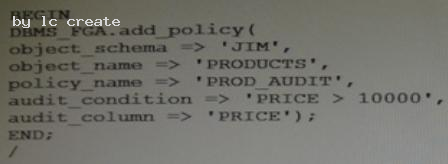
Which two statements are true?
- A. Fine-Grained Auditing (FGA) is enabled for the PRICE column in the PRODUCTS table for SELECT statements only when a row with PRICE > 10000 is accesse
- B. FGA is enabled for the PRODUCTS.PRICE column and an audit record is written whenever a row with PRICE > 10000 is accesse
- C. FGA is enabled for all DML operations by JIM on the PRODUCTS.PRICE column.
- D. FGA is enabled for the PRICE column of the PRODUCTS table and the SQL statements is captured in the FGA audit trial.
Answer: AD
NEW QUESTION 17
You are planning the creation of a new multitenant container database (CDB) and want to store the ROOT and SEED container data files in separate directories.
You plan to create the database using SQL statements.
Which three techniques can you use to achieve this?
- A. Use Oracle Managed Files (OMF).
- B. Specify the SEED FILE_NAME_CONVERT clause.
- C. Specify the PDB_FILE_NAME_CONVERT initialization parameter.
- D. Specify the DB_FILE_NAMECONVERT initialization parameter.
- E. Specify all files in the CREATE DATABASE statement without using Oracle managed Files (OMF).
Answer: ABC
P.S. Certleader now are offering 100% pass ensure 1Z0-060 dumps! All 1Z0-060 exam questions have been updated with correct answers: https://www.certleader.com/1Z0-060-dumps.html (191 New Questions)