It is more faster and easier to pass the Cisco 642-889 exam by using Free Cisco Implementing Cisco Service Provider Next-Generation Edge Network Services (SPEDGE) questuins and answers. Immediate access to the Improve 642-889 Exam and find the same core area 642-889 questions with professionally verified answers, then PASS your exam with a high score now.
Free 642-889 Demo Online For Cisco Certifitcation:
NEW QUESTION 1
Which option is the primary purpose of central service MPLS VPNs?
- A. provide customer access to provider resources while ensuring customers cannot communicate directly
- B. provide the provider access to customer resources while ensuring customers cannot communicate directly
- C. provide other service providers access to provider resources
- D. provide other service providers access to customer resources
Answer: A
NEW QUESTION 2
When implementing CSC services, which two methods can be used to exchange label information between the downstream CSC customer carrier and the CSC backbone carrier? {Choose two.}
- A. using MP-BGP
- B. using RSVP
- C. using IGP and LDP
- D. using back-to-back VRF
- E. using front VRF and internal VRF
Answer: AC
Explanation:
http://www.cisco.com/en/US/docs/net_mgmt/ip_solution_center/4.0/mpls/user/guide/9_iscqsg.html
Since the CSC-PE routers do not have to carry external routes in the VRF routing table, they can use the incoming label in the packet to forward the customer carrier Internet traffic. Adding MPLS to the routers provides a consistent method of transporting packets from the customer carrier to the backbone carrier. MPLS allows the exchange of an MPLS label between the CSC-PE and the CSC-CE routers for every internal customer carrier route. The routers in the customer carrier have all the external routes either through IBGP or route redistribution to provide Internet connectivity.
When a backbone carrier and the customer carrier both provide BGP/MPLS VPN services, the method of transporting data is different from when a customer carrier provides only ISP services. The following list highlights those differences.
•When a customer carrier provides BGP/MPLS VPN services, its external routes are VPN-IPv4 routes. When a customer carrier is an ISP, its external routes are IP routes.
•When a customer carrier provides BGP/MPLS VPN services, every site within the customer carrier must use MPLS. When a customer carrier is an ISP, the sites do not need to use MPLS.
NEW QUESTION 3
VPWS/EoMPLS offers which type of Ethernet services as defined by the MEF?
- A. E-Tree
- B. E-LAN
- C. E-Line
- D. E-Interworking
Answer: C
Explanation:
• E-Line is based on a point-to-point Ethernet Virtual Connection. Two E-Line services are defined:
- Ethernet Private Line {EPL}: A very simple and basic point-to-point service characterized by low frame delay, frame delay variation, and frame loss ratio. No service multiplexing is allowed, and other than a committed information rate {CIR} no class of service {CoS} {Bandwidth Profiling} is allowed.
- Ethernet Virtual Private Line {EVPL}: A point-to-point service wherein service multiplexing {more than one Ethernet Virtual Connection} is allowed. The individual Ethernet Virtual Circuits can be defined with a rich set of Bandwidth Profiles and Layer 2 Control Protocol Processing methods as defined by the Metro Ethernet Forum.
NEW QUESTION 4
Which two protocols can be used for VPLS signaling on a Cisco IOS XR router? {Choose two.}
- A. BGP
- B. LDP
- C. TDP
- D. RSVP
- E. PBB
Answer: AB
NEW QUESTION 5
Refer to the exhibit.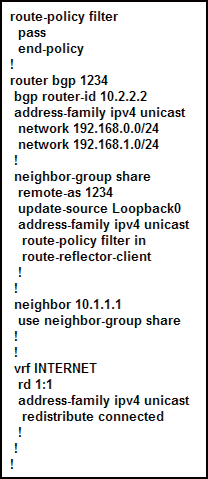
Given the output shown, which two statements are true? {Choose two.}
- A. The configured remote AS for neighbor 10.1.1.1 is 1234.
- B. Both prefixes that are referenced by network commands will be visible with the show bgp command from the information that is shown in the output.
- C. The neighbor 10.1.1.1 cannot learn any routes from this router.
- D. The router cannot learn any routes for neighbor 10.1.1.1.
- E. Routes from the Internet VRF that are injected into BGP through redistribution will be advertised to neighbor 10.1.1.1.
Answer: AC
NEW QUESTION 6
Which CE-to-PE routing protocol implements the down bit as a loop prevention mechanism?
- A. RIPv2
- B. EIGRP
- C. IS-IS
- D. OSPF
- E. BGP
Answer: D
Explanation:
https://www.racf.bnl.gov/Facility/TechnologyMeeting/Archive/06-30-04-CISCO/Using-OSPF-in-MPLS- VPNEnvironment.pdf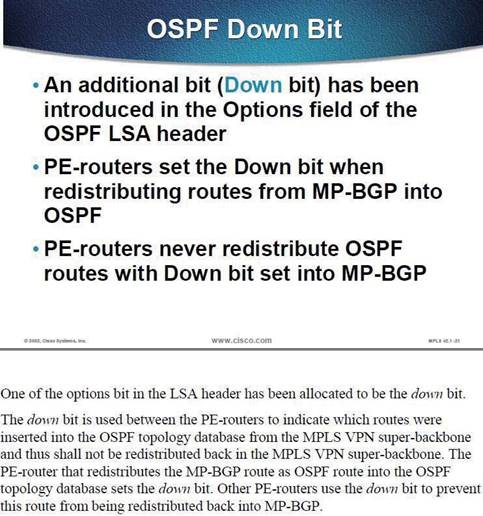
NEW QUESTION 7
When configuring an EoMPLS PW on a Cisco IOS XR router, what are the two supported transport modes? {Choose two.}
- A. ethernet {Ethernet port mode}
- B. ip {routed mode}
- C. vlan {VLAN-tagged mode}
- D. transparent {bridged mode}
Answer: AC
Explanation:
http://www.cisco.com/en/US/docs/ios_xr_sw/iosxr_r3.8/mpls/configuration/guide/gc38v2.html#wp1072883
•Ethernet Port Mode
•Ethernet Remote Port Shutdown
•VLAN Mode
•Inter-AS Mode
•QinQ Mode
•QinAny Mode
•Mac-in-Mac Protocol {Provide Backbone Bridging}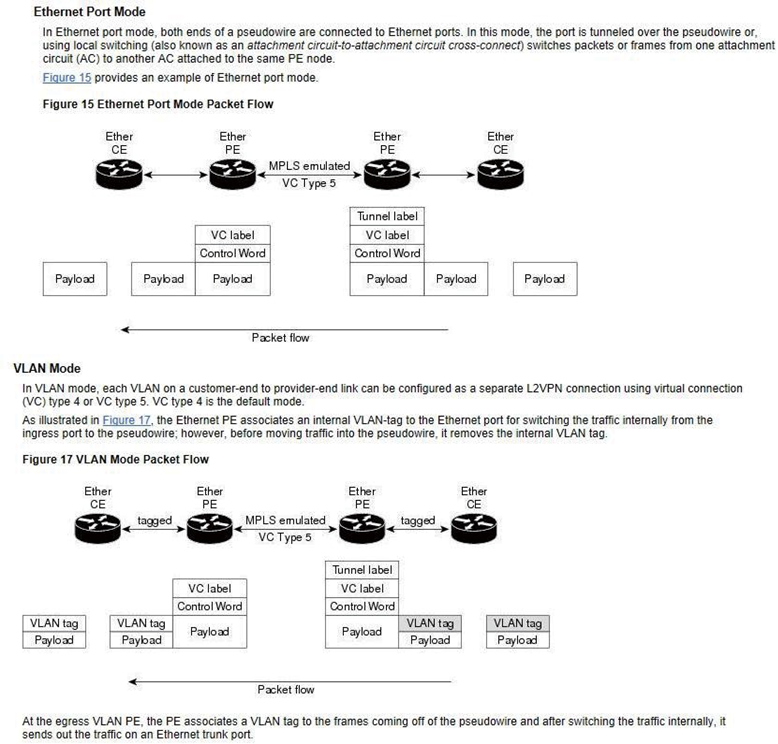
NEW QUESTION 8
Which Cisco IOS XR BGP configuration command is required to enable MP-BGP to carry IPv6 VPN routes?
- A. address-family ipv4 unicast
- B. address-family ipv6 unicast
- C. address-family vpnv4 unicast
- D. address-family vpnv6 unicast
Answer: D
Explanation:
http://www.cisco.com/en/US/tech/tk872/technologies_configuration_example09186a0080b3e11d.shtml
NEW QUESTION 9
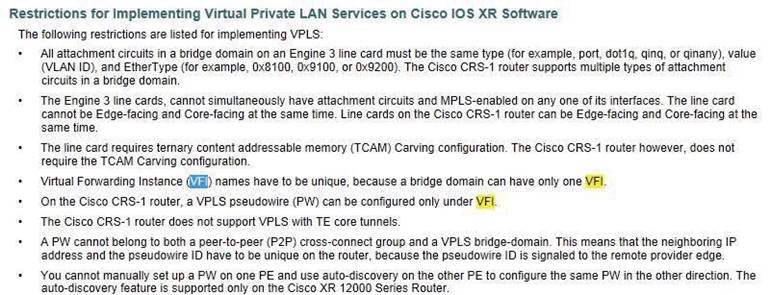
When configuring VPLS on the Cisco ASR 9000, which three configurations are required under the l2vpn configuration mode? {Choose three.}
- A. bridge-group
- B. bridge-domain
- C. xconnect
- D. vfi
- E. encapsulation
Answer: ABD
Explanation: 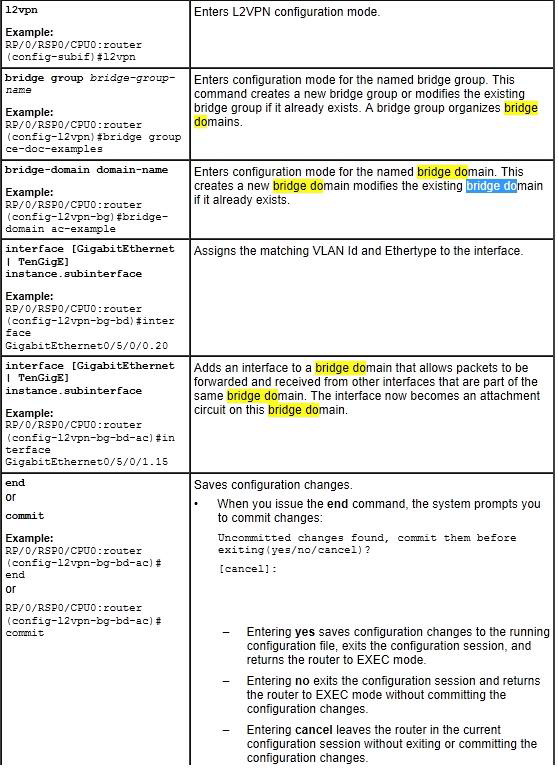
NEW QUESTION 10
A customer wants two separated sites to be connected via a pseudo-wire. Which solution provides the simplest implementation?
- A. AToM
- B. Layer 3 VPN
- C. VPLS
- D. GETVPN
Answer: A
NEW QUESTION 11
In hierarchical VPLS implementations, which two access architectures can be used between the UPE and NPE? {Choose two.}
- A. EoMPLS
- B. MP-BGP
- C. Frame Relay
- D. 802.1ad
Answer: AD
Explanation:
http://www.cisco.com/en/US/docs/switches/metro/me3600x_3800x/software/release/12.2_52_ey/configuration/gui de/swmpls.html#wp1244272
H-VPLS uses spoke connections, usually between Layer 2 switches acting as the CE and PE devices at the service provider's point-of presence {POP}. The spoke connections can be either an IEEE 802.1Q tagged connection or an MPLS LSP.
NEW QUESTION 12
Which type of VPN requires a full mesh of virtual circuits to provide optimal site-to-site connectivity?
- A. MPLS Layer 3 VPNs
- B. Layer 2 overlay VPNs
- C. GET VPNs
- D. peer-to-peer VPNs
Answer: B
Explanation: 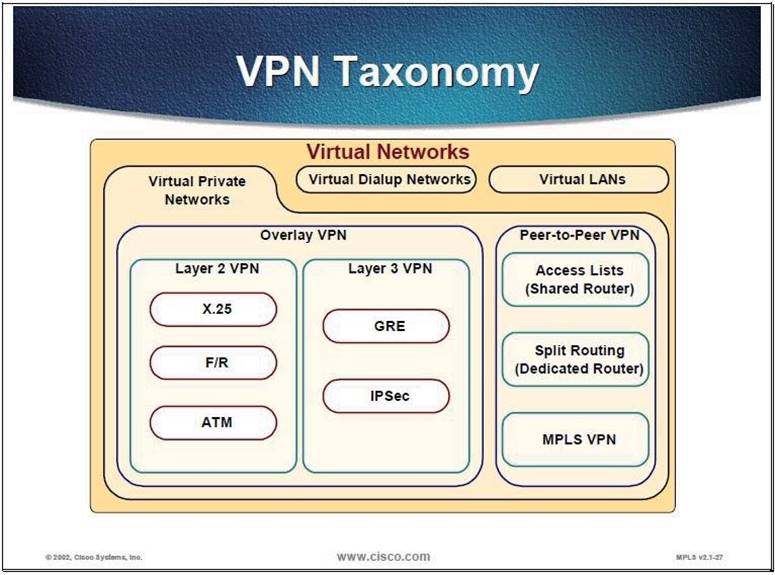
http://etutorials.org/Networking/MPLS+VPN+Architectures/Part+2+MPLSbased+Virtual+Private+Networks/Chapter+7.+Virtual+Private+Network+VPN+Implementation+Options/Overlay+and+Peer-to-peer+VPN+Model/
Two VPN implementation models have gained widespread use:
The overlay model, where the service provider provides emulated leased lines to the customer.
The service provider provides the customer with a set of emulated leased lines. These leased lines are called VCs, which can be either constantly available {PVCs} or established on demand {SVCs}. The QoS guarantees in the overlay VPN model usually are expressed in terms of bandwidth guaranteed on a certain VC {Committed Information Rate or CIR} and maximum bandwidth available on a certain VC {Peak Information Rate or PIR}. The committed bandwidth guarantee usually is provided through the statistical nature of the Layer 2 service but depends on the overbooking strategy of the service provider The peer-to-peer model, where the service provider and the customer exchange Layer 3 routing information and the provider relays the data between the customer sites on the optimum path between the sites and without the customer's involvement. The peer-to-peer VPN model was introduced a few years ago to alleviate the drawbacks of the overlay VPN model. In the peer-to-peer model, the Provider Edge {PE} device is a router {PE-router} that directly exchanges routing information with the CPE router. The Managed Network service offered by many service providers, where the service provider also manages the CPE devices, is not relevant to this discussion because it's only a repackaging of another service. The Managed Network provider concurrently assumes the role of the VPN service provider {providing the VPN infrastructure} and part of the VPN customer role {managing the CPE device}. The peer-to-peer model provides a number of advantages over the traditional overlay model:
Routing {from the customer's perspective} becomes exceedingly simple, as the customer router exchanges routing information with only one {or a few} PE-router, whereas in the overlay VPN network, the number of neighbor routers can grow to a large number.
Routing between the customer sites is always optimal, as the provider routers know the customer's network topology and can thus establish optimum inter-site routing.
Bandwidth provisioning is simpler because the customer has to specify only the inbound and outbound bandwidths for each site {Committed Access Rate [CAR] and Committed Delivery Rate [CDR]} and not the exact site-to-site traffic profile.
The addition of a new site is simpler because the service provider provisions only an additional site and changes the configuration on the attached PE-router. Under the overlay VPN model, the service provider must provision a whole set of VCs leading from that site to other sites of the customer VPN.
Prior to an MPLS-based VPN implementation, two implementation options existed for the peer-to-peer VPN model: The shared-router approach, where several VPN customers share the same PE-router.
The dedicated-router approach, where each VPN customer has dedicated PE-routers.
Overlay VPN paradigm has a number of drawbacks, most significant of them being the need for the customer to establish point-to-point links or virtual circuits between sites. The formula to calculate how many point-to-point links or virtual circuits you need in the worst case is {{n}{n-1}}/2, where n is the number of sites you need to connect. For example, if you need to have full-mesh connectivity between 4 sites, you will need a total of 6 point-to-point links or virtual circuits. To overcome this drawback and provide the customer with optimum data transport across the Service Provider backbone, the peer-to-peer VPN concept was introduced where the Service Provider actively participates in the customer routing, accepting customer routes, transporting them across the Service Provider backbone and finally propagating them to other customer sites.
NEW QUESTION 13
When you are using OSPF as the CE-to-PE routing protocol in MPLS VPN implementations, an OSPF route from customerA site 1 in Area 0 will appear as which kind of OSPF route in customerA site 2, also in Area 0?
- A. intra-area
- B. interarea
- C. E1
- D. E2
Answer: B
NEW QUESTION 14
Which two MPLS QoS models described by RFC3270 are used for CE-PE QoS implementation? {Choose two.}
- A. best effort
- B. pipe
- C. uniform
- D. integrated services
- E. differentiated services
Answer: BC
NEW QUESTION 15
A routing entry on a PE router has an ext-hop address of ::ffff:[IP ADDRESS]. Which service provider technology is being deployed?
- A. 6VPE
- B. 6PE
- C. 4to6 tunnel
- D. 6to4 tunnel
Answer: B
NEW QUESTION 16
In which configuration mode is a route distinguisher configured in a Cisco IOS XR router?
- A. config-vrf
- B. config-vrf-af
- C. config-bgp
- D. config-bgp-af
- E. config-bgp-vrf
Answer: E
Explanation:
http://www.cisco.com/en/US/docs/ios_xr_sw/iosxr_r3.6/routing/configuration/guide/rc36book.pdf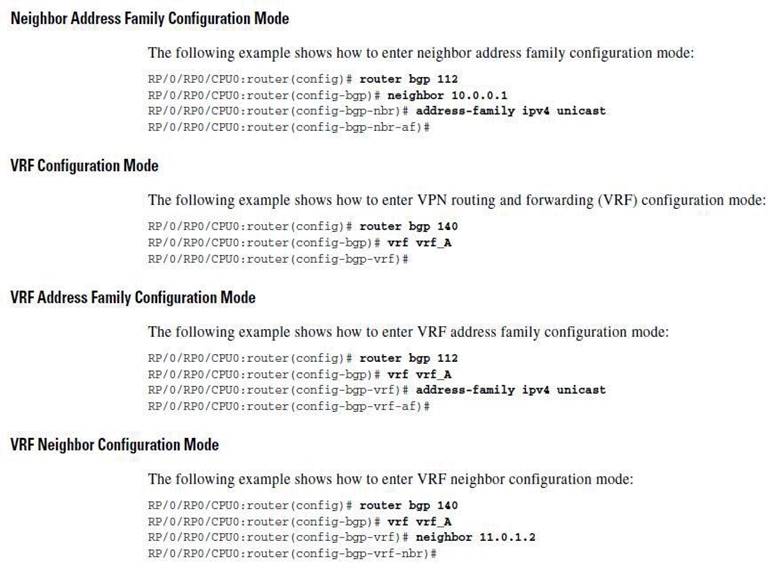
NEW QUESTION 17
Refer the exhibit.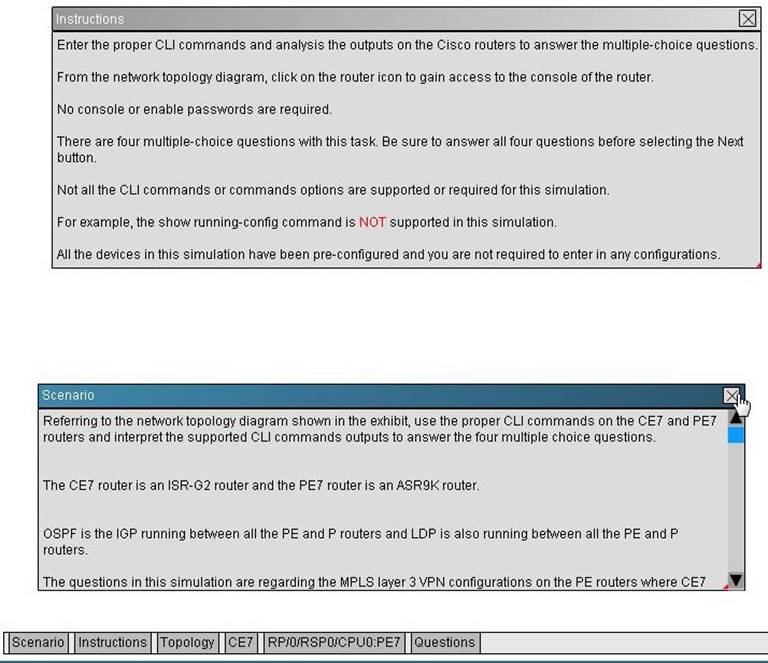
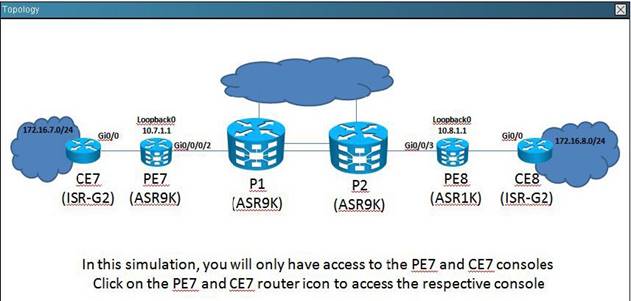
On PE7, which interface connects to the CE7 and what is the name of the VRF that interface is associated to? {Choose two.}
- A. Gi0/0/0/0
- B. Gi0/0/0/1
- C. Gi0/0/0/2
- D. Customer_1
- E. Customer_A
- F. Customer_CE7
Answer: BC
Explanation:
# show ip vrf interfaces
NEW QUESTION 18
An engineer is configuring VPLS BGP-based autodiscovery on a Cisco IOS XE PE router. Which two configurations must be included for proper implementation? {Choose two.}
- A. router bgp 61000neighbor 172.16.10.2 remote-as 61000
- B. router bgp 61000address-family l2vpn vpls send-community extended
- C. router bgp 61000neighbor 172.16.10.2 remote-as 62000
- D. router bgp 61000address-family l2vpn vpls send-community-eBGP
- E. l2vpn vfi context vpls1 autodiscovery bgp signaling ldp router bgp 61000neighbor 172.16.10.2 remote-as 62000
- F. l2vpn vfi context vpls1 autodiscovery bgp signaling ldp router bgp 61000neighbor 172.16.10.2 remote-as 61000
Answer: AB
NEW QUESTION 19
When implementing MPLS Layer 3 VPNs with customers running OSPF as the CE-PE routing protocol, the service provider MPLS backbone looks like what to the CE routers?
- A. the backbone {Area 0}
- B. an external routing domain
- C. a superbackbone that is transparent to the CE OSPF routers
- D. a transit area {similar to a transit area for supporting virtual links}
Answer: C
NEW QUESTION 20
When implementing H-VPLS with QinQ access on Cisco Metro Ethernet switches, which two commands enable the QinQ tagging? {Choose two.}
- A. encapsulation dot1q {customer-vlan} second-tag {sp-vlan}
- B. encapsulation dot1q {sp-vlan} second-tag {customer-vlan}
- C. switchport mode dot1q-tunnel
- D. switchport mode trunk
- E. switchport access vlan {sp-vlan}
- F. switchport access vlan {customer-vlan}
Answer: CE
NEW QUESTION 21
Refer to the exhibit.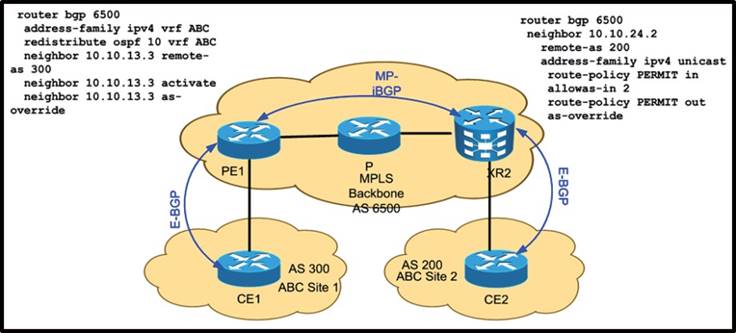
What is the AS-PATH list for an e-BGP update sent from ABC site 1 to ABC site 2 on the CE2 BGP table?
- A. 300 300
- B. 300 6500
- C. 6500 300
- D. 6500 6500
- E. 6500 6500 200
Answer: D
NEW QUESTION 22
In which Cisco IOS XR configuration mode is the redistribute static command applied to enable the redistribution of static VRF routes between the PE routers?
- A. RP/0/RP0/CPU0:PE{config-router}#
- B. RP/0/RP0/CPU0:PE{config-bgp}#
- C. RP/0/RP0/CPU0:PE{config-bgp-vrf}#
- D. RP/0/RP0/CPU0:PE{config-bgp-vrf-af}#
Answer: D
Explanation:
http://www.cisco.com/en/US/docs/routers/asr9000/software/routing/configuration/guide/rcasr9kstat.html#wp1041 359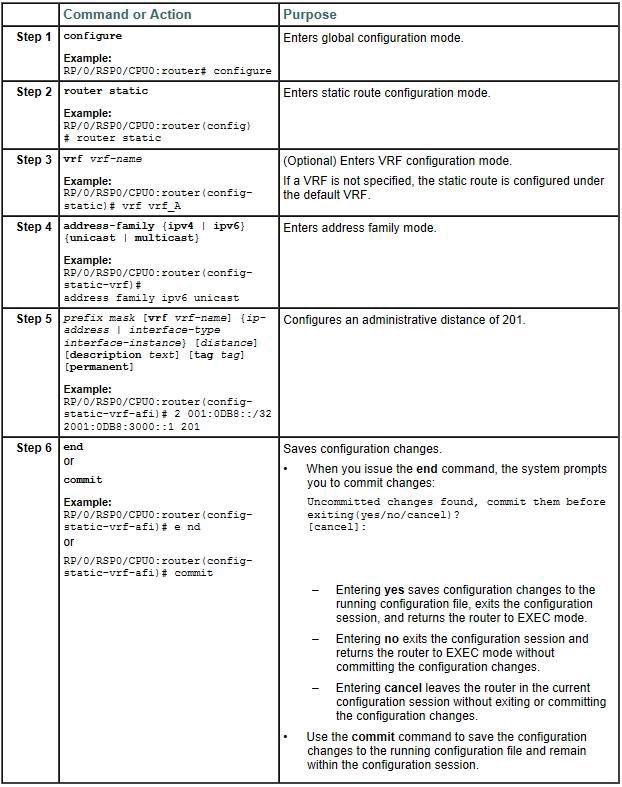
NEW QUESTION 23
When implementing EoMPLS PWs, which configuration is optional?
- A. matching PW ID on both ends
- B. Xconnect
- C. Cisco Express Forwarding
- D. control word
Answer: D
Explanation: 
NEW QUESTION 24
......
100% Valid and Newest Version 642-889 Questions & Answers shared by 2passeasy, Get Full Dumps HERE: https://www.2passeasy.com/dumps/642-889/ (New 126 Q&As)