We provide real AZ-204 exam questions and answers braindumps in two formats. Download PDF & Practice Tests. Pass Microsoft AZ-204 Exam quickly & easily. The AZ-204 PDF type is available for reading and printing. You can print more and practice many times. With the help of our Microsoft AZ-204 dumps pdf and vce product and material, you can easily pass the AZ-204 exam.
Also have AZ-204 free dumps questions for you:
NEW QUESTION 1
You are developing a Docker/Go using Azure App Service Web App for Containers. You plan to run the container in an App Service on Linux. You identify a Docker container image to use.
None of your current resource groups reside in a location that supports Linux. You must minimize the number of resource groups required.
You need to create the application and perform an initial deployment.
Which three Azure CLI commands should you use to develop the solution? To answer, move the appropriate commands from the list of commands to the answer area and arrange them in the correct order.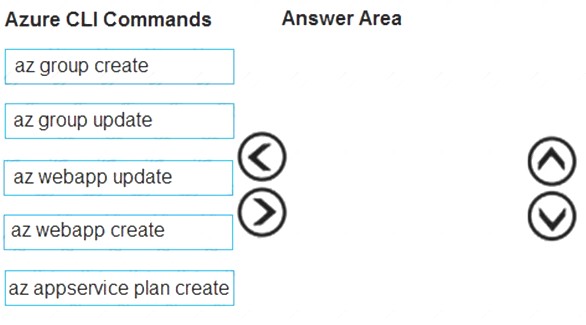
- A. Mastered
- B. Not Mastered
Answer: A
Explanation:
You can host native Linux applications in the cloud by using Azure Web Apps. To create a Web App for Containers, you must run Azure CLI commands that create a group, then a service plan, and finally the web app itself.
Step 1: az group create
In the Cloud Shell, create a resource group with the az group create command. Step 2: az appservice plan create
In the Cloud Shell, create an App Service plan in the resource group with the az appservice plan create command.
Step 3: az webapp create
In the Cloud Shell, create a web app in the myAppServicePlan App Service plan with the az webapp create command. Don't forget to replace with a unique app name, and <docker-ID> with your Docker ID.
References:
https://docs.microsoft.com/mt-mt/azure/app-service/containers/quickstart-docker-go?view=sql-server-ver15
NEW QUESTION 2
A company backs up all manufacturing data to Azure Blob Storage. Admins move blobs from hot storage to archive tier storage every month.
You must automatically move blocks to Archive tier after they have not been accessed for 180 days. The path for any item that is not archived must be placed in an existing queue. This operation must be performed automatically once a month. You set the value of TierAgeInDays to 180.
How should you configure the Logic App? To answer, drag the appropriate triggers or action blocks to the correct trigger or action slots. Each trigger or action block may be used once, more than once, or not at all. You may need to drag the split bar between panes or scroll to view content.
NOTE: Each correct selection is worth one point.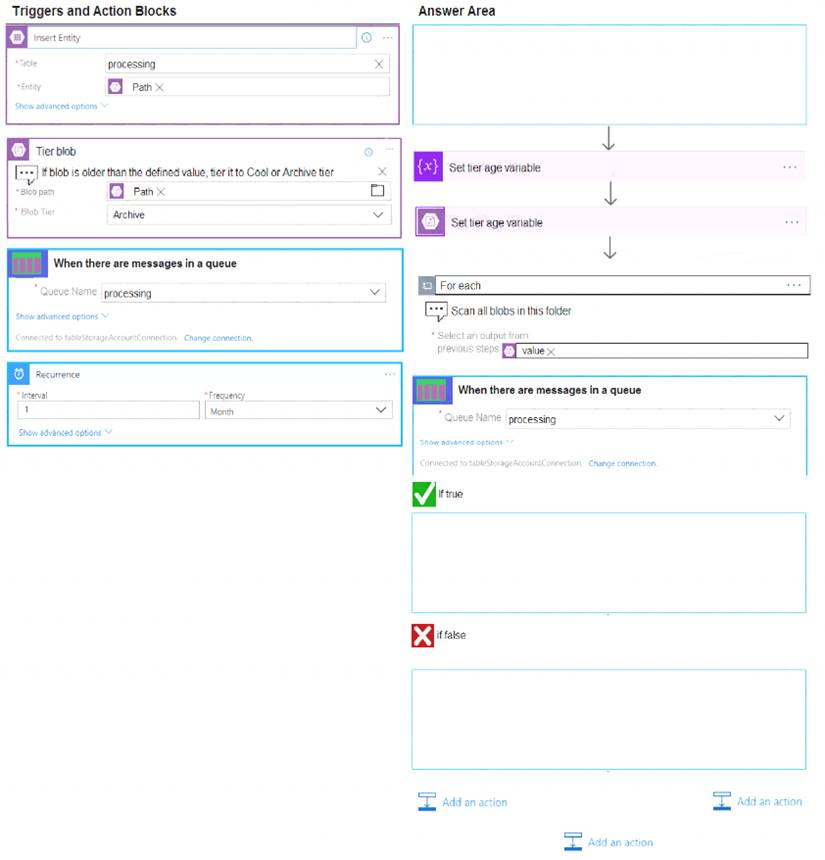
- A. Mastered
- B. Not Mastered
Answer: A
Explanation:
Box 1: Recurrence Box 2: Insert Entity
Box 3 (if true): Tier Blob Box 4: (if false):
Leave blank. References:
https://docs.microsoft.com/en-us/azure/logic-apps/logic-apps-perform-data-operations
NEW QUESTION 3
A company is developing a Java web app. The web app code is hosted in a GitHub repository located at https://github.com/Contoso/webapp.
The web app must be evaluated before it is moved to production. You must deploy the initial code release to a deployment slot named staging.
You need to create the web app and deploy the code.
How should you complete the commands? To answer, select the appropriate options in the answer area. NOTE: Each correct selection is worth one point.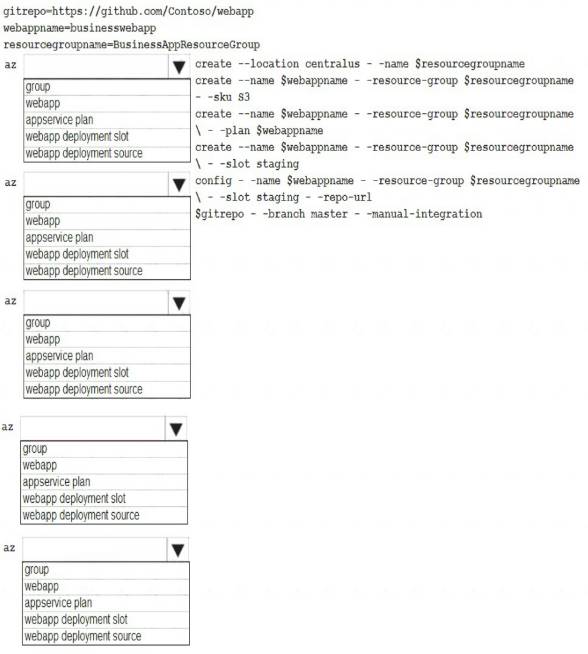
- A. Mastered
- B. Not Mastered
Answer: A
Explanation:
Box 1: group
# Create a resource group.
az group create --location westeurope --name myResourceGroup
Box 2: appservice plan
# Create an App Service plan in STANDARD tier (minimum required by deployment slots). az appservice plan create --name $webappname --resource-group myResourceGroup --sku S1 Box 3: webapp
# Create a web app.
az webapp create --name $webappname --resource-group myResourceGroup
--plan $webappname
Box 4: webapp deployment slot
#Create a deployment slot with the name "staging".
az webapp deployment slot create --name $webappname --resource-group myResourceGroup
--slot staging
Box 5: webapp deployment source
# Deploy sample code to "staging" slot from GitHub.
az webapp deployment source config --name $webappname --resource-group myResourceGroup
--slot staging --repo-url $gitrepo --branch master --manual-integration References:
https://docs.microsoft.com/en-us/azure/app-service/scripts/cli-deploy-staging-environment
NEW QUESTION 4
Note: This question is part of a series of questions that present the same scenario. Each question in the series contains a unique solution that might meet the stated goals. Some question sets might have more than one correct solution, while others might not have a correct solution.
After you answer a question in this question, you will NOT be able to return to it. As a result, these questions will not appear in the review screen.
Margie’s Travel is an international travel and bookings management service. The company is expanding into restaurant bookings. You are tasked with implementing Azure Search for the restaurants listed in their solution.
You create the index in Azure Search.
You need to import the restaurant data into the Azure Search service by using the Azure Search .NET SDK. Solution:
* 1. Create a SearchIndexClient object to connect to the search index.
* 2. Create a DataContainer that contains the documents which must be added.
* 3. Create a DataSource instance and set its Container property to the DataContainer.
* 4. Call the Documents.Suggest method of the SearchIndexClient and pass the DataSource. Does the solution meet the goal?
- A. Yes
- B. No
Answer: B
Explanation:
Use the following method:
* 1. - Create a SearchIndexClient object to connect to the search index
* 2. - Create an IndexBatch that contains the documents which must be added.
* 3. - Call the Documents.Index method of the SearchIndexClient and pass the IndexBatch. References:
https://docs.microsoft.com/en-us/azure/search/search-howto-dotnet-sdk
NEW QUESTION 5
You develop software solutions for a mobile delivery service. You are developing a mobile app that users can use to order from a restaurant in their area. The app uses the following workflow:
* 1. A driver selects the restaurants for which they will deliver orders.
* 2. Orders are sent to all available drivers in an area.
* 3. Only orders for the selected restaurants will appear for the driver.
* 4. The first driver to accept an order removes it from the list of available orders. You need to implement an Azure Service Bus solution.
Which three actions should you perform in sequence? To answer, move the appropriate actions from the list of actions to the answer area and arrange them in the correct order.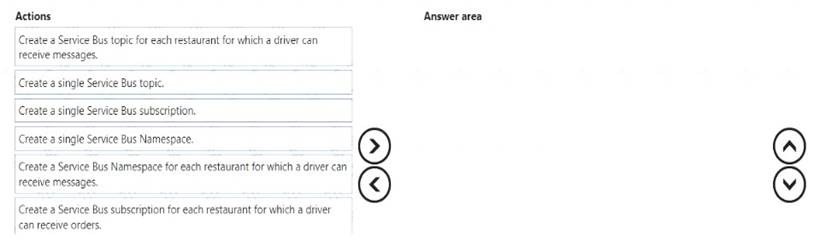
- A. Mastered
- B. Not Mastered
Answer: A
Explanation:
Box 1: Create a single Service Bus Namespace
To begin using Service Bus messaging entities in Azure, you must first create a namespace with a name that is unique across Azure. A namespace provides a scoping container for addressing Service Bus resources within your application.
Box 2: Create a Service Bus Topic for each restaurant for which a driver can receive messages. Create topics.
Box 3: Create a Service Bus subscription for each restaurant for which a driver can receive orders. Topics can have multiple, independent subscriptions.
References:
https://docs.microsoft.com/en-us/azure/service-bus-messaging/service-bus-messaging-overview
NEW QUESTION 6
You have an application that provides weather forecasting data to external partners. You use Azure API Management to publish APIs.
You must change the behavior of the API to meet the following requirements:
• Support alternative input parameters.
• Remove formatting text from responses.
• Provide additional context to back-end services.
Which types of policies should you implement? To answer, drag the policy types to the correct scenarios. Each policy type may be used once, more than once, or not at all. You may need to drag the split bar between panes or scroll to view content
NOTE: Each correct selection is worth one point.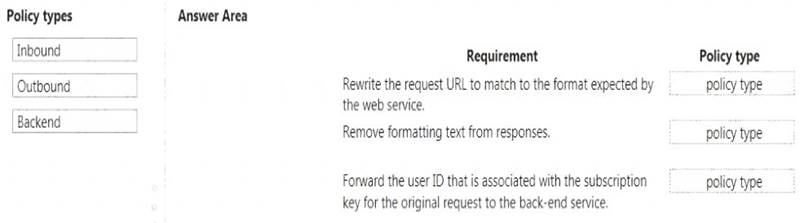
- A. Mastered
- B. Not Mastered
Answer: A
Explanation: 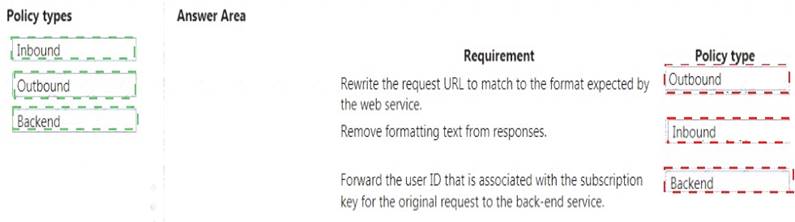
NEW QUESTION 7
You need to configure Azure App Service to support the REST API requirements.
Which values should you use? To answer, select the appropriate options in the answer area.
NOTE: Each correct selection is worth one point.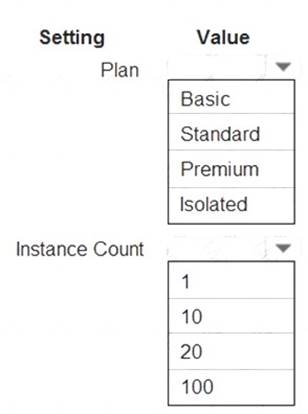
- A. Mastered
- B. Not Mastered
Answer: A
Explanation:
Plan: Standard
Standard support auto-scaling Instance Count: 10
Max instances for standard is 10. Scenario:
The REST API’s that support the solution must meet the following requirements: Allow deployment to a testing location within Azure while not incurring additional costs. Automatically scale to double capacity during peak shipping times while not causing application downtime.Minimize costs when selecting an Azure payment model. References:
https://azure.microsoft.com/en-us/pricing/details/app-service/plans/
NEW QUESTION 8
You need to migrate on-premises shipping data to Azure. What should you use?
- A. Azure Migrate
- B. Azure Cosmos DB Data Migration tool (dt.exe)
- C. AzCopy
- D. Azure Database Migration service
Answer: D
Explanation:
Migrate from on-premises or cloud implementations of MongoDB to Azure Cosmos DB with minimal downtime by using Azure Database Migration Service. Perform resilient migrations of MongoDB data at scale and with high reliability.
Scenario: Data migration from on-premises to Azure must minimize costs and downtime.
The application uses MongoDB JSON document storage database for all container and transport information. References:
https://azure.microsoft.com/en-us/updates/mongodb-to-azure-cosmos-db-online-and-offline-migrations-are-now
NEW QUESTION 9
You are a developer for a software as a service (SaaS) company that uses an Azure Function to process orders. The Azure Function currently runs on an Azure Function app that is triggered by an Azure Storage queue.
You are preparing to migrate the Azure Function to Kubernetes using Kubernetes-based Event Driven Autoscaling (KEDA).
You need to configure Kubernetes Custom Resource Definitions (CRD) for the Azure Function.
Which CRDs should you configure? To answer, drag the appropriate CRD types to the correct locations. Each CRD type may be used once, more than once, or not at all. You may need to drag the split bar between panes or scroll to view content.
NOTE: Each correct selection is worth one point.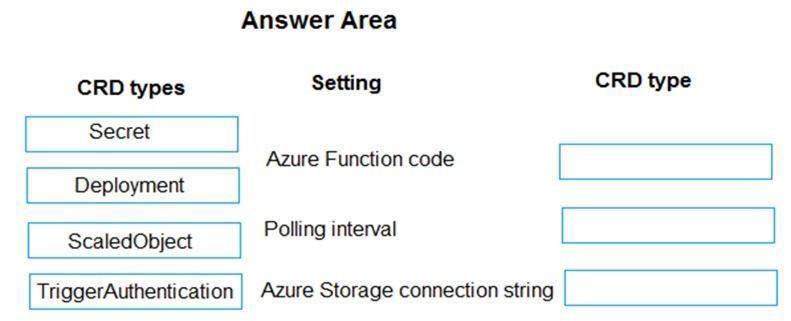
- A. Mastered
- B. Not Mastered
Answer: A
Explanation:
Box 1: Deployment
To deploy Azure Functions to Kubernetes use the func kubernetes deploy command has several attributes that directly control how our app scales, once it is deployed to Kubernetes.
Box 2: ScaledObject
With --polling-interval, we can control the interval used by KEDA to check Azure Service Bus Queue for messages.
Example of ScaledObject with polling interval apiVersion: keda.k8s.io/v1alpha1
kind: ScaledObject metadata:
name: transformer-fn namespace: tt
labels:
deploymentName: transformer-fn spec:
scaleTargetRef: deploymentName: transformer-fn pollingInterval: 5
minReplicaCount: 0
maxReplicaCount: 100
Box 3: Secret
Store connection strings in Kubernetes Secrets. Example: to create the Secret in our demo Namespace:
# create the k8s demo namespace kubectl create namespace tt
# grab connection string from Azure Service Bus KEDA_SCALER_CONNECTION_STRING=$(az servicebus queue authorization-rule keys list
-g $RG_NAME
--namespace-name $SBN_NAME
--queue-name inbound
-n keda-scaler
--query "primaryConnectionString"
-o tsv)
# create the kubernetes secret
kubectl create secret generic tt-keda-auth
--from-literal KedaScaler=$KEDA_SCALER_CONNECTION_STRING
--namespace tt Reference:
https://www.thinktecture.com/en/kubernetes/serverless-workloads-with-keda/
NEW QUESTION 10
You are developing a microservices solution. You plan to deploy the solution to a multinode Azure Kubernetes Service (AKS) cluster.
You need to deploy a solution that includes the following features:  reverse proxy capabilities
 configurable traffic routing TLS termination with a custom certificate
Which components should you use? To answer, drag the appropriate components to the correct requirements. Each component may be used once, more than once, or not at all. You may need to drag the split bar between panes or scroll to view content.
NOTE: Each correct selection is worth one point.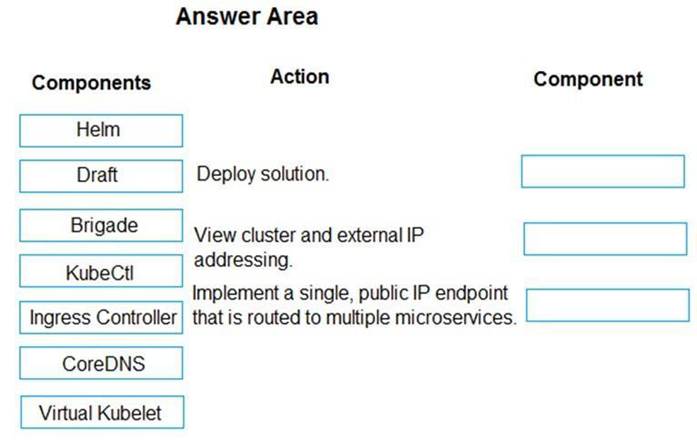
- A. Mastered
- B. Not Mastered
Answer: A
Explanation:
Box 1: Helm
To create the ingress controller, use Helm to install nginx-ingress. Box 2: kubectl
To find the cluster IP address of a Kubernetes pod, use the kubectl get pod command on your local machine, with the option -o wide .
Box 3: Ingress Controller
An ingress controller is a piece of software that provides reverse proxy, configurable traffic routing, and TLS termination for Kubernetes services. Kubernetes ingress resources are used to configure the ingress rules and routes for individual Kubernetes services.
Reference:
https://docs.microsoft.com/bs-cyrl-ba/azure/aks/ingress-basic https://www.digitalocean.com/community/tutorials/how-to-inspect-kubernetes-networking
NEW QUESTION 11
A company develops a series of mobile games. All games use a single leaderboard service. You have the following requirements:
•Code should be scalable and allow for growth.
•Each record must consist of a playedId, gameId, score, and time played.
•When users reach a new high score, the system will save the new score using the SaveScore function below.
•Each game is assigned and Id based on the series title.
You have the following code. (Line numbers are included for reference only.)
You store customer information in an Azure Cosmos database. The following data already exists in the database: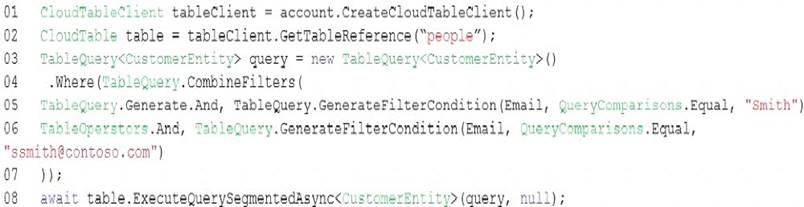
For each of the following statements, select Yes if the statement is true. Otherwise, select No. NOTE: Each correct selection is worth one point.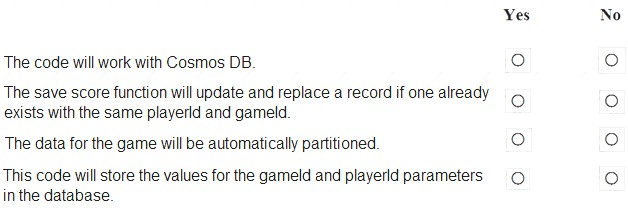
- A. Mastered
- B. Not Mastered
Answer: A
Explanation:
Box 1: Yes
Code for CosmosDB, example:
// Parse the connection string and return a reference to the storage account. CloudStorageAccount storageAccount = CloudStorageAccount.Parse( CloudConfigurationManager.GetSetting("StorageConnectionString"));
// Create the table client.
CloudTableClient tableClient = storageAccount.CreateCloudTableClient();
// Retrieve a reference to the table.
CloudTable table = tableClient.GetTableReference("people");
// Create the TableOperation object that inserts the customer entity. TableOperation insertOperation = TableOperation.Insert(customer1); Box 2: No
A new record will always be added as TableOperation.Insert is used, instead of TableOperation.InsertOrReplace.
Box 3: No
No partition key is used. Box 4: Yes
References:
https://docs.microsoft.com/en-us/azure/cosmos-db/table-storage-how-to-use-dotnet
NEW QUESTION 12
You are building a website to access project data related to terms within your organization. The website does not allow anonymous access. Authentication performed using an Azure Active Directory (Azure AD) app named internal.
The website has the following authentication requirements:
•Azure AD users must be able to login to the website.
•Personalization of the website must be based on membership in Active Directory groups. You need to configure the application’s manifest to meet the authentication requirements.
How should you configure the manifest? To answer, select the appropriate options in the answer area.
NOTE: Each correct selection is worth one point.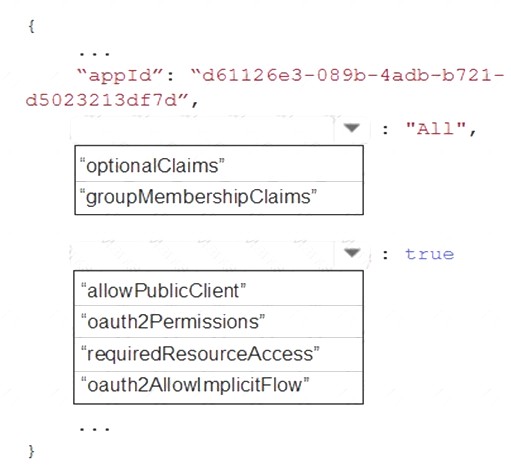
- A. Mastered
- B. Not Mastered
Answer: A
Explanation:
Box 1: groupMembershipClaims
Scenario: Personalization of the website must be based on membership in Active Directory groups. Group claims can also be configured in the Optional Claims section of the Application Manifest. Enable group membership claims by changing the groupMembershipClaim
The valid values are: "All" "SecurityGroup" "DistributionList" "DirectoryRole"
Box 2: oauth2Permissions
Scenario: Azure AD users must be able to login to the website.
oauth2Permissions specifies the collection of OAuth 2.0 permission scopes that the web API (resource) app exposes to client apps. These permission scopes may be granted to client apps during consent.
NEW QUESTION 13
Note: This question is part of a series of questions that present the same scenario. Each question in the series contains a unique solution that might meet the stated goals. Some question sets might have more than one correct solution, while others might not have a correct solution.
After you answer a question in this section, you will NOT be able to return to it. As a result, these questions will not appear in the review screen.
Margie’s Travel is an international travel and bookings management service. The company is expanding into restaurant bookings. You are tasked with implementing Azure Search for the restaurants listed in their solution You create the index in Azure Search.
You need to import the restaurant data into the Azure Search service by using the Azure Search NET SDK. Solution:
* 1 Create a SearchlndexClient object to connect to the search index
* 2. Create an IndexBatch that contains the documents which must be added.
* 3. Call the Documents.Index method of the SearchIndexClient and pass the IndexBatch..
Does the solution meet the goal?
- A. Yes
- B. No
Answer: A
Explanation:
* 1. The index needs to be populated. To do this, we will need a SearchIndexClient. There are two ways to obtain one: by constructing it, or by calling Indexes.GetClient on the SearchServiceClient. Here we will use the first method.
* 2. Create the indexBatch with the documents Something like:
var hotels = new Hotel[];
{
new Hotel()
{
HotelId = "3",
BaseRate = 129.99,
Description = "Close to town hall and the river"
}
};
…
var batch = IndexBatch.Upload(hotels);
* 3. The next step is to populate the newly-created index Example:
var batch = IndexBatch.Upload(hotels); try
{
indexClient.Documents.Index(batch);
}
References:
https://docs.microsoft.com/en-us/azure/search/search-howto-dotnet-sdk
NEW QUESTION 14
You are implementing a software as a service (SaaS) ASP.NET Core web service that will run as an Azure Web App. The web service will use an on-premises SQL Server database for storage. The web service also includes a WebJob that processes data updates. Four customers will use the web service.
•Each instance of the WebJob processes data for a single customer and must run as a singleton instance.
•Each deployment must be tested by using deployment slots prior to serving production data.
•Azure costs must be minimized.
•Azure resources must be located in an isolated network.
You need to configure the App Service plan for the Web App.
How should you configure the App Service plan? To answer, select the appropriate settings in the answer area. NOTE: Each correct selection is worth one point.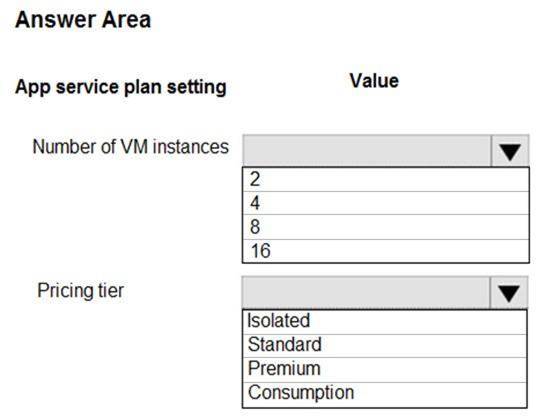
- A. Mastered
- B. Not Mastered
Answer: A
Explanation:
Number of VM instances: 4
You are not charged extra for deployment slots. Pricing tier: Isolated
The App Service Environment (ASE) is a powerful feature offering of the Azure App Service that gives network isolation and improved scale capabilities. It is essentially a deployment of the Azure App Service into a subnet of a customer’s Azure Virtual Network (VNet).
References:
https://azure.microsoft.com/sv-se/blog/announcing-app-service-isolated-more-power-scale-and-ease-of-use/
NEW QUESTION 15
Note: This question is part of a series of questions that present the same scenario. Each question in the series contains a unique solution that might meet the stated goals. Some question sets might have more than one correct solution, while others might not have a correct solution.
After you answer a question in this section, you will NOT be able to return to it. As a result, these questions will not appear in the review screen.
You are developing an Azure solution to collect point-of-sale (POS) device data from 2,000 stores located throughout the world. A single device can produce 2 megabytes (MB) of data every 24 hours. Each store location has one to five devices that send data.
You must store the device data in Azure Blob storage. Device data must be correlated based on a device identifier. Additional stores are expected to open in the future.
You need to implement a solution to receive the device data.
Solution: Provision an Azure Event Grid. Configure event filtering to evaluate the device identifier. Does the solution meet the goal?
- A. Yes
- B. No
Answer: B
Explanation:
Instead use an Azure Service Bus, which is used order processing and financial transactions.
Note: An event is a lightweight notification of a condition or a state change. Event hubs is usually used reacting to status changes.
Reference:
https://docs.microsoft.com/en-us/azure/event-grid/compare-messaging-services
NEW QUESTION 16
A company is implementing a publish-subscribe (Pub/Sub) messaging component by using Azure Service Bus. You are developing the first subscription application.
In the Azure portal you see that messages are being sent to the subscription for each topic. You create and initialize a subscription client object by supplying the correct details, but the subscription application is still not consuming the messages.
You need to complete the source code of the subscription client What should you do?
- A. await subscriptionClient.CloseAsync();
- B. await subscriptionClient.AddRuleAsync(new RuleDescription(RuleDescription.DefaultRuleName, new TrueFilter()));
- C. subscriptionClient.RegisterMessageHandler(ProcessMessagesAsync, messageHandlerOptions);
- D. subscriptionClient = new SubscriptionClient(ServiceBusConnectionString, TopicName, SubscriptionName);
Answer: C
Explanation:
Using topic client, call RegisterMessageHandler which is used to receive messages continuously from the entity. It registers a message handler and begins a new thread to receive messages. This handler is waited on every time a new message is received by the receiver.
subscriptionClient.RegisterMessageHandler(ReceiveMessagesAsync, messageHandlerOptions); References:
https://www.c-sharpcorner.com/article/azure-service-bus-topic-and-subscription-pub-sub/
NEW QUESTION 17
You have an Azure App Services Web App. Azure SQL Database instance. Azure Storage Account and an Azure Redis Cache instance in a resource group.
A developer must be able to publish code to the web app. You must grant the developer the Contribute role to the web app
You need to grant the role.
What two commands can you use? Each correct answer presents a complete solution. NOTE: Each correct selection is worth one point.
- A. New-AzureRmRoleAssignment
- B. az role assignment create
- C. az role definition create
- D. New-AzureRmRoleDefinition
Answer: AB
Explanation:
References:
https://docs.microsoft.com/en-us/cli/azure/role/assignment?view=azure-cli-latest#az-role-assignment-create https://docs.microsoft.com/en-us/powershell/module/azurerm.resources/new-azurermroleassignment?view=azur
NEW QUESTION 18
You are developing a software solution for an autonomous transportation system. The solution uses large data sets and Azure Batch processing to simulate navigation sets for entire fleets of vehicles.
You need to create compute nodes for the solution on Azure Batch. What should you do?
- A. In Python, implement the class: TaskAddParameter
- B. In Python, implement the class: JobAddParameter
- C. In the Azure portal, create a Batch account
- D. In a .NET method, call the method: BatchClient.PoolOperations.CreateJob
Answer: D
Explanation:
A Batch job is a logical grouping of one or more tasks. A job includes settings common to the tasks, such as priority and the pool to run tasks on. The app uses the BatchClient.JobOperations.CreateJob method to create a job on your pool.
Note:
Step 1: Create a pool of compute nodes. When you create a pool, you specify the number of compute nodes for the pool, their size, and the operating system. When each task in your job runs, it's assigned to execute on one of the nodes in your pool.
Step 2 : Create a job. A job manages a collection of tasks. You associate each job to a specific pool where that job's tasks will run.
Step 3: Add tasks to the job. Each task runs the application or script that you uploaded to process the data files it downloads from your Storage account. As each task completes, it can upload its output to Azure Storage.
NEW QUESTION 19
You are developing an application. You have an Azure user account that has access to two subscriptions. You need to retrieve a storage account key secret from Azure Key Vault.
In which order should you arrange the PowerShell commands to develop the solution? To answer, move all commands from the list of commands to the answer area and arrange them in the correct order.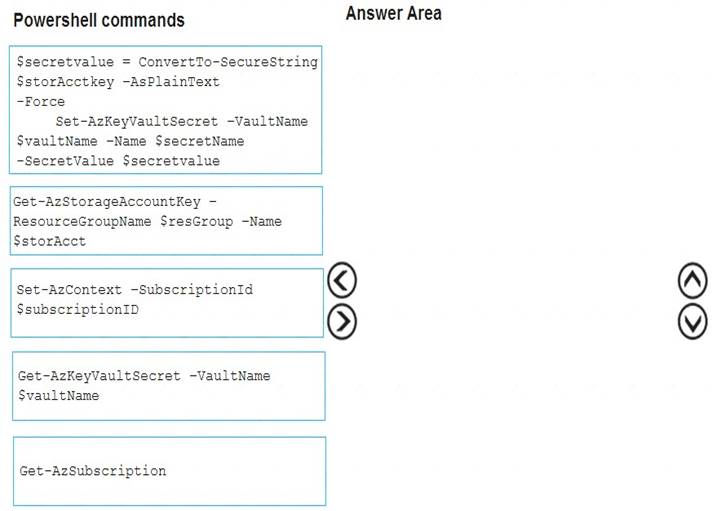
- A. Mastered
- B. Not Mastered
Answer: A
Explanation:
Step 1: Get-AzSubscription
If you have multiple subscriptions, you might have to specify the one that was used to create your key vault. Enter the following to see the subscriptions for your account:
Get-AzSubscription
Step 2: Set-AzContext -SubscriptionId
To specify the subscription that's associated with the key vault you'll be logging, enter: Set-AzContext -SubscriptionId <subscriptionID>
Step 3: Get-AzStorageAccountKey You must get that storage account key.
Step 4: $secretvalue = ConvertTo-SecureString <storageAccountKey> -AsPlainText -Force
Set-AzKeyVaultSecret -VaultName <vaultName> -Name <secretName> -SecretValue $secretvalue After retrieving your secret (in this case, your storage account key), you must convert that key to a secure
string, and then create a secret with that value in your key vault.
Step 5: Get-AzKeyVaultSecret
Next, get the URI for the secret you created. You'll need this URI in a later step to call the key vault and retrieve your secret. Run the following PowerShell command and make note of the ID value, which is the secret's URI:
Get-AzKeyVaultSecret –VaultName <vaultName> Reference:
https://docs.microsoft.com/bs-latn-ba/Azure/key-vault/key-vault-key-rotation-log-monitoring
NEW QUESTION 20
You develop a serverless application using several Azure Functions. These functions connect to data from within the code.
You want to configure tracing for an Azure Function App project. You need to change configuration settings in the hostjson file. Which tool should you use?
- A. Azure portal
- B. Azure PowerShell
- C. Azure Functions Core Tools (Azure CLI)
- D. Visual Studio
Answer: A
Explanation:
The function editor built into the Azure portal lets you update the function.json file and the code file for a function. The host.json file, which contains some runtime-specific configurations, is in the root folder of the function app.
References:
https://docs.microsoft.com/en-us/azure/azure-functions/functions-reference#fileupdate
NEW QUESTION 21
Fourth Coffee has an ASP.NET Core web app that runs in Docker. The app is mapped to the www.fourthcoffee.com domain.
Fourth Coffee is migrating this application to Azure.
You need to provision an App Service Web App to host this docker image and map the custom domain to the App Service web app.
A resource group named FourthCoffeePublicWebResourceGroup has been created in the WestUS region that contains an App Service Plan named AppServiceLinuxDockerPlan.
Which order should the CLI commands be used to develop the solution? To answer, move all of the Azure CLI command from the list of commands to the answer area and arrange them in the correct order.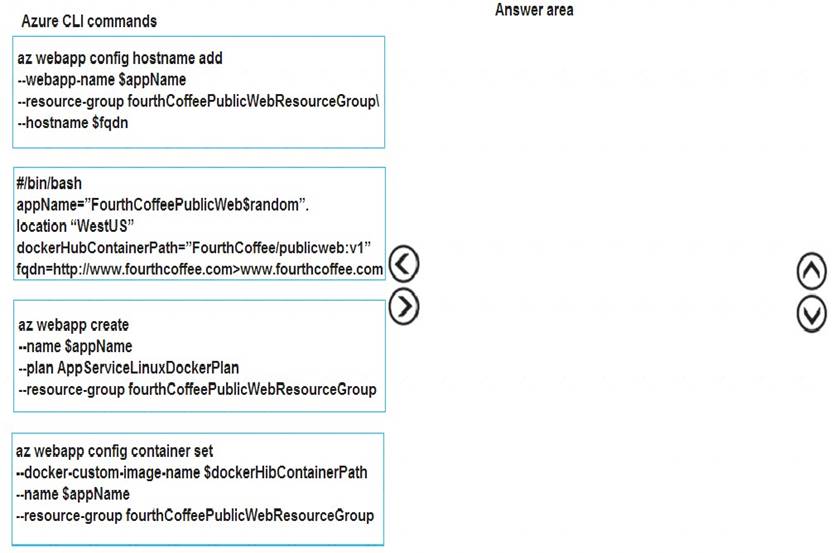
- A. Mastered
- B. Not Mastered
Answer: A
Explanation:
Step 1: #bin/bash
The appName is used when the webapp-name is created in step 2. Step 2: az webapp config hostname add
The webapp-name is used when the webapp is created in step 3. Step 3: az webapp create
Create a web app. In the Cloud Shell, create a web app in the myAppServicePlan App Service plan with the az webapp create command.
Step : az webapp confing container set
In Create a web app, you specified an image on Docker Hub in the az webapp create command. This is good enough for a public image. To use a private image, you need to configure your Docker account ID and password in your Azure web app.
In the Cloud Shell, follow the az webapp create command with az webapp config container set.
References:
https://docs.microsoft.com/en-us/azure/app-service/containers/tutorial-custom-docker-image
NEW QUESTION 22
......
Recommend!! Get the Full AZ-204 dumps in VCE and PDF From Certshared, Welcome to Download: https://www.certshared.com/exam/AZ-204/ (New 135 Q&As Version)