Master the AZ-303 Microsoft Azure Architect Technologies (beta) content and be ready for exam day success quickly with this Certleader AZ-303 free practice test. We guarantee it!We make it a reality and give you real AZ-303 questions in our Microsoft AZ-303 braindumps.Latest 100% VALID Microsoft AZ-303 Exam Questions Dumps at below page. You can use our Microsoft AZ-303 braindumps and pass your exam.
Microsoft AZ-303 Free Dumps Questions Online, Read and Test Now.
NEW QUESTION 1
You have an Azure App Service app.
You need to implement tracing for the app. The tracing information must include the following:  Usage trends AJAX call responses Page load speed by browser Server and browser exceptions
What should you do?
- A. Configure IIS logging in Azure Log Analytics.
- B. Configure a connection monitor in Azure Network Watcher.
- C. Configure custom logs in Azure Log Analytics.
- D. Enable the Azure Application Insights site extension.
Answer: D
Explanation:
For web pages, Application Insights JavaScript SDK automatically collects AJAX calls as dependencies. Note: Some of the things you can track or collect are:
What are the most popular webpages in your application, at what time of day and where is that traffic coming from?
Dependency rates or response times and failure rates to find out if there’s an external service that’s causing performance issues on your app, maybe a user is using a portal to get through to your application and there are response time issues going through there for instance.
Exceptions for both server and browser information, as well as page views and load performance from the end users’ side.
Reference:
https://azure.microsoft.com/en-us/blog/ajax-collection-in-application-insights/ https://blog.pragmaticworks.com/what-is-application-insights
NEW QUESTION 2
A company hosts virtual machines (VMs) in an on-premises datacenter and in Azure. The on-premises and Azure-based VMs communicate using ExpressRoute.
The company wants to be able to continue regular operations if the ExpressRoute connection fails. Failover connections must use the Internet and must not require Multiprotocol Label Switching (MPLS) support.
You need to recommend a solution that provides continued operations. What should you recommend?
- A. Set up a second ExpressRoute connection.
- B. Increase the bandwidth of the existing ExpressRoute connection.
- C. Increase the bandwidth for the on-premises internet connection.
- D. Set up a VPN connection.
Answer: D
Explanation:
References:
https://docs.microsoft.com/en-us/azure/architecture/reference-architectures/hybrid-networking/expressroutevpn-
NEW QUESTION 3
You have an Azure Active Directory (Azure AD) tenant that contains the user groups shown in the following table.
You enable self-service password reset (SSPR) for Group1.
You configure the Notifications settings as shown in the following exhibit.
For each of the following statements, select Yes if the statement is true. Otherwise, select No.
- A. Mastered
- B. Not Mastered
Answer: A
Explanation:
Box 1: Yes
Notify all admins when other admins reset their passwords: Yes. Box 2: No
Notify users on password resets: No. Box 3: No Notify users on password resets
If this option is set to Yes, then users resetting their password receive an email notifying them that their password has been changed. The email is sent via the SSPR portal to their primary and alternate email addresses that are on file in Azure AD. No one else is notified of the reset event. Notify all admins when other admins reset their passwords
If this option is set to Yes, then all administrators receive an email to their primary email address on file in Azure AD. The email notifies them that another administrator has changed their password by using SSPR.
Example: There are four administrators in an environment. Administrator A resets their password by using SSPR. Administrators B, C, and D receive an email alerting them of the password reset.
Reference:
https://docs.microsoft.com/en-us/azure/active-directory/authentication/concept-sspr-howitworks https://docs.microsoft.com/en-us/azure/active-directory/authentication/tutorial-enable-sspr
NEW QUESTION 4
You have an Azure Active Directory (Azure AD) tenant.
You need to create a conditional access policy that requires all users to use multi-factor authentication when they access the Azure portal.
Which three settings should you configure? To answer, select the appropriate settings to the answer area. NOTE: Each correct selection is worth one point.
- A. Mastered
- B. Not Mastered
Answer: A
Explanation:
https://docs.microsoft.com/en-us/azure/active-directory/conditional-access/concept-conditional-access-policies
NEW QUESTION 5
You have an Azure subscription that contains 100 virtual machines.
You have a set of Pester tests in PowerShell that validate the virtual machine environment.
You need to run the tests whenever there is an operating system update on the virtual machines. The solution must minimize implementation time and recurring costs.
D18912E1457D5D1DDCBD40AB3BF70D5D
Which three resources should you use to implement the tests? Each correct answer presents part of the solution.
NOTE: Each correct selection is worth one point.
- A. Azure Automation runbook
- B. an alert rule
- C. an Azure Monitor query
- D. a virtual machine that has network access to the 100 virtual machines
- E. an alert action group
Answer: ABE
Explanation:
Reference:
https://docs.microsoft.com/en-us/azure/automation/automation-create-alert-triggered-runbook https://techsnips.io/snips/how-to-create-and-test-azure-monitor-alerts/?page=13
NEW QUESTION 6
You play to deploy an Azure virtual machine named VM1 by using an Azure Resource Manager template. You need to complete the template.
What should you include in the template? To answer, select the appropriate options in the answer area.
NOTE: Each correct selection is worth one point.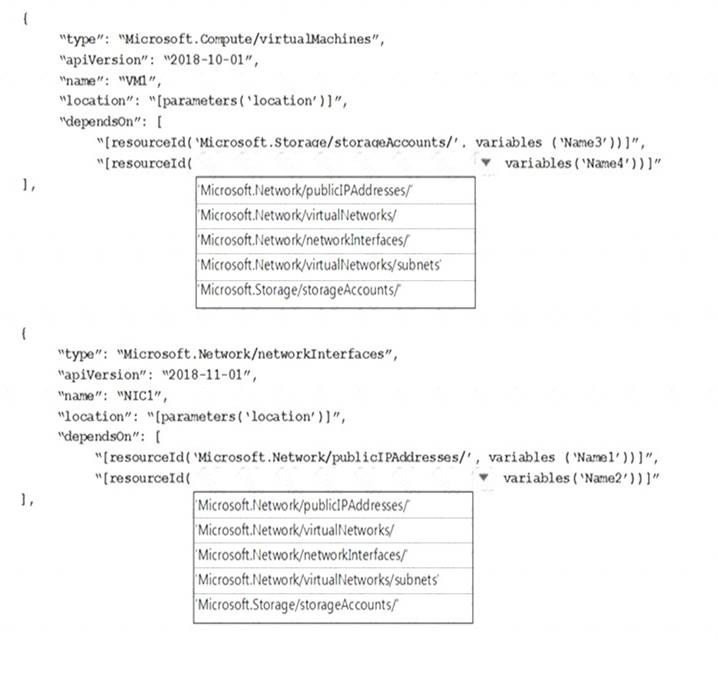
- A. Mastered
- B. Not Mastered
Answer: A
Explanation:
Within your template, the dependsOn element enables you to define one resource as a dependent on one or more resources. Its value can be a comma-separated list of resource names.
Box 1: 'Microsoft.Network/networkInterfaces'
This resource is a virtual machine. It depends on two other resources: Microsoft.Storage/storageAccounts Microsoft.Network/networkInterfaces
Box 2: 'Microsoft.Network/virtualNetworks/'
The dependsOn element enables you to define one resource as a dependent on one or more resources. The resource depends on two other resources: Microsoft.Network/publicIPAddresses Microsoft.Network/virtualNetworks
References:
https://docs.microsoft.com/en-us/azure/azure-resource-manager/resource-manager-tutorial-create-templates-with
NEW QUESTION 7
Your company has an office in Seattle.
You have an Azure subscription that contains a virtual network named VNET1. You create a site-to-site VPN between the Seattle office and VNET1.
VNET1 contains the subnets shown in the following table.
You need to redirect all Internet-bound traffic from Subnet1 to the Seattle office. What should you create?
- A. a route for Subnet1 That uses the virtual network gateway as the next hop
- B. a route for GatewaySubnet that uses the virtual network gateway as the next hop
- C. a route for GatewaySubnet that uses the local network gateway as the next hop
- D. a route for Subnet1 that uses The local network gateway as the next hop
Answer: B
Explanation:
A route with the 0.0.0.0/0 address prefix instructs Azure how to route traffic destined for an IP address that is not within the address prefix of any other route in a subnet's route table. When a subnet is created, Azure creates a default route to the 0.0.0.0/0 address prefix, with the Internet next hop type. We need to create a custom route in Azure to use a virtual network gateway in the Seattle office as the next hop.
References:
https://docs.microsoft.com/en-us/azure/virtual-network/virtual-networks-udr-overview
NEW QUESTION 8
You have an Azure subscription that contains the resource groups shown in the following table.
You create an Azure Resource Manager template named Template1 as shown in the following exhibit.
From the Azure portal, you deploy Template1 four times by using the settings shown in the following table.
What is the result of the deployment? To answer, select the appropriate options in the answer area.
NOTE: Each correct selection is worth one point.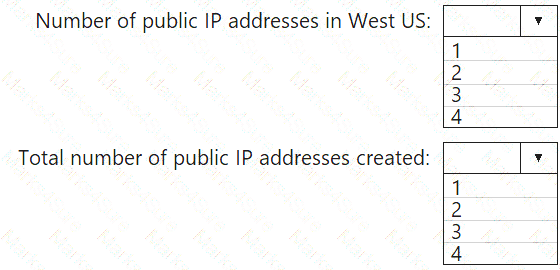
- A. Mastered
- B. Not Mastered
Answer: A
Explanation: 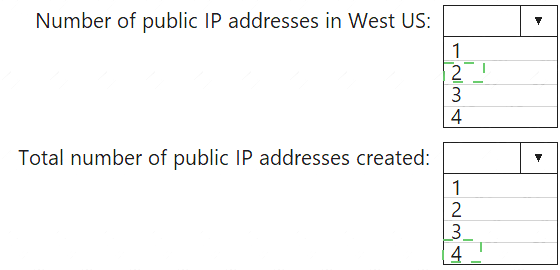
NEW QUESTION 9
You network contains an Active Directory domain named adatum.com and an Azure Active Directory (Azure AD) tenant named adatum.onmicrosoft.com.
Adatum.com contains the user accounts in the following table.
Adatum.onmicrosoft.com contains the user accounts in the following table.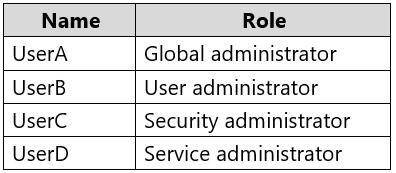
You need to implement Azure AD Connect. The solution must follow the principle of least privilege. Which user accounts should you use? To answer, select the appropriate options in the answer area. NOTE: Each correct selection is worth one point.
- A. Mastered
- B. Not Mastered
Answer: A
Explanation:
Box 1: User5
In Express settings, the installation wizard asks for the following: AD DS Enterprise Administrator credentials
Azure AD Global Administrator credentials
The AD DS Enterprise Admin account is used to configure your on-premises Active Directory. These credentials are only used during the installation and are not used after the installation has completed. The Enterprise Admin, not the Domain Admin should make sure the permissions in Active Directory can be set in all domains. Box 2: UserA
Azure AD Global Admin credentials are only used during the installation and are not used after the installation has completed. It is used to create the Azure AD Connector account used for synchronizing changes to Azure AD. The account also enables sync as a feature in Azure AD.
References:
https://docs.microsoft.com/en-us/azure/active-directory/connect/active-directory-aadconnect-accounts-permissio
NEW QUESTION 10
You have an Azure subscription that contains a resource group named RG1. You have a group named Group1 that is assigned the Contributor role for RG1.
You need to enhance security for the virtual machines in RG1 to meet the following requirements:
• Prevent Group1 from assigning external IP addresses to the virtual machines.
• Ensure that Group1 can establish an RDP connection to the virtual machines through a shared external IP address.
What should you use to meet each requirement? To answer, select the appropriate options in the answer area. NOTE: Each correct selection is worth one point.
- A. Mastered
- B. Not Mastered
Answer: A
Explanation: 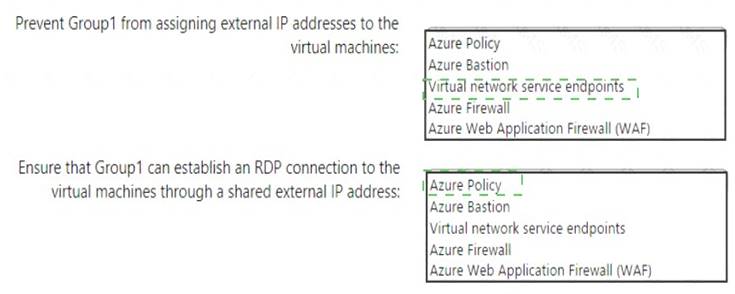
NEW QUESTION 11
You have an application named App1 that does not support Azure Active Directory (Azure AD) authentication.
You need to ensure that App1 can send messages to an Azure Service Bus queue. The solution must prevent Appl from listening to the queue.
What should you do?
- A. Modify the locks of the Queue
- B. Configure Access control (IAM) for the Service Bus
- C. Configure Access control (IAM) for the queue.
- D. Add a shared access policy to the queue
Answer: D
Explanation:
There are two ways to authenticate and authorize access to Azure Service Bus resources: Azure Activity Directory (Azure AD) and Shared Access Signatures (SAS).
Each Service Bus namespace and each Service Bus entity has a Shared Access Authorization policy made up of rules.
Reference:
https://docs.microsoft.com/en-us/azure/service-bus-messaging/service-bus-authentication-and-authorization https://docs.microsoft.com/en-us/azure/service-bus-messaging/service-bus-sas
NEW QUESTION 12
Note: This question is part of series of questions that present the same scenario. Each question in the series contains a unique solution that might meet the stated goals. Some question sets might have more than one correct solution, while others might not have a correct solution.
After you answer a question in this section, you will NOT be able to return to it. As a result, these questions will not appear in the review screen.
You have an Azure Active Directory (Azure AD) tenant that contains a group named Group1. You need to enable multi-factor authentication (MFA) for the users in Group1 only.
Solution: From the Azure portal, you configure an authentication method policy. Does this meet the goal?
- A. Yes
- B. No
Answer: B
Explanation:
We should use a Conditional Access policy.
Note: There are two ways to secure user sign-in events by requiring multi-factor authentication in Azure AD. The first, and preferred, option is to set up a Conditional Access policy that requires multi-factor authentication under certain conditions. The second option is to enable each user for Azure Multi-Factor Authentication. When users are enabled individually, they perform multi-factor authentication each time they sign in (with some exceptions, such as when they sign in from trusted IP addresses or when the remembered devices feature is turned on).
Enabling Azure Multi-Factor Authentication using Conditional Access policies is the recommended approach. Changing user states is no longer recommended unless your licenses don't include Conditional Access as it requires users to perform MFA every time they sign in.
https://docs.microsoft.com/en-us/azure/active-directory/authentication/howto-mfa-userstates
NEW QUESTION 13
You have an Azure subscription that contains the Azure SQL servers shown in the following table.
The subscription contains the elastic pool shown in the following table.
The subscription contains the Azure SQL databases shown in the following table.
For each of the following statements, select Yes if the statement is true. Otherwise, select No. NOTE: Each correct selection is worth one point.
- A. Mastered
- B. Not Mastered
Answer: A
Explanation:
Note: You cannot add databases from different servers into the same pool Box 1: Yes
Pool2 contains DB2 but DB1 and DB2 are on Sql1. DB1 can thus be added to Pool2. Box 2: Yes
Pool3 is empty. Box 3: Yes
Pool1 contains DB1 but DB3 and DB1 are on Sql1. DB3 can thus be added to Pool1. References:
https://docs.microsoft.com/en-us/azure/sql-database/sql-database-elastic-pool
NEW QUESTION 14
You have an Azure Active Directory (Azure AD) tenant linked to an Azure subscription. The tenant contains a group named Admins.
You need to prevent users, except for the members of Admins, from using the Azure portal and Azure PowerShell to access the subscription.
What should you do?
- A. From Azure AD, configure the User settings.
- B. From the Azure subscription, assign an Azure policy.
- C. From Azure AD, create a conditional access policy.
- D. From the Azure subscription, configure Access control (IAM).
Answer: D
NEW QUESTION 15
An administrator plans to create a function app in Azure that will have the following settings: Runtime stack: .NET Core Operating System: Linux Plan type: Consumption Enable Application Insights: Yes
You need to ensure that you can back up the function app.
Which settings should you recommend changing before creating the function app? D18912E1457D5D1DDCBD40AB3BF70D5D
- A. Runtime stack
- B. Enable Application Insights
- C. Operating System
- D. Plan type
Answer: D
Explanation:
The Backup and Restore feature requires the App Service plan to be in the Standard, Premium or Isolated tier. Reference:
https://docs.microsoft.com/en-us/azure/app-service/manage-backup#requirements-and-restrictions
NEW QUESTION 16
You create the Azure resources shown in the following table.
You attempt to add a role assignment to a resource group as shown in the following exhibit.

What should you do to ensure that you can assign VM2 the Reader role for the resource group?
- A. Modify the Reader role at the subscription level.
- B. Configure just in time (JIT) VM access on VM2.
- C. Configure Access control (IAM) on VM2.
- D. Assign a managed identity to VM2.
Answer: D
NEW QUESTION 17
A company runs multiple Windows virtual machines (VMs) in Azure.
The IT operations department wants to apply the same policies as they have for on-premises VMs to the VMs running in Azure, including domain administrator permissions and schema extensions.
You need to recommend a solution for the hybrid scenario that minimizes the amount of maintenance required. What should you recommend? To answer, select the appropriate options in the answer area.
NOTE: Each correct selection is worth one point.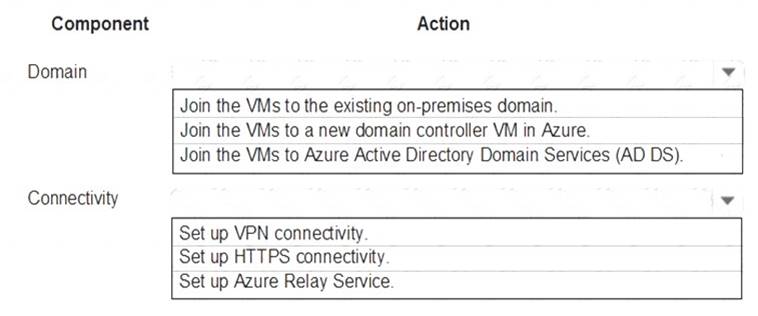
- A. Mastered
- B. Not Mastered
Answer: A
Explanation:
Box 1: Join the VMs to a new domain controller VM in Azure
Azure provides two solutions for implementing directory and identity services in Azure: (Used in this scenario) Extend your existing on-premises Active Directory infrastructure to Azure, by deploying a VM in Azure that runs AD DS as a Domain Controller. This architecture is more common when the on-premises network and the Azure virtual network (VNet) are connected by a VPN or ExpressRoute connection. Use Azure AD to create an Active Directory domain in the cloud and connect it to your on-premises Active Directory domain. Azure AD Connect integrates your on-premises directories with Azure AD.
Box 2: Set up VPN connectivity.
This architecture is more common when the on-premises network and the Azure virtual network (VNet) are connected by a VPN or ExpressRoute connection.
References:
https://docs.microsoft.com/en-us/azure/architecture/reference-architectures/identity/
NEW QUESTION 18
You have an Azure subscription.
You plan to deploy an app that has a web front end and an application tier.
You need to recommend a load balancing solution that meets the following requirements: Internet to web tier:
- Provides URL-based routing
- Supports connection draining
- Prevents SQL injection attacks Web tier to application tier:
- Provides port forwarding
- Supports HTTPS health probes
- Supports an availability set as a backend pool
Which load balancing solution should you recommend for each tier? To answer, select the appropriate options in the answer area.
NOTE: Each correct selection is worth one point.
- A. Mastered
- B. Not Mastered
Answer: A
Explanation:
Box 1: An Azure Application Gateway that has a web application firewall (WAF)
Azure Application Gateway offers a web application firewall (WAF) that provides centralized protection of your web applications from common exploits and vulnerabilities. Web applications are increasingly targeted by malicious attacks that exploit commonly known vulnerabilities. SQL injection and cross-site scripting are among the most common attacks.
Application Gateway operates as an application delivery controller (ADC). It offers Secure Sockets Layer (SSL) termination, cookie-based session affinity, round-robin load distribution, content-based routing, ability to host multiple websites, and security enhancements.
Box 2: An internal Azure Standard Load Balancer
The internet to web tier is the public interface, while the web tier to application tier should be internal. Note: When using load-balancing rules with Azure Load Balancer, you need to specify a health probes to
allow Load Balancer to detect the backend endpoint status.
Health probes support the TCP, HTTP, HTTPS protocols. References:
https://docs.microsoft.com/en-us/azure/application-gateway/waf-overview https://docs.microsoft.com/en-us/azure/load-balancer/load-balancer-custom-probe-overview
NEW QUESTION 19
You have an Azure subscription that contains the resources shown in the following table.
In RG2, you need to create a new virtual machine named VM2 that will connect to VNET1. VM2 will use a network interface named VM2_Interface.
In which region should you create VM2 and VM2_Interface? To answer, drag the appropriate regions to the correct targets. Each region may be used once, more than once, or not at all. You may need to drag the split bar between panes or scroll to view content.
NOTE: Each correct selection is worth one point.
- A. Mastered
- B. Not Mastered
Answer: A
Explanation:
VM2: West US
In RG2, which is in West US, you need to create a new virtual machine named VM2. VM2_interface: East US
VM2 will use a network interface named VM2_Interface to connect to VNET1, which is in East US. References:
https://docs.microsoft.com/en-us/azure/virtual-network/associate-public-ip-address-vm
NEW QUESTION 20
You have an Azure subscription that contains an Azure Log Analytics workspace. You have a resource group that contains 100 virtual machines. The virtual machines run Linux. You need to collect events from the virtual machines to the Log Analytics workspace. Which type of data source should you configure in the workspace?
- A. Syslog
- B. Linux performance counters
- C. custom fields
Answer: A
Explanation:
https://docs.microsoft.com/en-us/azure/azure-monitor/learn/quick-collect-azurevm
Syslog is an event logging protocol that is common to Linux. Applications will send messages that may be stored on the local machine or delivered to a Syslog collector. When the Log Analytics agent for Linux is installed, it configures the local Syslog daemon to forward messages to the agent. The agent then sends the message to Azure Monitor where a corresponding record is created.
Reference:
https://docs.microsoft.com/en-us/azure/azure-monitor/platform/data-sources-custom-logs
NEW QUESTION 21
......
P.S. Thedumpscentre.com now are offering 100% pass ensure AZ-303 dumps! All AZ-303 exam questions have been updated with correct answers: https://www.thedumpscentre.com/AZ-303-dumps/ (0 New Questions)