We provide real DP-100 exam questions and answers braindumps in two formats. Download PDF & Practice Tests. Pass Microsoft DP-100 Exam quickly & easily. The DP-100 PDF type is available for reading and printing. You can print more and practice many times. With the help of our Microsoft DP-100 dumps pdf and vce product and material, you can easily pass the DP-100 exam.
Also have DP-100 free dumps questions for you:
NEW QUESTION 1
Your team is building a data engineering and data science development environment. The environment must support the following requirements: support Python and Scala compose data storage, movement, and processing services into automated data pipelines the same tool should be used for the orchestration of both data engineering and data science support workload isolation and interactive workloads enable scaling across a cluster of machines You need to create the environment.
What should you do?
- A. Build the environment in Apache Hive for HDInsight and use Azure Data Factory for orchestration.
- B. Build the environment in Azure Databricks and use Azure Data Factory for orchestration.
- C. Build the environment in Apache Spark for HDInsight and use Azure Container Instances for orchestration.
- D. Build the environment in Azure Databricks and use Azure Container Instances for orchestration.
Answer: B
Explanation:
In Azure Databricks, we can create two different types of clusters. Standard, these are the default clusters and can be used with Python, R, Scala and SQL High-concurrency
Azure Databricks is fully integrated with Azure Data Factory.
NEW QUESTION 2
You plan to preprocess text from CSV files. You load the Azure Machine Learning Studio default stop words list.
You need to configure the Preprocess Text module to meet the following requirements: Ensure that multiple related words from a single canonical form. Remove pipe characters from text. Remove words to optimize information retrieval.
Which three options should you select? To answer, select the appropriate options in the answer area. NOTE: Each correct selection is worth one point.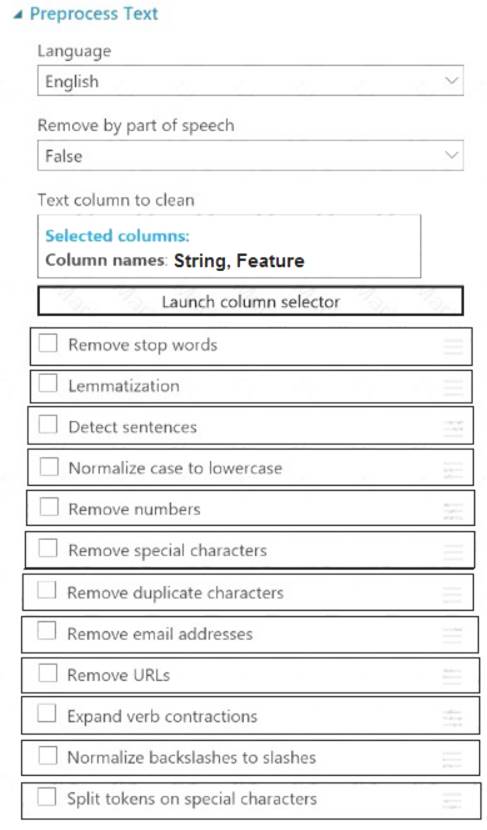
- A. Mastered
- B. Not Mastered
Answer: A
Explanation:
Box 1: Remove stop words
Remove words to optimize information retrieval.
Remove stop words: Select this option if you want to apply a predefined stopword list to the text column. Stop word removal is performed before any other processes.
Box 2: Lemmatization
Ensure that multiple related words from a single canonical form. Lemmatization converts multiple related words to a single canonical form Box 3: Remove special characters
Remove special characters: Use this option to replace any non-alphanumeric special characters with the pipe | character.
References:
https://docs.microsoft.com/en-us/azure/machine-learning/studio-module-reference/preprocess-text
NEW QUESTION 3
You need to implement a model development strategy to determine a user’s tendency to respond to an ad. Which technique should you use?
- A. Use a Relative Expression Split module to partition the data based on centroid distance.
- B. Use a Relative Expression Split module to partition the data based on distance travelled to the event.
- C. Use a Split Rows module to partition the data based on distance travelled to the event.
- D. Use a Split Rows module to partition the data based on centroid distance.
Answer: A
Explanation:
Split Data partitions the rows of a dataset into two distinct sets.
The Relative Expression Split option in the Split Data module of Azure Machine Learning Studio is helpful when you need to divide a dataset into training and testing datasets using a numerical expression.
Relative Expression Split: Use this option whenever you want to apply a condition to a number column. The number could be a date/time field, a column containing age or dollar amounts, or even a percentage. For example, you might want to divide your data set depending on the cost of the items, group people by age ranges, or separate data by a calendar date.
Scenario:
Local market segmentation models will be applied before determining a user’s propensity to respond to an advertisement.
The distribution of features across training and production data are not consistent References:
https://docs.microsoft.com/en-us/azure/machine-learning/studio-module-reference/split-data
NEW QUESTION 4
Note: This question is part of a series of questions that present the same scenario. Each question in the series contains a unique solution that might meet the stated goals. Some question sets might have more than one correct solution, while others might not have a correct solution.
After you answer a question in this section, you will NOT be able to return to it. As a result, these questions will not appear in the review screen.
You are creating a new experiment in Azure Machine Learning Studio.
One class has a much smaller number of observations than the other classes in the training set. You need to select an appropriate data sampling strategy to compensate for the class imbalance. Solution: You use the Stratified split for the sampling mode.
Does the solution meet the goal?
- A. Yes
- B. No
Answer: B
Explanation:
Instead use the Synthetic Minority Oversampling Technique (SMOTE) sampling mode.
Note: SMOTE is used to increase the number of underepresented cases in a dataset used for machine learning. SMOTE is a better way of increasing the number of rare cases than simply duplicating existing cases.
References:
https://docs.microsoft.com/en-us/azure/machine-learning/studio-module-reference/smote
NEW QUESTION 5
Note: This question is part of a series of questions that present the same scenario. Each question in the series contains a unique solution that might meet the stated goals. Some question sets might have more than one correct solution, while others might not have a correct solution.
After you answer a question in this section, you will NOT be able to return to it. As a result, these questions will not appear in the review screen.
You are a data scientist using Azure Machine Learning Studio.
You need to normalize values to produce an output column into bins to predict a target column. Solution: Apply an Equal Width with Custom Start and Stop binning mode.
Does the solution meet the goal?
- A. Yes
- B. No
Answer: B
Explanation:
Use the Entropy MDL binning mode which has a target column.
References:
https://docs.microsoft.com/en-us/azure/machine-learning/studio-module-reference/group-data-into-bins
NEW QUESTION 6
You need to resolve the local machine learning pipeline performance issue. What should you do?
- A. Increase Graphic Processing Units (GPUs).
- B. Increase the learning rate.
- C. Increase the training iterations,
- D. Increase Central Processing Units (CPUs).
Answer: A
NEW QUESTION 7
You create a binary classification model by using Azure Machine Learning Studio.
You must tune hyperparameters by performing a parameter sweep of the model. The parameter sweep must
meet the following requirements: iterate all possible combinations of hyperparameters minimize computing resources required to perform the sweep You need to perform a parameter sweep of the model.
Which parameter sweep mode should you use?
- A. Random sweep
- B. Sweep clustering
- C. Entire grid
- D. Random grid
- E. Random seed
Answer: D
Explanation:
Maximum number of runs on random grid: This option also controls the number of iterations over a random sampling of parameter values, but the values are not generated randomly from the specified range; instead, a matrix is created of all possible combinations of parameter values and a random sampling is taken over the matrix. This method is more efficient and less prone to regional oversampling or undersampling.
If you are training a model that supports an integrated parameter sweep, you can also set a range of seed values to use and iterate over the random seeds as well. This is optional, but can be useful for avoiding bias introduced by seed selection.
NEW QUESTION 8
You have a Python data frame named salesData in the following format: The data frame must be unpivoted to a long data format as follows:
You need to use the pandas.melt() function in Python to perform the transformation.
How should you complete the code segment? To answer, select the appropriate options in the answer area.
NOTE: Each correct selection is worth one point.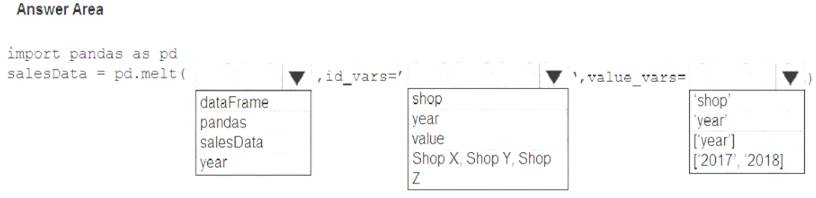
- A. Mastered
- B. Not Mastered
Answer: A
Explanation:
Box 1: dataFrame
Syntax: pandas.melt(frame, id_vars=None, value_vars=None, var_name=None, value_name='value', col_level=None)[source]
Where frame is a DataFrame
Box 2: shop
Paramter id_vars id_vars : tuple, list, or ndarray, optional Column(s) to use as identifier variables.
Box 3: ['2021','2021']
value_vars : tuple, list, or ndarray, optional
Column(s) to unpivot. If not specified, uses all columns that are not set as id_vars. Example:
df = pd.DataFrame({'A': {0: 'a', 1: 'b', 2: 'c'},
'B': {0: 1, 1: 3, 2: 5},
'C': {0: 2, 1: 4, 2: 6}})
pd.melt(df, id_vars=['A'], value_vars=['B', 'C']) A variable value
0 a B 1
1 b B 3
2 c B 5
3 a C 2
4 b C 4
5 c C 6
References:
https://pandas.pydata.org/pandas-docs/stable/reference/api/pandas.melt.html
NEW QUESTION 9
You are using the Azure Machine Learning Service to automate hyperparameter exploration of your neural network classification model.
You must define the hyperparameter space to automatically tune hyperparameters using random sampling according to following requirements: The learning rate must be selected from a normal distribution with a mean value of 10 and a standard deviation of 3. Batch size must be 16, 32 and 64. Keep probability must be a value selected from a uniform distribution between the range of 0.05 and 0.1.
You need to use the param_sampling method of the Python API for the Azure Machine Learning Service. How should you complete the code segment? To answer, select the appropriate options in the answer area. NOTE: Each correct selection is worth one point.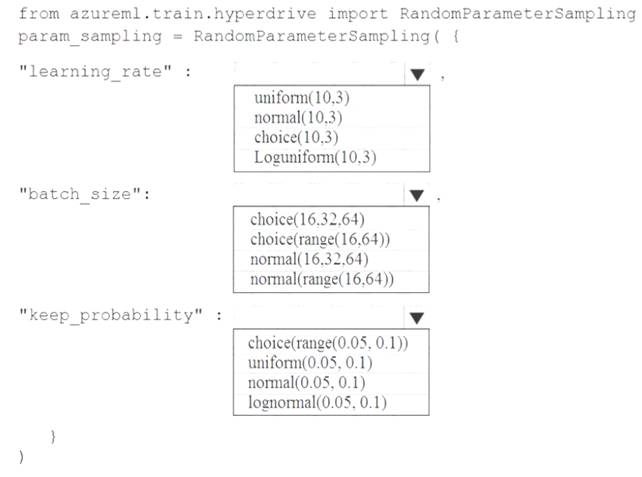
- A. Mastered
- B. Not Mastered
Answer: A
Explanation:
In random sampling, hyperparameter values are randomly selected from the defined search space. Random sampling allows the search space to include both discrete and continuous hyperparameters.
Example:
from azureml.train.hyperdrive import RandomParameterSampling param_sampling = RandomParameterSampling( { "learning_rate": normal(10, 3),
"keep_probability": uniform(0.05, 0.1),
"batch_size": choice(16, 32, 64)
}
Reference:
https://docs.microsoft.com/en-us/azure/machine-learning/service/how-to-tune-hyperparameters
NEW QUESTION 10
You create a classification model with a dataset that contains 100 samples with Class A and 10,000 samples with Class B
The variation of Class B is very high. You need to resolve imbalances. Which method should you use?
- A. Partition and Sample
- B. Cluster Centroids
- C. Tomek links
- D. Synthetic Minority Oversampling Technique (SMOTE)
Answer: D
NEW QUESTION 11
You need to select an environment that will meet the business and data requirements. Which environment should you use?
- A. Azure HDInsight with Spark MLlib
- B. Azure Cognitive Services
- C. Azure Machine Learning Studio
- D. Microsoft Machine Learning Server
Answer: D
NEW QUESTION 12
You are creating a machine learning model. You have a dataset that contains null rows.
You need to use the Clean Missing Data module in Azure Machine Learning Studio to identify and resolve the
null and missing data in the dataset. Which parameter should you use?
- A. Replace with mean
- B. Remove entire column
- C. Remove entire row
- D. Hot Deck
Answer: B
Explanation:
Remove entire row: Completely removes any row in the dataset that has one or more missing values. This is useful if the missing value can be considered randomly missing.
References:
https://docs.microsoft.com/en-us/azure/machine-learning/studio-module-reference/clean-missing-data
NEW QUESTION 13
You are performing a classification task in Azure Machine Learning Studio.
You must prepare balanced testing and training samples based on a provided data set. You need to split the data with a 0.75:0.25 ratio.
Which value should you use for each parameter? To answer, select the appropriate options in the answer area.
NOTE: Each correct selection is worth one point.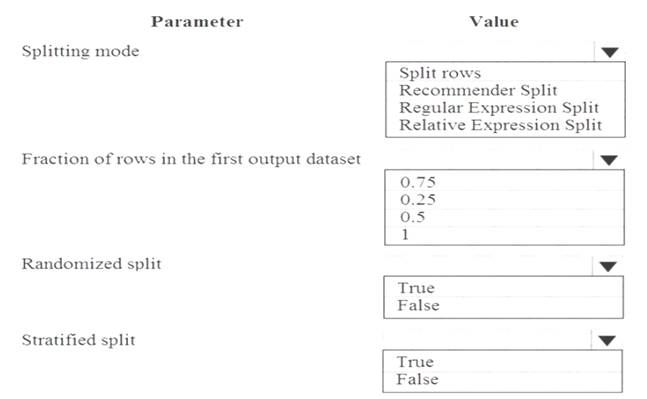
- A. Mastered
- B. Not Mastered
Answer: A
Explanation:
Box 1: Split rows
Use the Split Rows option if you just want to divide the data into two parts. You can specify the percentage of data to put in each split, but by default, the data is divided 50-50.
You can also randomize the selection of rows in each group, and use stratified sampling. In stratified sampling, you must select a single column of data for which you want values to be apportioned equally among the two result datasets.
Box 2: 0.75
If you specify a number as a percentage, or if you use a string that contains the "%" character, the value is interpreted as a percentage. All percentage values must be within the range (0, 100), not including the values 0 and 100.
Box 3: Yes
To ensure splits are balanced. Box 4: No
If you use the option for a stratified split, the output datasets can be further divided by subgroups, by selecting a strata column.
Reference:
https://docs.microsoft.com/en-us/azure/machine-learning/studio-module-reference/split-data
NEW QUESTION 14
You are building recurrent neural network to perform a binary classification.
The training loss, validation loss, training accuracy, and validation accuracy of each training epoch has been provided. You need to identify whether the classification model is over fitted.
Which of the following is correct?
- A. The training loss increases while the validation loss decreases when training the model.
- B. The training loss decreases while the validation loss increases when training the model.
- C. The training loss stays constant and the validation loss decreases when training the model.
- D. The training loss .stays constant and the validation loss stays on a constant value and close to the training loss value when training the model.
Answer: B
Explanation:
An overfit model is one where performance on the train set is good and continues to improve, whereas performance on the validation set improves to a point and then begins to degrade.
References:
https://machinelearningmastery.com/diagnose-overfitting-underfitting-lstm-models/
NEW QUESTION 15
You are conducting feature engineering to prepuce data for further analysis. The data includes seasonal patterns on inventory requirements.
You need to select the appropriate method to conduct feature engineering on the data. Which method should you use?
- A. Exponential Smoothing (ETS) function.
- B. One Class Support Vector Machine module
- C. Time Series Anomaly Detection module
- D. Finite Impulse Response (FIR) Filter module.
Answer: D
NEW QUESTION 16
You are developing a linear regression model in Azure Machine Learning Studio. You run an experiment to compare different algorithms.
The following image displays the results dataset output: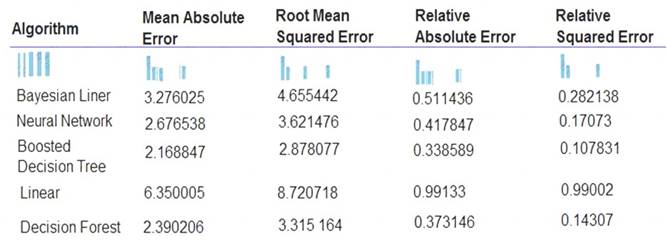
Use the drop-down menus to select the answer choice that answers each question based on the information presented in the image.
NOTE: Each correct selection is worth one point.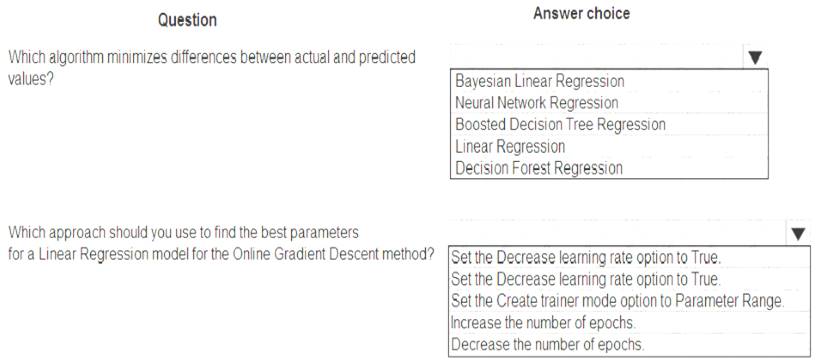
- A. Mastered
- B. Not Mastered
Answer: A
Explanation:
Box 1: Boosted Decision Tree Regression
Mean absolute error (MAE) measures how close the predictions are to the actual outcomes; thus, a lower score is better.
Box 2:
Online Gradient Descent: If you want the algorithm to find the best parameters for you, set Create trainer
mode option to Parameter Range. You can then specify multiple values for the algorithm to try. References:
https://docs.microsoft.com/en-us/azure/machine-learning/studio-module-reference/evaluate-model https://docs.microsoft.com/en-us/azure/machine-learning/studio-module-reference/linear-regression
NEW QUESTION 17
You are developing a machine learning, experiment by using Azure. The following images show the input and output of a machine learning experiment: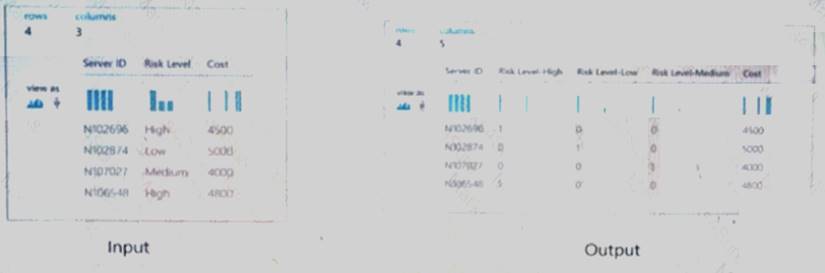
Use the drop-down menus to select the answer choice that answers each question based on the information presented in the graphic.
NOTE: Each correct selection is worth one point.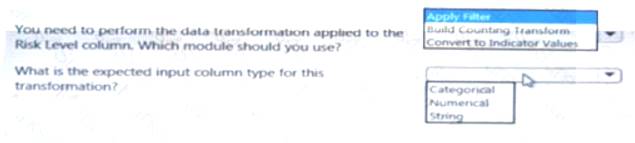
- A. Mastered
- B. Not Mastered
Answer: A
Explanation: 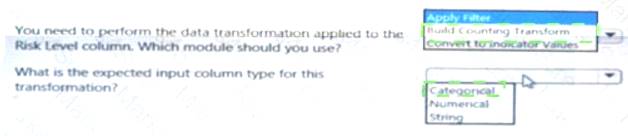
NEW QUESTION 18
You are retrieving data from a large datastore by using Azure Machine Learning Studio.
You must create a subset of the data for testing purposes using a random sampling seed based on the system clock.
You add the Partition and Sample module to your experiment. You need to select the properties for the module.
Which values should you select? To answer, select the appropriate options in the answer area. NOTE: Each correct selection is worth one point.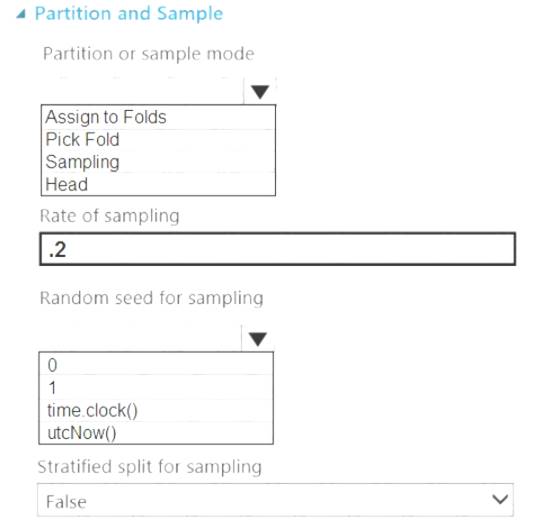
- A. Mastered
- B. Not Mastered
Answer: A
Explanation:
Box 1: Sampling Create a sample of data
This option supports simple random sampling or stratified random sampling. This is useful if you want to create a smaller representative sample dataset for testing.
1. Add the Partition and Sample module to your experiment in Studio, and connect the dataset.
2. Partition or sample mode: Set this to Sampling.
3. Rate of sampling. See box 2 below. Box 2: 0
3. Rate of sampling. Random seed for sampling: Optionally, type an integer to use as a seed value.
This option is important if you want the rows to be divided the same way every time. The default value is 0, meaning that a starting seed is generated based on the system clock. This can lead to slightly different results each time you run the experiment.
References:
https://docs.microsoft.com/en-us/azure/machine-learning/studio-module-reference/partition-and-sample
NEW QUESTION 19
Note: This question is part of a series of questions that present the same scenario. Each question in the series contains a unique solution that might meet the stated goals. Some question sets might have more than one correct solution, while others might not have a correct solution.
After you answer a question in this section, you will NOT be able to return to it. As a result, these questions will not appear in the review screen.
You are creating a model to predict the price of a student’s artwork depending on the following variables: the student’s length of education, degree type, and art form.
You start by creating a linear regression model.
You need to evaluate the linear regression model.
Solution: Use the following metrics: Relative Squared Error, Coefficient of Determination, Accuracy, Precision, Recall, F1 score, and AUC.
Does the solution meet the goal?
- A. Yes
- B. No
Answer: B
Explanation:
Relative Squared Error, Coefficient of Determination are good metrics to evaluate the linear regression model, but the others are metrics for classification models.
References:
https://docs.microsoft.com/en-us/azure/machine-learning/studio-module-reference/evaluate-model
NEW QUESTION 20
Note: This question is part of a series of questions that present the same scenario. Each question in the series contains a unique solution that might meet the stated goals. Some question sets might have more than one correct solution, while others might not have a correct solution.
After you answer a question in this section, you will NOT be able to return to it. As a result, these questions will not appear in the review screen.
You are analyzing a numerical dataset which contain missing values in several columns.
You must clean the missing values using an appropriate operation without affecting the dimensionality of the feature set.
You need to analyze a full dataset to include all values.
Solution: Use the last Observation Carried Forward (IOCF) method to impute the missing data points. Does the solution meet the goal?
- A. Yes
- B. No
Answer: B
Explanation:
Instead use the Multiple Imputation by Chained Equations (MICE) method.
Replace using MICE: For each missing value, this option assigns a new value, which is calculated by using a method described in the statistical literature as "Multivariate Imputation using Chained Equations" or "Multiple Imputation by Chained Equations". With a multiple imputation method, each variable with missing
data is modeled conditionally using the other variables in the data before filling in the missing values.
Note: Last observation carried forward (LOCF) is a method of imputing missing data in longitudinal studies. If a person drops out of a study before it ends, then his or her last observed score on the dependent variable is used for all subsequent (i.e., missing) observation points. LOCF is used to maintain the sample size and to reduce the bias caused by the attrition of participants in a study.
References:
https://methods.sagepub.com/reference/encyc-of-research-design/n211.xml https://www.ncbi.nlm.nih.gov/pmc/articles/PMC3074241/
NEW QUESTION 21
You use the Two-Class Neural Network module in Azure Machine Learning Studio to build a binary classification model. You use the Tune Model Hyperparameters module to tune accuracy for the model.
You need to select the hyperparameters that should be tuned using the Tune Model Hyperparameters module. Which two hyperparameters should you use? Each correct answer presents part of the solution.
NOTE: Each correct selection is worth one point.
- A. Number of hidden nodes
- B. Learning Rate
- C. The type of the normalizer
- D. Number of learning iterations
- E. Hidden layer specification
Answer: DE
Explanation:
D: For Number of learning iterations, specify the maximum number of times the algorithm should process the training cases.
E: For Hidden layer specification, select the type of network architecture to create.
Between the input and output layers you can insert multiple hidden layers. Most predictive tasks can be accomplished easily with only one or a few hidden layers.
References:
https://docs.microsoft.com/en-us/azure/machine-learning/studio-module-reference/two-class-neural-network
NEW QUESTION 22
You are determining if two sets of data are significantly different from one another by using Azure Machine Learning Studio.
Estimated values in one set of data may be more than or less than reference values in the other set of data. You must produce a distribution that has a constant Type I error as a function of the correlation.
You need to produce the distribution.
Which type of distribution should you produce?
- A. Paired t-test with a two-tail option
- B. Unpaired t-test with a two tail option
- C. Paired t-test with a one-tail option
- D. Unpaired t-test with a one-tail option
Answer: A
Explanation:
Choose a one-tail or two-tail test. The default is a two-tailed test. This is the most common type of test, in which the expected distribution is symmetric around zero.
Example: Type I error of unpaired and paired two-sample t-tests as a function of the correlation. The simulated random numbers originate from a bivariate normal distribution with a variance of 1.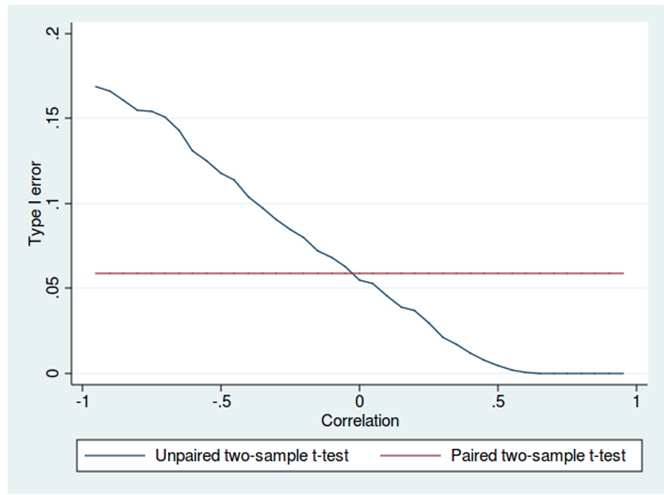
Reference:
https://docs.microsoft.com/en-us/azure/machine-learning/studio-module-reference/test-hypothesis-using-t-test https://en.wikipedia.org/wiki/Student%27s_t-test
NEW QUESTION 23
Note: This question is part of a series of questions that present the same scenario. Each question in the series contains a unique solution that might meet the stated goals. Some question sets might have more than one correct solution, while others might not have a correct solution.
After you answer a question in this section, you will NOT be able to return to it. As a result, these questions will not appear in the review screen.
You are a data scientist using Azure Machine Learning Studio.
You need to normalize values to produce an output column into bins to predict a target column. Solution: Apply a Quantiles normalization with a QuantileIndex normalization.
Does the solution meet the GOAL?
- A. Yes
- B. No
Answer: B
Explanation:
Use the Entropy MDL binning mode which has a target column. References:
https://docs.microsoft.com/en-us/azure/machine-learning/studio-module-reference/group-data-into-bins
NEW QUESTION 24
......
P.S. Dumps-files.com now are offering 100% pass ensure DP-100 dumps! All DP-100 exam questions have been updated with correct answers: https://www.dumps-files.com/files/DP-100/ (111 New Questions)