Your success in Microsoft DP-201 is our sole target and we develop all our DP-201 braindumps in a way that facilitates the attainment of this target. Not only is our DP-201 study material the best you can find, it is also the most detailed and the most updated. DP-201 Practice Exams for Microsoft Microsoft Other Exam DP-201 are written to the highest standards of technical accuracy.
Online Microsoft DP-201 free dumps demo Below:
NEW QUESTION 1
A company installs IoT devices to monitor its fleet of delivery vehicles. Data from devices is collected from Azure Event Hub.
The data must be transmitted to Power BI for real-time data visualizations. You need to recommend a solution.
What should you recommend?
- A. Azure HDInsight with Spark Streaming
- B. Apache Spark in Azure Databricks
- C. Azure Stream Analytics
- D. Azure HDInsight with Storm
Answer: C
Explanation:
Step 1: Get your IoT hub ready for data access by adding a consumer group.
Step 2: Create, configure, and run a Stream Analytics job for data transfer from your IoT hub to your Power BI account.
Step 3: Create and publish a Power BI report to visualize the data. References:
https://docs.microsoft.com/en-us/azure/iot-hub/iot-hub-live-data-visualization-in-power-bi
NEW QUESTION 2
Note: This question is part of a series of questions that present the same scenario. Each question in the series contains a unique solution that might meet the stated goals. Some question sets might have more than one correct solution, while others might not have a correct solution.
After you answer a question in this section, you will NOT be able to return to it. As a result, these questions will not appear in the review screen.
A company is developing a solution to manage inventory data for a group of automotive repair shops. The
solution will use Azure SQL Data Warehouse as the data store. Shops will upload data every 10 days.
Data corruption checks must run each time data is uploaded. If corruption is detected, the corrupted data must be removed.
You need to ensure that upload processes and data corruption checks do not impact reporting and analytics processes that use the data warehouse.
Proposed solution: Insert data from shops and perform the data corruption check in a transaction. Rollback transfer if corruption is detected.
Does the solution meet the goal?
- A. Yes
- B. No
Answer: B
Explanation:
Instead, create a user-defined restore point before data is uploaded. Delete the restore point after data corruption checks complete.
References:
https://docs.microsoft.com/en-us/azure/sql-data-warehouse/backup-and-restore
NEW QUESTION 3
Note: This question is part of a series of questions that present the same scenario. Each question in the series contains a unique solution that might meet the stated goals. Some question sets might have more than one correct solution, while others might not have a correct solution.
After you answer a question in this section, you will NOT be able to return to it. As a result, these questions will not appear in the review screen.
You are designing an Azure SQL Database that will use elastic pools. You plan to store data about customers in a table. Each record uses a value for CustomerID.
You need to recommend a strategy to partition data based on values in CustomerID. Proposed Solution: Separate data into shards by using horizontal partitioning.
Does the solution meet the goal?
- A. Yes
- B. No
Answer: A
Explanation:
Horizontal Partitioning - Sharding: Data is partitioned horizontally to distribute rows across a scaled out data
tier. With this approach, the schema is identical on all participating databases. This approach is also called “sharding”. Sharding can be performed and managed using (1) the elastic database tools libraries or (2) selfsharding.
An elastic query is used to query or compile reports across many shards. References:
https://docs.microsoft.com/en-us/azure/sql-database/sql-database-elastic-query-overview
NEW QUESTION 4
You plan to use an Azure SQL data warehouse to store the customer data. You need to recommend a disaster recovery solution for the data warehouse. What should you include in the recommendation?
- A. AzCopy
- B. Read-only replicas
- C. AdICopy
- D. Geo-Redundant backups
Answer: D
Explanation:
References:
https://docs.microsoft.com/en-us/azure/sql-data-warehouse/backup-and-restore
NEW QUESTION 5
You are evaluating data storage solutions to support a new application.
You need to recommend a data storage solution that represents data by using nodes and relationships in graph structures.
Which data storage solution should you recommend?
- A. Blob Storage
- B. Cosmos DB
- C. Data Lake Store
- D. HDInsight
Answer: B
Explanation:
For large graphs with lots of entities and relationships, you can perform very complex analyses very quickly. Many graph databases provide a query language that you can use to traverse a network of relationships efficiently.
Relevant Azure service: Cosmos DB
References:
https://docs.microsoft.com/en-us/azure/architecture/guide/technology-choices/data-store-overview
NEW QUESTION 6
You need to design the solution for analyzing customer data. What should you recommend?
- A. Azure Databricks
- B. Azure Data Lake Storage
- C. Azure SQL Data Warehouse
- D. Azure Cognitive Services
- E. Azure Batch
Answer: A
Explanation:
Customer data must be analyzed using managed Spark clusters. You create spark clusters through Azure Databricks. References:
https://docs.microsoft.com/en-us/azure/azure-databricks/quickstart-create-databricks-workspace-portal
NEW QUESTION 7
You are designing a real-time stream solution based on Azure Functions. The solution will process data uploaded to Azure Blob Storage.
The solution requirements are as follows:
New blobs must be processed with a little delay as possible. Scaling must occur automatically.
Costs must be minimized. What should you recommend?
- A. Deploy the Azure Function in an App Service plan and use a Blob trigger.
- B. Deploy the Azure Function in a Consumption plan and use an Event Grid trigger.
- C. Deploy the Azure Function in a Consumption plan and use a Blob trigger.
- D. Deploy the Azure Function in an App Service plan and use an Event Grid trigger.
Answer: C
Explanation:
Create a function, with the help of a blob trigger template, which is triggered when files are uploaded to or updated in Azure Blob storage.
You use a consumption plan, which is a hosting plan that defines how resources are allocated to your function app. In the default Consumption Plan, resources are added dynamically as required by your functions. In this serverless hosting, you only pay for the time your functions run. When you run in an App Service plan, you must manage the scaling of your function app.
References:
https://docs.microsoft.com/en-us/azure/azure-functions/functions-create-storage-blob-triggered-function
NEW QUESTION 8
A company has locations in North America and Europe. The company uses Azure SQL Database to support business apps.
Employees must be able to access the app data in case of a region-wide outage. A multi-region availability solution is needed with the following requirements: Read-access to data in a secondary region must be available only in case of an outage of the primary region. The Azure SQL Database compute and storage layers must be integrated and replicated together.
You need to design the multi-region high availability solution.
What should you recommend? To answer, select the appropriate values in the answer area.
NOTE: Each correct selection is worth one point.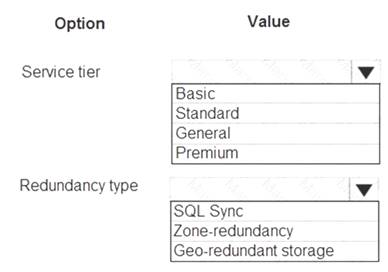
- A. Mastered
- B. Not Mastered
Answer: A
Explanation:
Box 1: Standard
The following table describes the types of storage accounts and their capabilities: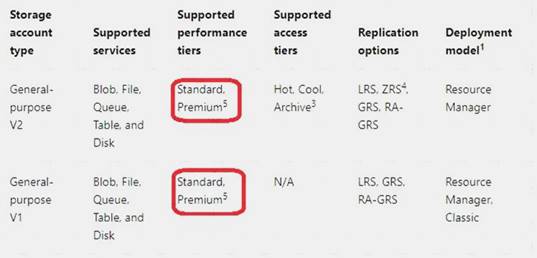
Box 2: Geo-redundant storage
If your storage account has GRS enabled, then your data is durable even in the case of a complete regional outage or a disaster in which the primary region isn't recoverable.
Note: If you opt for GRS, you have two related options to choose from:
GRS replicates your data to another data center in a secondary region, but that data is available to be read only if Microsoft initiates a failover from the primary to secondary region.
Read-access geo-redundant storage (RA-GRS) is based on GRS. RA-GRS replicates your data to another data center in a secondary region, and also provides you with the option to read from the secondary region. With RA-GRS, you can read from the secondary region regardless of whether Microsoft initiates a failover from the primary to secondary region.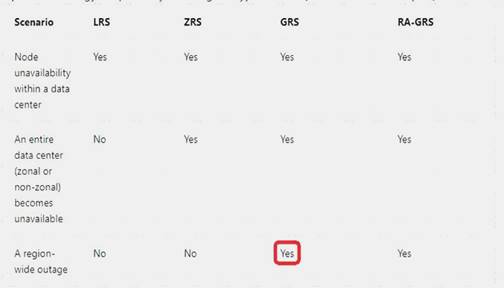
References:
https://docs.microsoft.com/en-us/azure/storage/common/storage-introduction https://docs.microsoft.com/en-us/azure/storage/common/storage-redundancy-grs
NEW QUESTION 9
You need to design the encryption strategy for the tagging data and customer data.
What should you recommend? To answer, drag the appropriate setting to the correct drop targets. Each source may be used once, more than once, or not at all. You may need to drag the split bar between panes or scroll to view content.
NOTE: Each correct selection is worth one point.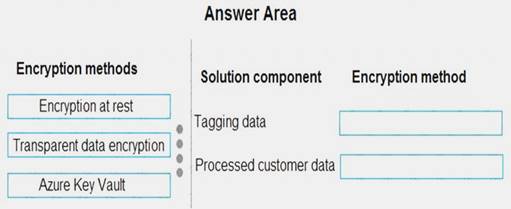
- A. Mastered
- B. Not Mastered
Answer: A
Explanation:
All cloud data must be encrypted at rest and in transit. Box 1: Transparent data encryption
Encryption of the database file is performed at the page level. The pages in an encrypted database are encrypted before they are written to disk and decrypted when read into memory.
Box 2: Encryption at rest
Encryption at Rest is the encoding (encryption) of data when it is persisted. References:
https://docs.microsoft.com/en-us/sql/relational-databases/security/encryption/transparent-data-encryption?view= https://docs.microsoft.com/en-us/azure/security/azure-security-encryption-atrest
NEW QUESTION 10
You are designing a solution for a company. You plan to use Azure Databricks. You need to recommend workloads and tiers to meet the following requirements: Provide managed clusters for running production jobs. Provide persistent clusters that support auto-scaling for analytics processes. Provide role-based access control (RBAC) support for Notebooks.
What should you recommend? To answer, select the appropriate options in the answer area.
NOTE: Each correct selection is worth one point.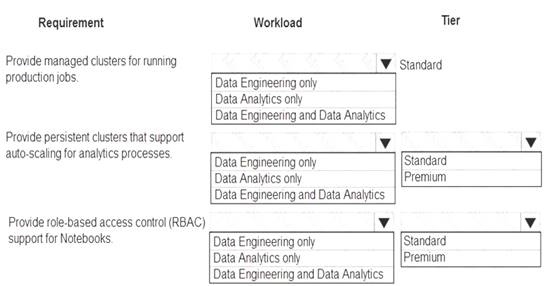
- A. Mastered
- B. Not Mastered
Answer: A
Explanation:
Box 1: Data Engineering Only
Box 2: Data Engineering and Data Analytics Box 3: Standard
Box 4: Data Analytics only Box 5: Premium
Premium required for RBAC. Data Analytics Premium Tier provide interactive workloads to analyze data collaboratively with notebooks
References:
https://azure.microsoft.com/en-us/pricing/details/databricks/
NEW QUESTION 11
A company stores data in multiple types of cloud-based databases.
You need to design a solution to consolidate data into a single relational database. Ingestion of data will occur at set times each day.
What should you recommend?
- A. SQL Server Migration Assistant
- B. SQL Data Sync
- C. Azure Data Factory
- D. Azure Database Migration Service
- E. Data Migration Assistant
Answer: C
Explanation:
https://docs.microsoft.com/en-us/azure/data-factory/introduction
https://azure.microsoft.com/en-us/blog/operationalize-azure-databricks-notebooks-using-data-factory/ https://azure.microsoft.com/en-us/blog/data-ingestion-into-azure-at-scale-made-easier-with-latest-enhancements
NEW QUESTION 12
You are designing a solution for a company. The solution will use model training for objective classification. You need to design the solution.
What should you recommend?
- A. an Azure Cognitive Services application
- B. a Spark Streaming job
- C. interactive Spark queries
- D. Power BI models
- E. a Spark application that uses Spark MLib.
Answer: E
Explanation:
Spark in SQL Server big data cluster enables AI and machine learning.
You can use Apache Spark MLlib to create a machine learning application to do simple predictive analysis on an open dataset.
MLlib is a core Spark library that provides many utilities useful for machine learning tasks, including utilities that are suitable for: Classification Regression Clustering Topic modeling Singular value decomposition (SVD) and principal component analysis (PCA) Hypothesis testing and calculating sample statistics
References:
https://docs.microsoft.com/en-us/azure/hdinsight/spark/apache-spark-machine-learning-mllib-ipython
NEW QUESTION 13
You need to optimize storage for CONT_SQL3. What should you recommend?
- A. AlwaysOn
- B. Transactional processing
- C. General
- D. Data warehousing
Answer: B
Explanation:
CONT_SQL3 with the SQL Server role, 100 GB database size, Hyper-VM to be migrated to Azure VM. The storage should be configured to optimized storage for database OLTP workloads.
Azure SQL Database provides three basic in-memory based capabilities (built into the underlying database engine) that can contribute in a meaningful way to performance improvements:
In-Memory Online Transactional Processing (OLTP)
Clustered columnstore indexes intended primarily for Online Analytical Processing (OLAP) workloads Nonclustered columnstore indexes geared towards Hybrid Transactional/Analytical Processing (HTAP) workloads
References:
https://www.databasejournal.com/features/mssql/overview-of-in-memory-technologies-of-azure-sqldatabase.htm
NEW QUESTION 14
You have an on-premises MySQL database that is 800 GB in size.
You need to migrate a MySQL database to Azure Database for MySQL. You must minimize service interruption to live sites or applications that use the database.
What should you recommend?
- A. Azure Database Migration Service
- B. Dump and restore
- C. Import and export
- D. MySQL Workbench
Answer: A
Explanation:
You can perform MySQL migrations to Azure Database for MySQL with minimal downtime by using the newly introduced continuous sync capability for the Azure Database Migration Service (DMS). This functionality limits the amount of downtime that is incurred by the application. References:
https://docs.microsoft.com/en-us/azure/mysql/howto-migrate-online
NEW QUESTION 15
You need to design a solution to meet the SQL Server storage requirements for CONT_SQL3. Which type of disk should you recommend?
- A. Standard SSD Managed Disk
- B. Premium SSD Managed Disk
- C. Ultra SSD Managed Disk
Answer: C
Explanation:
CONT_SQL3 requires an initial scale of 35000 IOPS.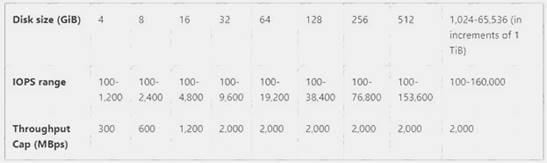
The following table provides a comparison of ultra solid-state-drives (SSD) (preview), premium SSD, standard SSD, and standard hard disk drives (HDD) for managed disks to help you decide what to use.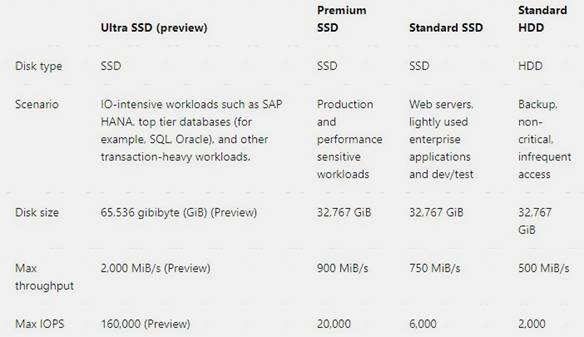
References:
https://docs.microsoft.com/en-us/azure/virtual-machines/windows/disks-types
NEW QUESTION 16
Note: This question is part of a series of questions that present the same scenario. Each question in the series contains a unique solution that might meet the stated goals. Some question sets might have more than one correct solution, while others might not have a correct solution.
After you answer a question in this section, you will NOT be able to return to it. As a result, these
questions will not appear in the review screen.
You are designing an HDInsight/Hadoop cluster solution that uses Azure Data Lake Gen1 Storage. The solution requires POSIX permissions and enables diagnostics logging for auditing.
You need to recommend solutions that optimize storage.
Proposed Solution: Ensure that files stored are larger than 250MB. Does the solution meet the goal?
- A. Yes
- B. No
Answer: A
Explanation:
Depending on what services and workloads are using the data, a good size to consider for files is 256 MB or greater. If the file sizes cannot be batched when landing in Data Lake Storage Gen1, you can have a separate compaction job that combines these files into larger ones.
Note: POSIX permissions and auditing in Data Lake Storage Gen1 comes with an overhead that becomes apparent when working with numerous small files. As a best practice, you must batch your data into larger files versus writing thousands or millions of small files to Data Lake Storage Gen1. Avoiding small file sizes can have multiple benefits, such as:
Lowering the authentication checks across multiple files Reduced open file connections
Faster copying/replication
Fewer files to process when updating Data Lake Storage Gen1 POSIX permissions References:
https://docs.microsoft.com/en-us/azure/data-lake-store/data-lake-store-best-practices
NEW QUESTION 17
A company has an application that uses Azure SQL Database as the data store.
The application experiences a large increase in activity during the last month of each year.
You need to manually scale the Azure SQL Database instance to account for the increase in data write operations.
Which scaling method should you recommend?
- A. Scale up by using elastic pools to distribute resources.
- B. Scale out by sharding the data across databases.
- C. Scale up by increasing the database throughput units.
Answer: C
Explanation:
As of now, the cost of running an Azure SQL database instance is based on the number of Database Throughput Units (DTUs) allocated for the database. When determining the number of units to allocate for the
solution, a major contributing factor is to identify what processing power is needed to handle the volume of expected requests.
Running the statement to upgrade/downgrade your database takes a matter of seconds.
NEW QUESTION 18
You are designing a Spark job that performs batch processing of daily web log traffic.
When you deploy the job in the production environment, it must meet the following requirements:  Run once a day. Display status information on the company intranet as the job runs. You need to recommend technologies for triggering and monitoring jobs.
Which technologies should you recommend? To answer, drag the appropriate technologies to the correct locations. Each technology may be used once, more than once, or not at all. You may need to drag the split bar between panes or scroll to view content.
NOTE: Each correct selection is worth one point.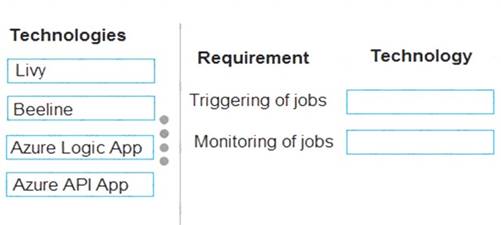
- A. Mastered
- B. Not Mastered
Answer: A
Explanation:
Box 1: Livy
You can use Livy to run interactive Spark shells or submit batch jobs to be run on Spark. Box 2: Beeline
Apache Beeline can be used to run Apache Hive queries on HDInsight. You can use Beeline with Apache Spark.
Note: Beeline is a Hive client that is included on the head nodes of your HDInsight cluster. Beeline uses JDBC to connect to HiveServer2, a service hosted on your HDInsight cluster. You can also use Beeline to access Hive on HDInsight remotely over the internet.
References:
https://docs.microsoft.com/en-us/azure/hdinsight/spark/apache-spark-livy-rest-interface https://docs.microsoft.com/en-us/azure/hdinsight/hadoop/apache-hadoop-use-hive-beeline
NEW QUESTION 19
You need to design the unauthorized data usage detection system. What Azure service should you include in the design?
- A. Azure Databricks
- B. Azure SQL Data Warehouse
- C. Azure Analysis Services
- D. Azure Data Factory
Answer: B
NEW QUESTION 20
You design data engineering solutions for a company.
A project requires analytics and visualization of large set of data. The project has the following requirements: Notebook scheduling Cluster automation Power BI Visualization
You need to recommend the appropriate Azure service. Which Azure service should you recommend?
- A. Azure Batch
- B. Azure Stream Analytics
- C. Azure ML Studio
- D. Azure Databricks
- E. Azure HDInsight
Answer: D
Explanation:
A databrick job is a way of running a notebook or JAR either immediately or on a scheduled basis.
Azure Databricks has two types of clusters: interactive and job. Interactive clusters are used to analyze data collaboratively with interactive notebooks. Job clusters are used to run fast and robust automated workloads using the UI or API.
You can visualize Data with Azure Databricks and Power BI Desktop.
References:
https://docs.azuredatabricks.net/user-guide/clusters/index.html https://docs.azuredatabricks.net/user-guide/jobs.html
NEW QUESTION 21
You need to design the vehicle images storage solution. What should you recommend?
- A. Azure Media Services
- B. Azure Premium Storage account
- C. Azure Redis Cache
- D. Azure Cosmos DB
Answer: B
Explanation:
Premium Storage stores data on the latest technology Solid State Drives (SSDs) whereas Standard Storage stores data on Hard Disk Drives (HDDs). Premium Storage is designed for Azure Virtual Machine workloads which require consistent high IO performance and low latency in order to host IO intensive workloads like OLTP, Big Data, and Data Warehousing on platforms like SQL Server, MongoDB, Cassandra, and others. With Premium Storage, more customers will be able to lift-and-shift demanding enterprise applications to the cloud.
Scenario: Traffic sensors will occasionally capture an image of a vehicle for debugging purposes. You must optimize performance of saving/storing vehicle images.
The impact of vehicle images on sensor data throughout must be minimized. References:
https://azure.microsoft.com/es-es/blog/introducing-premium-storage-high-performance-storage-for-azure-virtual
NEW QUESTION 22
You need to design a backup solution for the processed customer data. What should you include in the design?
- A. AzCopy
- B. AdlCopy
- C. Geo-Redundancy
- D. Geo-Replication
Answer: C
Explanation:
Scenario: All data must be backed up in case disaster recovery is required.
Geo-redundant storage (GRS) is designed to provide at least 99.99999999999999% (16 9's) durability of objects over a given year by replicating your data to a secondary region that is hundreds of miles away from
the primary region. If your storage account has GRS enabled, then your data is durable even in the case of a complete regional outage or a disaster in which the primary region isn't recoverable. References:
https://docs.microsoft.com/en-us/azure/storage/common/storage-redundancy-grs
NEW QUESTION 23
HOTSPOT
You need to ensure that security policies for the unauthorized detection system are met. What should you recommend? To answer, select the appropriate options in the answer area. NOTE: Each correct selection is worth one point.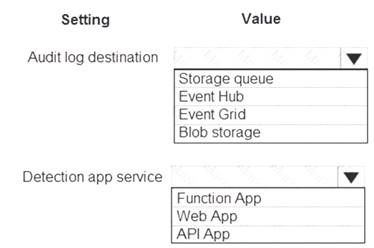
- A. Mastered
- B. Not Mastered
Answer: A
Explanation:
Box 1: Blob storage
Configure blob storage for audit logs.
Scenario: Unauthorized usage of the Planning Assistance data must be detected as quickly as possible. Unauthorized usage is determined by looking for an unusual pattern of usage.
Data used for Planning Assistance must be stored in a sharded Azure SQL Database. Box 2: Web Apps
SQL Advanced Threat Protection (ATP) is to be used.
One of Azure’s most popular service is App Service which enables customers to build and host web applications in the programming language of their choice without managing infrastructure. App Service offers auto-scaling and high availability, supports both Windows and Linux. It also supports automated deployments from GitHub, Visual Studio Team Services or any Git repository. At RSA, we announced that Azure Security Center leverages the scale of the cloud to identify attacks targeting App Service applications.
References:
https://azure.microsoft.com/sv-se/blog/azure-security-center-can-identify-attacks-targeting-azure-app-service-ap
NEW QUESTION 24
A company stores sensitive information about customers and employees in Azure SQL Database. You need to ensure that the sensitive data remains encrypted in transit and at rest.
What should you recommend?
- A. Transparent Data Encryption
- B. Always Encrypted with secure enclaves
- C. Azure Disk Encryption
- D. SQL Server AlwaysOn
Answer: B
Explanation:
References:
https://cloudblogs.microsoft.com/sqlserver/2021/12/17/confidential-computing-using-always-encrypted-withsec
NEW QUESTION 25
You are designing a recovery strategy for your Azure SQL Databases.
The recovery strategy must use default automated backup settings. The solution must include a Point-in time restore recovery strategy.
You need to recommend which backups to use and the order in which to restore backups.
What should you recommend? To answer, select the appropriate configuration in the answer area.
NOTE: Each correct selection is worth one point.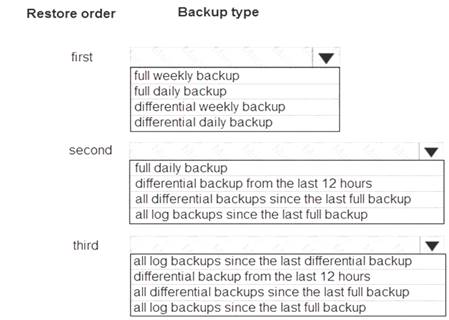
- A. Mastered
- B. Not Mastered
Answer: A
Explanation:
All Basic, Standard, and Premium databases are protected by automatic backups. Full backups are taken every week, differential backups every day, and log backups every 5 minutes.
References:
https://azure.microsoft.com/sv-se/blog/azure-sql-database-point-in-time-restore/
NEW QUESTION 26
......
Thanks for reading the newest DP-201 exam dumps! We recommend you to try the PREMIUM Simply pass DP-201 dumps in VCE and PDF here: https://www.simply-pass.com/Microsoft-exam/DP-201-dumps.html (74 Q&As Dumps)