Master the HPE6-A70 Implementing Aruba WLAN (IAW) 8.4 content and be ready for exam day success quickly with this Examcollection HPE6-A70 pdf exam. We guarantee it!We make it a reality and give you real HPE6-A70 questions in our HP HPE6-A70 braindumps.Latest 100% VALID HP HPE6-A70 Exam Questions Dumps at below page. You can use our HP HPE6-A70 braindumps and pass your exam.
Free HPE6-A70 Demo Online For HP Certifitcation:
NEW QUESTION 1
A network administrator configures this policy:
Users to which this policy applies are unable to receive IP addresses with DHCP. How should the administrator fix the issue?
- A. Change user to any in the user any svc-dhcp permit rule.
- B. Move the user any svc-dhcp permit rule to the bottom of the list.
- C. Remove the deny rule from the policy.
- D. Use the correct service alias in the user any svc-dhcp permit rule.
Answer: D
NEW QUESTION 2
An Aruba solution has a WLAN that uses WPA2-Personal security. How are encryption keys dynamically managed for the wireless users?
- A. The MM generates and distributes keys to clients and access points (APs).
- B. Administrators configure identical key strings on the Mobility Controllers (MCs) and wireless client 802.1X settings.
- C. Keys are generated and distributed securely during each wireless user authentication process.
- D. Keys are derived from the preshared key configured on the WLAN and on each wireless client.
Answer: D
NEW QUESTION 3
A WLAN in an Aruba Mobility Master (MM)-based solution enforces Enterprise-WPA2 security and uses the tunnel forwarding mode. The company has an external RADIUS server.
Which device exchanges RADIUS packets with the RADIUS server?
- A. Mobility Controller (MC)
- B. wireless client
- C. access point (AP)
- D. Mobility Master (MM)
Answer: D
NEW QUESTION 4
Which class of controller is more appropriate in a branch installation with up to 64 APs?
- A. A.-7008B.7030C.7205D.7210
Answer: B
NEW QUESTION 5
Which task can an Aruba Air Monitor (AM) perform?
- A. Analyze wireless traffic patterns at the application level.
- B. Optimize RF through the AP channel and transmit power plans.
- C. Analyze RF signals to determine the cause of non-802.11 interference.
- D. Prevent client connections to rogue APs.
Answer: D
NEW QUESTION 6
How does a high-gain omni-directional antenna compare to a typical omni-directional antenna?
- A. it provides more multi-user spatial streams.
- B. it provides more coverage in the horizontal direction than in the vertical direction.
- C. it provides more single-user spatial streams.
- D. it provides more coverage in both the horizontal and vertical directions.
Answer: B
NEW QUESTION 7
What is one difference between how a network administrator can monitor clients in the Mobility (MM) interface and in the AirWave Management Platform?
- A. AirWave shows trends for the past several minutes, while MM shows longer trends.
- B. AirWave combines information from more sources, such as RADIUS authenticating servers and APs.
- C. AirWave shows the current signal level for the client connection, while MM does not show RF statistics.
- D. MM shows user and role information associated with clients, while AirWave does not.
Answer: B
NEW QUESTION 8
What is the minimum space between channels in the 2.4GHz range to prevent overlap?
- A. 1 channel
- B. 3 channels
- C. 5 channels
- D. 7 channels
Answer: C
NEW QUESTION 9
Refer to the exhibit.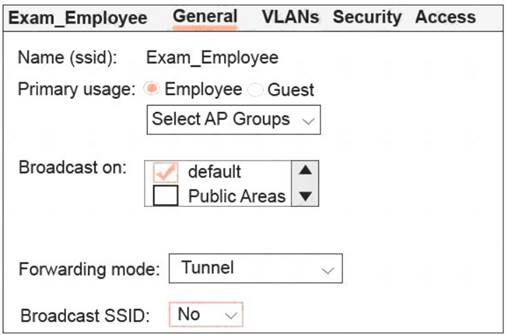
What describes the behavior for this WLAN?
- A. APs in the default group broadcast the SSI
- B. Clients can connect to the WLAN on APs in the default group only.
- C. No APs broadcast the SSI
- D. Clients cannot connect to the WLAN until administrators activate it.
- E. No APs broadcast the SSI
- F. Clients can connect to the WLAN on APs in the default group only.
- G. APs in the default group broadcast the SSI
- H. Clients can connect to the WLAN on APs in any group.
Answer: C
NEW QUESTION 10
What is a key difference between an Aruba Air Monitor (AM) and an Aruba Spectrum Analyzer (SA)?
- A. An AM detects threats such as rogue APs, while an SA analyzes RF conditions.
- B. An AM detects rogue APs and provides data services to clients, while an SA only detects rogue APs.
- C. An AM scans on only one 802.11 frequency band, while an SA scans on both 802.11 frequency bands.
- D. An AM both detects wireless intrusion attempts and mitigates them, while an SA only detects wireless intrusion attempts.
Answer: A
NEW QUESTION 11
An Aruba Remote AP (RAP) operates in split-tunnel mode. How does the AP forward traffic?
- A. It sends all user traffic in a GRE tunnel to a central Mobility Controller (MC), and it sends control traffic in an IPsec tunnel to the controller.
- B. It sends traffic designed to the corporate network in an IPsec tunnel to a central Mobility Controller (MC), and it bridges other traffic locally.
- C. It sends user and control traffic in two separate IPsec tunnels to the Mobility Controller (MC).
- D. It sends all employee and control traffic in a GRE tunnel to a central Mobility Controller (MC), and it bridges all guest traffic locally.
Answer: B
NEW QUESTION 12
Refer to the exhibits.
Exhibit 1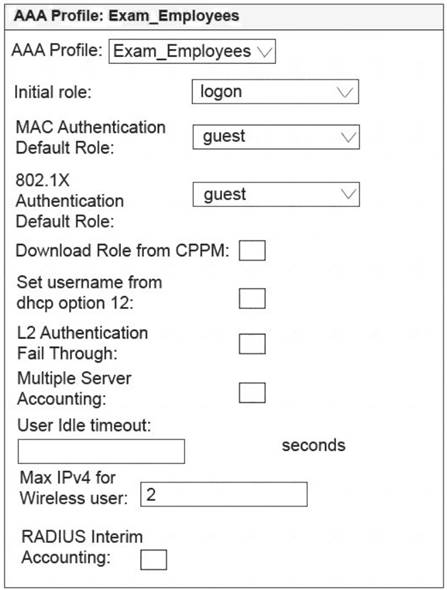
Exhibit 2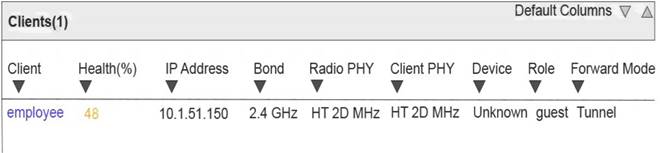
An Aruba solution supports a WLAN that uses WPA2-Enterprise security. Exhibit 1 shows the AAA policy for the WLAN. Users are supposed to be assigned to different roles after authentication. Network administrators test a connection with the employee user account. Exhibit 2 shows the status for the client after this test.
What is a possible reason for the issue shown in Exhibit 2?
- A. The shared key configured for the ClearPass server is incorrect.
- B. The RADIUS server is not correctly set up to send a user role for the employee account.
- C. MAC authentication is enabled on the WLAN, and the test device does not have an authorized address.
- D. The administrators entered the wrong password for the employee account.
Answer: B
NEW QUESTION 13
An Aruba solution has a WLAN that uses WPA2-Enterprise security. How are encryption keys dynamically managed for the wireless users?
- A. The MM generates and distributes keys to clients and access points (APs).
- B. Administrators configure identical key strings on the Mobility Controllers (MCs) and wireless client 802.1X settings.
- C. Keys are generated and distributed securely during each wireless user authentication process.
- D. Keys are derived from the preshared key configured on the WLAN and on each wireless client.
Answer: C
NEW QUESTION 14
Refer to the exhibit.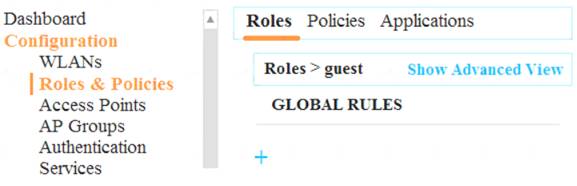
A network administrator adds a global rule in the area shown in the exhibit. Where does the global rule take effect?
- A. It immediately applies only to the guest role, as part of the final policy applied to the role.Administrators cannot apply the rule to other roles.
- B. It immediately applies to the guest role and other roles, as part of the first policy applied to the role.
- C. It immediately applies to the guest role and other roles, as part of the final policy applied to the role.
- D. It immediately applies only to the guest role and other roles, as part of the first policy applied to the role.Administrators can choose to apply the rule to other roles.
Answer: D
NEW QUESTION 15
A network administrator wants to implement MAC filtering for the wireless network of a local financial firm to ensure that only employees can access the wireless network. What is a potential weakness of this solution?
- A. MAC filters cannot be applied with WPA2 encryption.
- B. Authorized MAC addresses are visible in plaintext in the air and can be easily spoofed.
- C. Many popular clients do not have the capability to connect to WLANs that use MAC filters.
- D. MAC filters offer no protection against authorized users who try to connect unauthorized devices.
Answer: B
NEW QUESTION 16
A company has many 7220 controllers in its Aruba wireless architecture. A network administrator wants to use the Traffic Analysis dashboard in order to monitor which type of applications is being used by wireless users.
What is required for this implementation?
- A. Airmatch and ClientMatch must be enabled.
- B. The solution must have active PEFNG licenses.
- C. Firewall policies must include application filtering rules.
- D. WLANs must use the decrypt-tunnel forwarding option.
Answer: B
NEW QUESTION 17
Refer to the exhibit.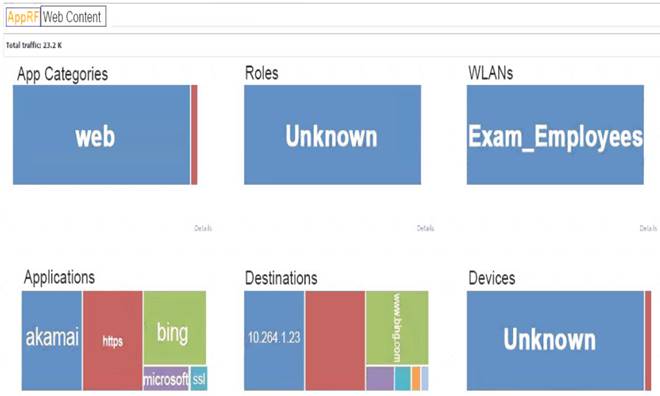
The exhibit shows output from a Mobility Master (MM) dashboard. What is a valid reason for the administrator to click the akamai square under applications?
- A. to create filter rules in order to control wireless user access to this application
- B. to download a report about the usage of this application over time
- C. to see more details about this application, such as a list of aggregated sessions
- D. to see the break down for only roles, destinations, WLANs and devices that use this application
Answer: C
NEW QUESTION 18
Which IEEE standard provides the highest transmission rates in the 2.4GHz frequency band?
- A. 802.11a
- B. 802.11ac
- C. 802.11g
- D. 802.11n
Answer: D
NEW QUESTION 19
A company has an Aruba solution. The company wants to host a guest login portal with this solution, and the login portal must gie guests the option to create their own login accounts.
How can a network administrator help meet these criteria?
- A. Choose the Internal captive portal with email registration option for the guest WLAN.
- B. Make sure to create a guest provisioning account for the guest WLAN.
- C. Disable authentication in the captive portal profile for the guest WLAN.
- D. Choose ClearPass or the other external captive portal option for the guest WLAN.
Answer: D
NEW QUESTION 20
How does WPA2 protect wireless user traffic in the air?
- A. It provides data integrity with AES and no data privacy.
- B. It provides both data integrity and privacy with AES.
- C. It provides data privacy with TKIP and no data integrity.
- D. It provides data integrity with TKIP and data privacy with AES.
Answer: B
NEW QUESTION 21
A company has an Aruba Mobility Master (MM)-based solution. Under which circumstance will an AP radio change channel without the use of the Mobility Master (MM)?
- A. when the MM detects that a different channel has significantly better quality
- B. when the Mobility Controller (MC) detects a rogue AP on the channel
- C. when the AP detects a large amount of interference on its channel
- D. when the Client Match rules indicate that nearby clients do not support the current channel
Answer: C
NEW QUESTION 22
......
100% Valid and Newest Version HPE6-A70 Questions & Answers shared by Dumps-hub.com, Get Full Dumps HERE: https://www.dumps-hub.com/HPE6-A70-dumps.html (New 131 Q&As)