Testking offers free demo for SAA-C01 exam. "AWS Certified Solutions Architect - Associate", also known as SAA-C01 exam, is a Amazon-Web-Services Certification. This set of posts, Passing the Amazon-Web-Services SAA-C01 exam, will help you answer those questions. The SAA-C01 Questions & Answers covers all the knowledge points of the real exam. 100% real Amazon-Web-Services SAA-C01 exams and revised by experts!
Also have SAA-C01 free dumps questions for you:
NEW QUESTION 1
You are deploying an application to track GPS coordinates of delivery trucks in the United States. Coordinates are transmitted from each delivery truck once every three seconds. You need to design an architecture that will enable real-time processing of these coordinates from multiple consumers. Which service should you use to implement data ingestion?
- A. Amazon Kinesis
- B. AWS Data Pipeline
- C. Amazon AppStream
- D. Amazon Simple Queue Service
Answer: A
Explanation:
https://aws.amazon.com/streaming-data/
NEW QUESTION 2
_____ embodies the "share-nothing" architecture and essentially involves breaking a large database into several smaller databases. Common ways to split a database include 1) splitting tables that are not joined in the same query onto different hosts or 2) duplicating a table across multiple hosts and then using a hashing algorithm to determine which host receives a given update.
- A. Sharding
- B. Failure recovery
- C. Federation
- D. DDL operations
Answer: A
Explanation:
Sharding embodies the "share-nothing" architecture and essentially just involves breaking a larger database up into smaller databases. Common ways to split a database are:
Splitting tables that are not joined in the same query onto different hosts Duplicating a table across multiple hosts and then splitting where a row goes.
More detailed information on the pros and cons of sharing can be found at the following sites: http://technoroy.blogspot.com/2008/07/shard-database-design.html http://www.hibernate.org/subprojects/shards.html
How Amazon RDS Helps With Sharing Maintenance Overhead
NEW QUESTION 3
Amazon S3 buckets in all other regions (other than US Standard) provide read-after-write consistency for PUTS of new objects.
- A. True
- B. False
Answer: A
NEW QUESTION 4
In Amazon RDS, security groups are ideally used to:
- A. Define maintenance period for database engines
- B. Launch Amazon RDS instances in a subnet
- C. Create, describe, modify, and delete DB instances
- D. Control what IP addresses or EC2 instances can connect to your databases on a DB instance
Answer: D
Explanation:
In Amazon RDS, security groups are used to control what IP addresses or EC2 instances can connect to your databases on a DB instance.
When you first create a DB instance, its firewall prevents any database access except through rules specified by an associated security group.
NEW QUESTION 5
True or False: Without IAM, you cannot control the tasks a particular user or system can do and what AWS resources they might use.
- A. FALSE
- B. TRUE
Answer: B
Explanation:
http://docs.aws.amazon.com/IAM/latest/UserGuide/getting-setup.html
NEW QUESTION 6
True or false: A VPC contains multiple subnets, where each subnet can span multiple Availability Zones.
- A. This is true only if requested during the set-up of VPC.
- B. This is true.
- C. This is false.
- D. This is true only for US region
Answer: C
Explanation:
A VPC can span several Availability Zones. In contrast, a subnet must reside within a single Availability Zone.
NEW QUESTION 7
What is the data model of DynamoDB?
- A. Since DynamoDB is schema-less, there is no data model.
- B. "Items", with Keys and one or more Attribute; and "Attribute", with Name and Value.
- C. "Table", a collection of Items; "Items", with Keys and one or more Attribute; and "Attribute", with Name and Value.
- D. "Database", which is a set of "Tables", which is a set of "Items", which is a set of "Attributes".
Answer: C
Explanation:
The data model of DynamoDB is: "Table", a collection of Items;
"Items", with Keys and one or more Attribute; "Attribute", with Name and Value.
NEW QUESTION 8
Your startup wants to implement an order fulfillment process for selling a personalized gadget that needs an average of 3-4 days to produce with some orders taking up to 6 months you expect 10 orders per day on your first day. 1000 orders per day after 6 months and 10,000 orders after 12 months.
Orders coming in are checked for consistency men dispatched to your manufacturing plant for production quality control packaging shipment and payment processing If the product does not meet the quality standards at any stage of the process employees may force the process to repeat a step Customers are notified via email about order status and any critical issues with their orders such as payment failure.
Your case architecture includes AWS Elastic Beanstalk for your website with an RDS MySQL instance for customer data and orders.
How can you implement the order fulfillment process while making sure that the emails are delivered reliably?
- A. Add a business process management application to your Elastic Beanstalk app servers and re-use the ROS database for tracking order status use one of the Elastic Beanstalk instances to send emails to customers.
- B. Use SWF with an Auto Scaling group of activity workers and a decider instance in another Auto Scaling group with min/max=1 Use the decider instance to send emails to customers.
- C. Use SWF with an Auto Scaling group of activity workers and a decider instance in another Auto Scaling group with min/max=1 use SES to send emails to customers.
- D. Use an SQS queue to manage all process tasks Use an Auto Scaling group of EC2 Instances that poll the tasks and execute the
- E. Use SES to send emails to customers.
Answer: C
Explanation:
http://media.amazonwebservices.com/architecturecenter/AWS_ac_ra_ecommerce_checkout_13.pdf
NEW QUESTION 9
Are you able to integrate a multi-factor token service with the AWS Platform?
- A. Yes, you can integrate private multi-factor token devices to authenticate users to the AWS platform.
- B. No, you cannot integrate multi-factor token devices with the AWS platform.
- C. Yes, using the AWS multi-factor token devices to authenticate users on the AWS platfor
Answer: C
Explanation:
Private MFA does not apply here.
Q. What is AWS MFA?
AWS multi-factor authentication (AWS MFA) provides an extra level of security that you can apply to your AWS environment. You can enable AWS MFA for your AWS account and for individual AWS Identity and Access Management (IAM) users you create under your account.
NEW QUESTION 10
The fastest way to load 300 TB of data to AWS is _____.
- A. to directly upload all data to S3 over a dedicated 100 Mbps connection
- B. to use AWS Import/Export Snowball
- C. to use VM Import/Export
- D. to zip all the data and then upload to S3
Answer: B
Explanation:
Even with high-speed Internet connections, it can take months to transfer large amounts of data. For example, 100 terabytes of data will take more than 100 days to transfer over a dedicated 100 Mbps connection. That same transfer can be accomplished in less than one day, plus shipping time, using two Snowball appliances.
http://aws.amazon.com/importexport/
NEW QUESTION 11
A company needs to deploy services to an AWS region which they have not previously used. The company currently has an AWS identity and Access Management (IAM) role for the Amazon EC2 instances, which permits the instance to have access to Amazon DynamoDB. The company wants their EC2 instances in the new region to have the same privileges. How should the company achieve this?
- A. Create a new IAM role and associated policies within the new region
- B. Assign the existing IAM role to the Amazon EC2 instances in the new region
- C. Copy the IAM role and associated policies to the new region and attach it to the instances
- D. Create an Amazon Machine Image (AMI) of the instance and copy it to the desired region using the AMI Copy feature
Answer: B
NEW QUESTION 12
Which one of the below is not an AWS Storage Service?
- A. Amazon S3
- B. Amazon Glacier
- C. Amazon CloudFront
- D. Amazon EBS
Answer: C
Explanation:
AWS Storage Services are: Amazon S3
Amazon Glacier Amazon EBS
AWS Storage Gateway
NEW QUESTION 13
What is the maximum response time for a Business level Premium Support case?
- A. 120 seconds
- B. 1 hour
- C. 10 minutes
- D. 12 hours
Answer: B
Explanation:
https://aws.amazon.com/premiumsupport/features/
NEW QUESTION 14
You need a solution to distribute traffic evenly across all of the containers for a task running on Amazon ECS. Your task definitions define dynamic host port mapping for your containers. What AWS feature provides this functionality?
- A. Application Load Balancers support dynamic host port mapping.
- B. CloudFront custom origins support dynamic host port mapping.
- C. All Elastic Load Balancing instances support dynamic host port mapping.
- D. Classic Load Balancers support dynamic host port mappin
Answer: A
NEW QUESTION 15
Amazon S3 buckets in all Regions provide which of the following?
- A. Read-after-write consistency for PUTS of new objects AND Strongly consistent for POST & DELETES
- B. Read-after-write consistency for POST of new objects AND Eventually consistent for overwrite PUTS & DELETES
- C. Read-after-write consistency for PUTS of new objects AND Eventually consistent for overwrite PUTS & DELETES
- D. Read-after-write consistency for POST of new objects AND Strongly consistent for POST & DELETES
Answer: C
Explanation: 
NEW QUESTION 16
You have multiple Amazon EC2 instances running in a cluster across multiple Availability Zones within the same region. What combination of the following should be used to ensure the highest network performance (packets per second), lowest latency, and lowest jitter? (Choose three.)
- A. Amazon EC2 placement groups
- B. Enhanced networking
- C. Amazon PV AMI
- D. Amazon HVM AMI
- E. Amazon Linux
- F. Amazon VPC
Answer: BDF
Explanation:
Enhanced Networking enables you to get significantly higher packet per second (PPS) performance,
lower network jitter and lower latencies. This feature uses a new network virtualization stack that provides higher I/O performance and lower CPU utilization compared to traditional implementations. In order to take advantage of Enhanced Networking, you should launch an HVM AMI in VPC, and install the appropriate driver. For instructions on how to enable Enhanced Networking on EC2 instances, see the Enhanced Networking on Linux and Enhanced Networking on Windows tutorials. For availability of this feature by instance, or to learn more, visit the Enhanced Networking FAQ section.
NEW QUESTION 17
In Amazon Elastic Compute Cloud, which of the following is used for communication between instances in the same network (EC2-Classic or a VPC)?
- A. Private IP addresses
- B. Elastic IP addresses
- C. Static IP addresses
- D. Public IP addresses
Answer: A
Explanation:
A private IP address is an IP address that's not reachable over the Internet. You can use private IP addresses for communication between instances in the same network (EC2-Classic or a VPC).
NEW QUESTION 18
Your website is serving on-demand training videos to your workforce. Videos are uploaded monthly in high resolution MP4 format. Your workforce is distributed globally often on the move and using
company-provided tablets that require the HTTP Live Streaming (HLS) protocol to watch a video. Your company has no video transcoding expertise and it required you may need to pay for a consultant.
How do you implement the most cost-efficient architecture without compromising high availability and quality of video delivery'?
- A. A video transcoding pipeline running on EC2 using SQS to distribute tasks and Auto Scaling to adjust the number of nodes depending on the length of the queu
- B. EBS volumes to host videos and EBS snapshots to incrementally backup original files after a few day
- C. CloudFront to serve HLS transcoded videos from EC2.
- D. Elastic Transcoder to transcode original high-resolution MP4 videos to HL
- E. EBS volumes to host videos and EBS snapshots to incrementally backup original files after a few day
- F. CloudFront to serve HLS transcoded videos from EC2.
- G. Elastic Transcoder to transcode original high-resolution MP4 videos to HL
- H. S3 to host videos with Lifecycle Management to archive original files to Glacier after a few day
- I. CloudFront to serve HLS transcoded videos from S3.
- J. A video transcoding pipeline running on EC2 using SQS to distribute tasks and Auto Scaling to adjust the number of nodes depending on the length of the queu
- K. S3 to host videos with Lifecycle Management to archive all files to Glacier after a few day
- L. CloudFront to serve HLS transcoded videos from Glacier.
Answer: C
NEW QUESTION 19
An online gaming site asked you if you can deploy a database that is a fast, highly scalable NoSQL database service in AWS for a new site that he wants to build. Which database should you recommend?
- A. Amazon DynamoDB
- B. Amazon RDS
- C. Amazon Redshift
- D. Amazon SimpleDB
Answer: A
Explanation:
Amazon DynamoDB is ideal for database applications that require very low latency and predictable performance at any scale but don't need complex querying capabilities like joins or transactions. Amazon DynamoDB is a fully-managed NoSQL database service that offers high performance, predictable throughput and low cost. It is easy to set up, operate, and scale. With Amazon DynamoDB, you can start small, specify the throughput and storage you need, and easily scale your capacity requirements on the fly. Amazon DynamoDB automatically partitions data over a number of servers to meet your request capacity. In addition, DynamoDB automatically replicates your data synchronously across multiple Availability Zones within an AWS Region to ensure high-availability and data durability.
NEW QUESTION 20
SQL Server stores logins and passwords in the master database.
- A. True
- B. False
Answer: A
Explanation: 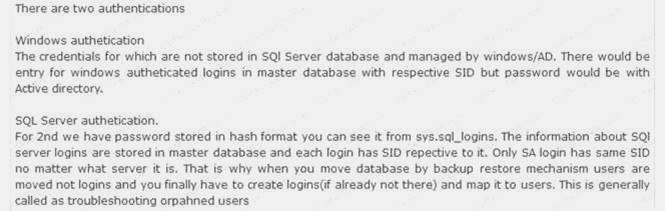
NEW QUESTION 21
After deploying a new website for a client on AWS, he asks if you can set it up so that if it fails it can be automatically redirected to a backup website that he has stored on a dedicated server elsewhere. You are wondering whether Amazon Route 53 can do this.
Which statement below is correct in regards to Amazon Route 53?
- A. Amazon Route 53 can't help detect an outag
- B. You need to use another service.
- C. Amazon Route 53 can help detect an outage of your website and redirect your end users to alternate locations.
- D. Amazon Route 53 can help detect an outage of your website but can't redirect your end users to alternate locations.
- E. Amazon Route 53 can't help detect an outage of your website, but can redirect your end users to alternate locations.
Answer: B
Explanation:
With DNS Failover, Amazon Route 53 can help detect an outage of your website and redirect your end users to alternate locations where your application is operating properly.
NEW QUESTION 22
The one-time payment for Reserved Instances is ____ refundable if the reservation is cancelled.
- A. always
- B. in some circumstances
- C. never
Answer: C
Explanation:
the one-time fee is non-refundable.
https://aws.amazon.com/ec2/purchasing-options/reserved-instances/buyer/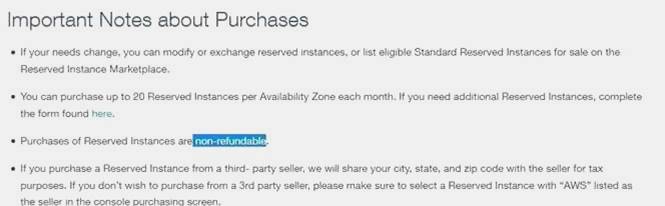
NEW QUESTION 23
A user has created a mobile application on an EC2 instance which makes calls to DynamoDB to fetch certain data. The application is using the DynamoDB SDK and root account access/secret access key to connect to DynamoDB from mobile. Which security method below does AWS recommend in this scenario?
- A. The user should create a separate IAM user for each mobile application and provide DynamoDB access with it
- B. Create an IAM Role with DynamoDB access and attach it with the mobile application
- C. The application should use an IAM role with web identity federation which validates calls to DynamoDB with identity providers, such as Google, Amazon, and Facebook
- D. The user should create an IAM role with DynamoDB and EC2 acces
- E. Attach the role with EC2 and route all calls from the mobile through EC2
Answer: C
NEW QUESTION 24
In order to optimize performance for a compute cluster that requires low inter-node latency, which of the following feature should you use?
- A. Multiple Availability Zones
- B. AWS Direct Connect
- C. EC2 Dedicated Instances
- D. Placement Groups
- E. VPC private subnets
Answer: D
Explanation:
A placement group is a logical grouping of instances within a single Availability Zone. Using placement groups enables applications to participate in a low-latency, 10 Gigabits per second (Gbps) network. http://docs.aws.amazon.com/AWSEC2/latest/UserGuide/placement-groups.html References:
NEW QUESTION 25
An International company has deployed a multi-tier web application that relies on DynamoDB in a single region. For regulatory reasons they need disaster recovery capability In a separate region with a Recovery Time Objective of 2 hours and a Recovery Point Objective of 24 hours They should synchronize their data on a regular basis and be able to provision me web application rapidly using CloudFormation.
The objective is to minimize changes to the existing web application, control the throughput of DynamoDB used for the synchronization of data and synchronize only the modified elements. Which design would you choose to meet these requirements?
- A. Use AWS data Pipeline to schedule a DynamoDB cross region copy once a da
- B. create a Lastupdated' attribute in your DynamoDB table that would represent the timestamp of the last update and use it as a filter.
- C. Use EMR and write a custom script to retrieve data from DynamoDB in the current region using a SCAN operation and push it to DynamoDB in the second region.
- D. Use AWS data Pipeline to schedule an export of the DynamoDB table to S3 in the current region once a day then schedule another task immediately after it that will import data from S3 to DynamoDB in the other region.
- E. Send also each Ante into an SQS queue in me second region; use an auto-scaling group behind the SQS queue to replay the write in the second region.
Answer: A
NEW QUESTION 26
The billing process for Amazon EC2 instances was updated as of October 2, 2021. Which of the following statements is true regarding how you pay for Amazon EC2 instances? (Choose two.)
- A. Payment does not vary based on the instance AMI's operating system.
- B. You can pay per hour or per second, depending on the instance AMI's operating system.
- C. You pay for compute capacity by the day; hours are billed in proportion.
- D. You can pay per hour or per second, depending on the instance typ
Answer: BD
Explanation:
Previously, if you launched an instance for 5 minutes, you would pay for 1 hour. If you launched an instance for 45 minutes, you would also pay for 1 hour. This means that partial hours cost as much as one full hour. Pricing is per instance-hour consumed for each instance, from the time an instance is
launched until it is terminated or stopped. Each partial instance-hour consumed will be billed as a full hour.
With EC2 services now billed per-second in some cases, as well as per-hour in others as of October 2, 2021, there is more to consider. Amazon AWS is still based on the concept of pay-as-you-go. You pay Amazon EC2 instances by the second for all instance types except Dedicated Host, which is still billed per instance-hour. You are billed per second when using Linux operating systems with no separate hourly charge, and billed per hour when using Windows operating systems. http://aws.amazon.com/ec2/pricing/
NEW QUESTION 27
When does the billing of an Amazon EC2 system begin?
- A. It starts when the Status column for your distribution changes from Creating to Deployed.
- B. It starts as soon as you click the create instance option on the main EC2 console.
- C. It starts when your instance reaches 720 instance hours.
- D. It starts when Amazon EC2 initiates the boot sequence of an AMI instanc
Answer: D
Explanation:
Billing commences when Amazon EC2 initiates the boot sequence of an AMI instance. Billing ends when the instance terminates, which could occur through a web services command, by running "shutdown -h", or through instance failure. When you stop an instance, Amazon shuts it down but doesn’t charge hourly usage for a stopped instance, or data transfer fees, but charges for the storage for any Amazon EBS volumes.
NEW QUESTION 28
A user has attached 1 EBS volume to a VPC instance. The user wants to achieve the best fault tolerance of data possible. Which of the below mentioned options can help achieve fault tolerance?
- A. Attach one more volume with RAID 1 configuration.
- B. Attach one more volume with RAID 0 configuration.
- C. Connect multiple volumes and stripe them with RAID 6 configuration.
- D. Use the EBS volume as a root devic
Answer: A
Explanation:
The user can join multiple provisioned IOPS volumes together in a RAID 1 configuration to achieve better fault tolerance. RAID 1 does not provide a write performance improvement; it requires more bandwidth than non-RAID configurations since the data is written simultaneously to multiple volumes. Reference: http://docs.aws.amazon.com/AWSEC2/latest/UserGuide/raid-config.html
NEW QUESTION 29
A gaming company comes to you and asks you to build them infrastructure for their site. They are not sure how big they will be as with all startups they have limited money and big ideas. What they do tell you is that if the game becomes successful, like one of their previous games, it may rapidly grow to millions of users and generate tens (or even hundreds) of thousands of writes and reads per
second. After considering all of this, you decide that they need a fully managed NoSQL database service that provides fast and predictable performance with seamless scalability. Which of the following databases do you think would best fit their needs?
- A. Amazon DynamoDB
- B. Amazon Redshift
- C. Any non-relational database.
- D. Amazon SimpleDB
Answer: A
Explanation:
Amazon DynamoDB is a fully managed NoSQL database service that provides fast and predictable performance with seamless scalability. Amazon DynamoDB enables customers to offload the administrative burdens of operating and scaling distributed databases to AWS, so they don't have to worry about hardware provisioning, setup and configuration, replication, software patching, or cluster scaling.
Today's web-based applications generate and consume massive amounts of data. For example, an online game might start out with only a few thousand users and a light database workload consisting of 10 writes per second and 50 reads per second. However, if the game becomes successful, it may rapidly grow to millions of users and generate tens (or even hundreds) of thousands of writes and reads per second. It may also create terabytes or more of data per day.
Developing your applications against Amazon DynamoDB enables you to start small and simply dialup your request capacity for a table as your requirements scale, without incurring downtime.
You pay highly cost-efficient rates for the request capacity you provision, and let Amazon DynamoDB do the work over partitioning your data and traffic over sufficient server capacity to meet your
needs. Amazon DynamoDB does the database management and administration, and you simply store and request your data. Automatic replication and failover provides built-in fault tolerance, high availability, and data durability. Amazon DynamoDB gives you the peace of mind that your database is fully managed and can grow with your application requirements.
NEW QUESTION 30
......
P.S. 2passeasy now are offering 100% pass ensure SAA-C01 dumps! All SAA-C01 exam questions have been updated with correct answers: https://www.2passeasy.com/dumps/SAA-C01/ (288 New Questions)