We provide real SCS-C01 exam questions and answers braindumps in two formats. Download PDF & Practice Tests. Pass Amazon-Web-Services SCS-C01 Exam quickly & easily. The SCS-C01 PDF type is available for reading and printing. You can print more and practice many times. With the help of our Amazon-Web-Services SCS-C01 dumps pdf and vce product and material, you can easily pass the SCS-C01 exam.
Amazon-Web-Services SCS-C01 Free Dumps Questions Online, Read and Test Now.
NEW QUESTION 1
You have a set of Keys defined using the AWS KMS service. You want to stop using a couple of keys , but are not sure of which services are currently using the keys. Which of the following would be a safe option to stop using the keys from further usage.
Please select:
- A. Delete the keys since anyway there is a 7 day waiting period before deletion
- B. Disable the keys
- C. Set an alias for the key
- D. Change the key material for the key
Answer: B
Explanation:
Option A is invalid because once you schedule the deletion and waiting period ends, you cannot come back from the deletion process.
Option C and D are invalid because these will not check to see if the keys are being used or not The AWS Documentation mentions the following
Deleting a customer master key (CMK) in AWS Key Management Service (AWS KMS) is destructive and potentially dangerous. It deletes the key material and all metadata associated with the CMK, and is irreversible. After a CMK is deleted you can no longer decrypt the data that was encrypted under that CMK, which means that data becomes unrecoverable. You should delete a CMK only when you are sure that you don't need to use it anymore. If you are not sure, consider disabling the CMK instead of deleting it. You can re-enable a disabled CMK if you need to use it again later, but you cannot recover a deleted CMK.
For more information on deleting keys from KMS, please visit the below URL: https://docs.aws.amazon.com/kms/latest/developereuide/deleting-keys.html
The correct answer is: Disable the keys Submit your Feedback/Queries to our Experts
NEW QUESTION 2
Your application currently uses customer keys which are generated via AWS KMS in the US east region. You now want to use the same set of keys from the EU-Central region. How can this be accomplished?
Please select:
- A. Export the key from the US east region and import them into the EU-Central region
- B. Use key rotation and rotate the existing keys to the EU-Central region
- C. Use the backing key from the US east region and use it in the EU-Central region
- D. This is not possible since keys from KMS are region specific
Answer: D
Explanation:
Option A is invalid because keys cannot be exported and imported across regions. Option B is invalid because key rotation cannot be used to export keys
Option C is invalid because the backing key cannot be used to export keys This is mentioned in the AWS documentation
What geographic region are my keys stored in?
Keys are only stored and used in the region in which they are created. They cannot be transferred to another region. For example; keys created in the EU-Central (Frankfurt) region are only stored and used within the EU-Central (Frankfurt) region
For more information on KMS please visit the following URL: https://aws.amazon.com/kms/faqs/
The correct answer is: This is not possible since keys from KMS are region specific Submit your Feedback/Queries to our Experts
NEW QUESTION 3
You have just received an email from AWS Support stating that your AWS account might have been compromised. Which of the following steps would you look to carry out immediately. Choose 3 answers from the options below.
Please select:
- A. Change the root account password.
- B. Rotate all 1AM access keys
- C. Keep all resources running to avoid disruption
- D. Change the password for all 1AM users.
Answer: ABD
Explanation:
One of the articles from AWS mentions what should be done in such a scenario
If you suspect that your account has been compromised, or if you have received a notification from AWS that the account has been compromised, perform the following tasks:
Change your AWS root account password and the passwords of any 1AM users.
Delete or rotate all root and AWS Identity and Access Management (1AM) access keys.
Delete any resources on your account you didn't create, especially running EC2 instances, EC2 spot bids, or 1AM users.
Respond to any notifications you received from AWS Support through the AWS Support Center.
Option C is invalid because there could be compromised instances or resources running on your environment. They should be shutdown or stopped immediately.
For more information on the article, please visit the below URL: https://aws.amazon.com/premiumsupport/knowledee-center/potential-account-compromise>
The correct answers are: Change the root account password. Rotate all 1AM access keys. Change the password for all 1AM users. Submit your Feedback/Queries to our Experts
NEW QUESTION 4
A windows machine in one VPC needs to join the AD domain in another VPC. VPC Peering has been
established. But the domain join is not working. What is the other step that needs to be followed to ensure that the AD domain join can work as intended
Please select:
- A. Change the VPC peering connection to a VPN connection
- B. Change the VPC peering connection to a Direct Connect connection
- C. Ensure the security groups for the AD hosted subnet has the right rule for relevant subnets
- D. Ensure that the AD is placed in a public subnet
Answer: C
Explanation:
In addition to VPC peering and setting the right route tables, the security groups for the AD EC2 instance needs to ensure the right rules are put in place for allowing incoming traffic.
Option A and B is invalid because changing the connection type will not help. This is a problem with the Security Groups.
Option D is invalid since the AD should not be placed in a public subnet
For more information on allowing ingress traffic for AD, please visit the following url
|https://docs.aws.amazon.com/quickstart/latest/active-directory-ds/ingress.html|
The correct answer is: Ensure the security groups for the AD hosted subnet has the right rule for relevant subnets Submit your Feedback/Queries to our Experts
NEW QUESTION 5
An organization has tens of applications deployed on thousands of Amazon EC2 instances. During testing, the Application team needs information to let them know whether the network access control lists (network ACLs) and security groups are working as expected.
How can the Application team’s requirements be met?
- A. Turn on VPC Flow Logs, send the logs to Amazon S3, and use Amazon Athena to query the logs.
- B. Install an Amazon Inspector agent on each EC2 instance, send the logs to Amazon S3, and use Amazon EMR to query the logs.
- C. Create an AWS Config rule for each network ACL and security group configuration, send the logs to Amazon S3, and use Amazon Athena to query the logs.
- D. Turn on AWS CloudTrail, send the trails to Amazon S3, and use AWS Lambda to query the trails.
Answer: A
NEW QUESTION 6
Your company has a set of EC2 Instances that are placed behind an ELB. Some of the applications hosted on these instances communicate via a legacy protocol. There is a security mandate that all traffic between the client and the EC2 Instances need to be secure. How would you accomplish this?
Please select:
- A. Use an Application Load balancer and terminate the SSL connection at the ELB
- B. Use a Classic Load balancer and terminate the SSL connection at the ELB
- C. Use an Application Load balancer and terminate the SSL connection at the EC2 Instances
- D. Use a Classic Load balancer and terminate the SSL connection at the EC2 Instances
Answer: D
Explanation:
Since there are applications which work on legacy protocols, you need to ensure that the ELB can be used at the network layer as well and hence you should choose the Classic ELB. Since the traffic needs to be secure till the EC2 Instances, the SSL termination should occur on the Ec2 Instances.
Option A and C are invalid because you need to use a Classic Load balancer since this is a legacy application. Option B is incorrect since encryption is required until the EC2 Instance
For more information on HTTPS listeners for classic load balancers, please refer to below URL https://docs.aws.ama20n.com/elasticloadbalancing/latest/classic/elb-https-load-balancers.htmll
The correct answer is: Use a Classic Load balancer and terminate the SSL connection at the EC2 Instances Submit your Feedback/Queries to our Experts
NEW QUESTION 7
A Security Engineer is looking for a way to control access to data that is being encrypted under a CMK. The Engineer is also looking to use additional authenticated data (AAD) to prevent tampering with ciphertext.
Which action would provide the required functionality?
- A. Pass the key alias to AWS KMS when calling Encrypt and Decrypt API actions.
- B. Use IAM policies to restrict access to Encrypt and Decrypt API actions.
- C. Use kms:EncryptionContext as a condition when defining IAM policies for the CMK.
- D. Use key policies to restrict access to the appropriate IAM groups.
Answer: D
NEW QUESTION 8
During a security event, it is discovered that some Amazon EC2 instances have not been sending Amazon CloudWatch logs.
Which steps can the Security Engineer take to troubleshoot this issue? (Select two.)
- A. Connect to the EC2 instances that are not sending the appropriate logs and verify that the CloudWatch Logs agent is running.
- B. Log in to the AWS account and select CloudWatch Log
- C. Check for any monitored EC2 instances that are in the “Alerting” state and restart them using the EC2 console.
- D. Verify that the EC2 instances have a route to the public AWS API endpoints.
- E. Connect to the EC2 instances that are not sending log
- F. Use the command prompt to verify that the right permissions have been set for the Amazon SNS topic.
- G. Verify that the network access control lists and security groups of the EC2 instances have the access to send logs over SNMP.
Answer: AE
NEW QUESTION 9
Which of the following is the responsibility of the customer? Choose 2 answers from the options given below. Please select:
- A. Management of the Edge locations
- B. Encryption of data at rest
- C. Protection of data in transit
- D. Decommissioning of old storage devices
Answer: BC
Explanation:
Below is the snapshot of the Shared Responsibility Model 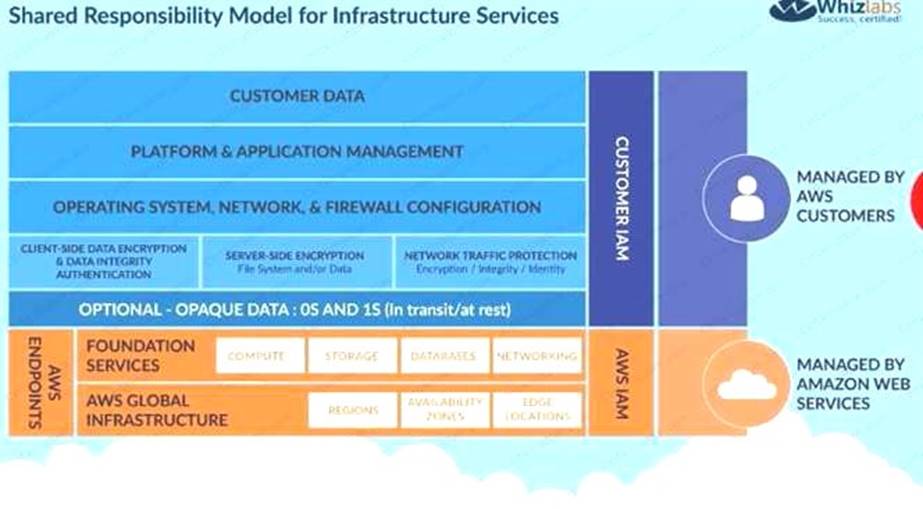
C:UserswkDesktopmudassarUntitled.jpg
For more information on AWS Security best practises, please refer to below URL awsstatic corn/whitepapers/Security/AWS Practices.
The correct answers are: Encryption of data at rest Protection of data in transit Submit your Feedback/Queries to our Experts
NEW QUESTION 10
During a recent security audit, it was discovered that multiple teams in a large organization have placed restricted data in multiple Amazon S3 buckets, and the data may have been exposed. The auditor has requested that the organization identify all possible objects that contain personally identifiable information (PII) and then determine whether this information has been accessed.
What solution will allow the Security team to complete this request?
- A. Using Amazon Athena, query the impacted S3 buckets by using the PII query identifier functio
- B. Then, create a new Amazon CloudWatch metric for Amazon S3 object access to alert when the objects are accessed.
- C. Enable Amazon Macie on the S3 buckets that were impacted, then perform data classificatio
- D. For identified objects that contain PII, use the research function for auditing AWS CloudTrail logs and S3 bucket logs for GET operations.
- E. Enable Amazon GuardDuty and enable the PII rule set on the S3 buckets that were impacted, then perform data classificatio
- F. Using the PII findings report from GuardDuty, query the S3 bucket logs by using Athena for GET operations.
- G. Enable Amazon Inspector on the S3 buckets that were impacted, then perform data classificatio
- H. For identified objects that contain PII, query the S3 bucket logs by using Athena for GET operations.
Answer: B
NEW QUESTION 11
You want to get a list of vulnerabilities for an EC2 Instance as per the guidelines set by the Center of Internet Security. How can you go about doing this?
Please select:
- A. Enable AWS Guard Duty for the Instance
- B. Use AWS Trusted Advisor
- C. Use AWS inspector
- D. UseAWSMacie
Answer: C
Explanation:
The AWS Inspector service can inspect EC2 Instances based on specific Rules. One of the rules packages is based on the guidelines set by the Center of Internet Security
Center for Internet security (CIS) Benchmarks
The CIS Security Benchmarks program provides well-defined, un-biased and consensus-based industry best practices to help organizations assess and improve their security. Amazon Web Services is a CIS Security Benchmarks Member company and the list of Amazon Inspector certifications can be viewed nere.
Option A is invalid because this can be used to protect an instance but not give the list of vulnerabilities Options B and D are invalid because these services cannot give a list of vulnerabilities For more information
on the guidelines, please visit the below URL:
* https://docs.aws.amazon.com/inspector/latest/userguide/inspector_cis.html The correct answer is: Use AWS Inspector
Submit your Feedback/Queries to our Experts
NEW QUESTION 12
You are trying to use the Systems Manager to patch a set of EC2 systems. Some of the systems are not getting covered in the patching process. Which of the following can be used to troubleshoot the issue? Choose 3 answers from the options given below.
Please select:
- A. Check to see if the right role has been assigned to the EC2 instances
- B. Check to see if the 1AM user has the right permissions for EC2
- C. Ensure that agent is running on the instances.
- D. Check the Instance status by using the Health API.
Answer: ACD
Explanation:
For ensuring that the instances are configured properly you need to ensure the followi .
1) You installed the latest version of the SSM Agent on your instance
2) Your instance is configured with an AWS Identity and Access Management (1AM) role that enables the instance to communicate with the Systems Manager API
3) You can use the Amazon EC2 Health API to quickly determine the following information about Amazon EC2 instances The status of one or more instances
The last time the instance sent a heartbeat value The version of the SSM Agent
The operating system
The version of the EC2Config service (Windows) The status of the EC2Config service (Windows)
Option B is invalid because 1AM users are not supposed to be directly granted permissions to EC2 Instances For more information on troubleshooting AWS SSM, please visit the following URL:
https://docs.aws.amazon.com/systems-manager/latest/userguide/troubleshooting-remote-commands.html
The correct answers are: Check to see if the right role has been assigned to the EC2 Instances, Ensure that agent is running on the Instances., Check the Instance status by using the Health API.
Submit your Feedback/Queries to our Experts
NEW QUESTION 13
An application makes calls to AWS services using the AWS SDK. The application runs on Amazon EC2 instances with an associated IAM role. When the application attempts to access an object within an Amazon S3 bucket; the Administrator receives the following error message: HTTP 403: Access Denied.
Which combination of steps should the Administrator take to troubleshoot this issue? (Select three.)
- A. Confirm that the EC2 instance's security group authorizes S3 access.
- B. Verify that the KMS key policy allows decrypt access for the KMS key for this IAM principle.
- C. Check the S3 bucket policy for statements that deny access to objects.
- D. Confirm that the EC2 instance is using the correct key pair.
- E. Confirm that the IAM role associated with the EC2 instance has the proper privileges.
- F. Confirm that the instance and the S3 bucket are in the same Region.
Answer: ABC
NEW QUESTION 14
An enterprise wants to use a third-party SaaS application. The SaaS application needs to have access to issue several API commands to discover Amazon EC2 resources running within the enterprise's account. The enterprise has internal security policies that require any outside access to their environment must conform to the principles of least privilege and there must be controls in place to ensure that the credentials used by the SaaS vendor cannot be used by any other third party. Which of the following would meet all of these conditions?
Please select:
- A. From the AWS Management Console, navigate to the Security Credentials page and retrieve the access and secret key for your account.
- B. Create an 1AM user within the enterprise account assign a user policy to the 1AM user that allows only the actions required by the SaaS applicatio
- C. Create a new access and secret key for the user and provide these credentials to the SaaS provider.
- D. Create an 1AM role for cross-account access allows the SaaS provider's account to assume the role and assign it a policy that allows only the actions required by the SaaS application.
- E. Create an 1AM role for EC2 instances, assign it a policy that allows only the actions required tor the Saas application to work, provide the role ARN to the SaaS provider to use when launching their application instances.
Answer: C
Explanation:
The below diagram from an AWS blog shows how access is given to other accounts for the services in your own account
C:UserswkDesktopmudassarUntitled.jpg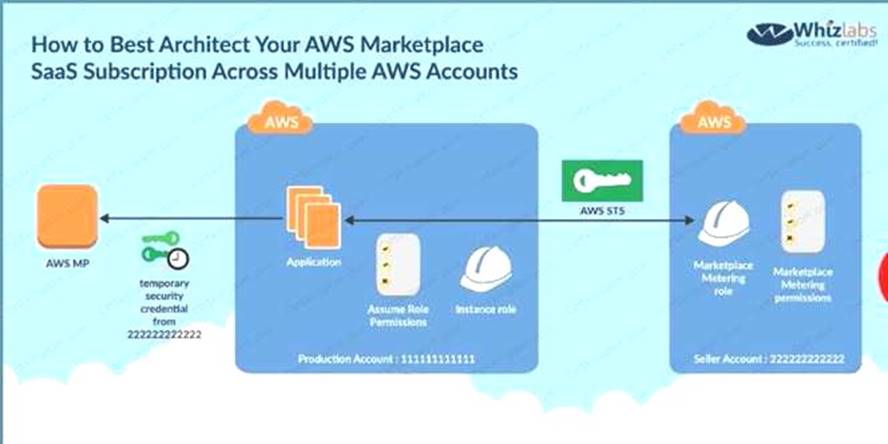
Options A and B are invalid because you should not user 1AM users or 1AM Access keys Options D is invalid because you need to create a role for cross account access
For more information on Allowing access to external accounts, please visit the below URL:
|https://aws.amazon.com/blogs/apn/how-to-best-architect-your-aws-marketplace-saas-subscription-across-multip The correct answer is: Create an 1AM role for cross-account access allows the SaaS provider's account to assume the role and assign it a policy that allows only the actions required by the SaaS application.
Submit your Feedback/Queries to our Experts
NEW QUESTION 15
Your company is planning on developing an application in AWS. This is a web based application. The application users will use their facebook or google identities for authentication. You want to have the ability to manage user profiles without having to add extra coding to manage this. Which of the below would assist in this.
Please select:
- A. Create an OlDC identity provider in AWS
- B. Create a SAML provider in AWS
- C. Use AWS Cognito to manage the user profiles
- D. Use 1AM users to manage the user profiles
Answer: B
Explanation:
The AWS Documentation mentions the following The AWS Documentation mentions the following
OIDC identity providers are entities in 1AM that describe an identity provider (IdP) service that supports the OpenID Connect (OIDC) standard. You use an OIDC identity provider when you want to establish trust between an OlDC-compatible IdP—such as Google, Salesforce, and many others—and your AWS account This is useful if you are creating a mobile app or web application that requires access to AWS resources, but you don't want to create custom sign-in code or manage your own user identities
Option A is invalid because in the security groups you would not mention this information/ Option C is invalid because SAML is used for federated authentication
Option D is invalid because you need to use the OIDC identity provider in AWS For more information on ODIC identity providers, please refer to the below Link:
https://docs.aws.amazon.com/IAM/latest/UserGuide/id roles providers create oidc.htmll
The correct answer is: Create an OIDC identity provider in AWS
NEW QUESTION 16
In response to the past DDoS attack experiences, a Security Engineer has set up an Amazon CloudFront distribution for an Amazon S3 bucket. There is concern that some users may bypass the CloudFront distribution and access the S3 bucket directly.
What must be done to prevent users from accessing the S3 objects directly by using URLs?
- A. Change the S3 bucket/object permission so that only the bucket owner has access.
- B. Set up a CloudFront origin access identity (OAI), and change the S3 bucket/object permission so that only the OAI has access.
- C. Create IAM roles for CloudFront, and change the S3 bucket/object permission so that only the IAM role has access.
- D. Redirect S3 bucket access to the corresponding CloudFront distribution.
Answer: B
NEW QUESTION 17
A company has hired a third-party security auditor, and the auditor needs read-only access to all AWS resources and logs of all VPC records and events that have occurred on AWS. How can the company meet the auditor's requirements without comprising security in the AWS environment? Choose the correct answer from the options below
Please select:
- A. Create a role that has the required permissions for the auditor.
- B. Create an SNS notification that sends the CloudTrail log files to the auditor's email when CIoudTrail delivers the logs to S3, but do not allow the auditor access to the AWS environment.
- C. The company should contact AWS as part of the shared responsibility model, and AWS will grant required access to th^ third-party auditor.
- D. Enable CloudTrail logging and create an 1AM user who has read-only permissions to the required AWS resources, including the bucket containing the CloudTrail logs.
Answer: D
Explanation:
AWS CloudTrail is a service that enables governance, compliance, operational auditing, and risk auditing of your AWS account. With CloudTrail, you can log, continuously monitor, and retain events related to API calls across your AWS infrastructure. CloudTrail provides a history of AWS API calls for your account including API calls made through the AWS Management Console, AWS SDKs, command line tools, and other AWS services. This history simplifies security analysis, resource change tracking, and troubleshooting.
Option A and C are incorrect since Cloudtrail needs to be used as part of the solution Option B is incorrect since the auditor needs to have access to Cloudtrail
For more information on cloudtrail, please visit the below URL: https://aws.amazon.com/cloudtraiL
The correct answer is: Enable CloudTrail logging and create an 1AM user who has read-only permissions to the required AWS resources, including the bucket containing the CloudTrail logs.
Submit your Feedback/Queries to our Experts
NEW QUESTION 18
You need to create a policy and apply it for just an individual user. How could you accomplish this in the right way?
Please select:
- A. Add an AWS managed policy for the user
- B. Add a service policy for the user
- C. Add an 1AM role for the user
- D. Add an inline policy for the user
Answer: D
Explanation:
Options A and B are incorrect since you need to add an inline policy just for the user Option C is invalid because you don't assign an 1AM role to a user
The AWS Documentation mentions the following
An inline policy is a policy that's embedded in a principal entity (a user, group, or role)—that is, the policy is an inherent part of the principal entity. You can create a policy and embed it in a principal entity, either when you create the principal entity or later.
For more information on 1AM Access and Inline policies, just browse to the below URL: https://docs.aws.amazon.com/IAM/latest/UserGuide/access
The correct answer is: Add an inline policy for the user Submit your Feedback/Queries to our Experts
NEW QUESTION 19
There are currently multiple applications hosted in a VPC. During monitoring it has been noticed that multiple port scans are coming in from a specific IP Address block. The internal security team has requested that all offending IP Addresses be denied for the next 24 hours. Which of the following is the best method to quickly
and temporarily deny access from the specified IP Address's. Please select:
- A. Create an AD policy to modify the Windows Firewall settings on all hosts in the VPC to deny access from the IP Address block.
- B. Modify the Network ACLs associated with all public subnets in the VPC to deny access from the IP Address block.
- C. Add a rule to all of the VPC Security Groups to deny access from the IP Address block.
- D. Modify the Windows Firewall settings on all AMI'S that your organization uses in that VPC to deny access from the IP address block.
Answer: B
Explanation:
NACL acts as a firewall at the subnet level of the VPC and we can deny the offending IP address block at the subnet level using NACL rules to block the incoming traffic to the VPC instances. Since NACL rules are applied as per the Rule numbers make sure that this rule number should take precedence over other rule numbers if there are any such rules that will allow traffic from these IP ranges. The lowest rule number has more precedence over a rule that has a higher number.
The AWS Documentation mentions the following as a best practices for 1AM users
For extra security, enable multi-factor authentication (MFA) for privileged 1AM users (users who are allowed access to sensitive resources or APIs). With MFA, users have a device that generates a unique authentication code (a one-time password, or OTP). Users must provide both their normal credentials (like their user name and password) and the OTP. The MFA device can either be a special piece of hardware, or it can be a virtual device (for example, it can run in an app on a smartphone).
Options C is invalid because these options are not available Option D is invalid because there is not root access for users
For more information on 1AM best practices, please visit the below URL: https://docs.aws.amazon.com/IAM/latest/UserGuide/best-practices.html
The correct answer is: Modify the Network ACLs associated with all public subnets in the VPC to deny access from the IP Address block.
omit your Feedback/Queries to our Experts
NEW QUESTION 20
You currently have an S3 bucket hosted in an AWS Account. It holds information that needs be accessed by a partner account. Which is the MOST secure way to allow the partner account to access the S3 bucket in your account? Select 3 options.
Please select:
- A. Ensure an 1AM role is created which can be assumed by the partner account.
- B. Ensure an 1AM user is created which can be assumed by the partner account.
- C. Ensure the partner uses an external id when making the request
- D. Provide the ARN for the role to the partner account
- E. Provide the Account Id to the partner account
- F. Provide access keys for your account to the partner account
Answer: ACD
Explanation:
Option B is invalid because Roles are assumed and not 1AM users
Option E is invalid because you should not give the account ID to the partner Option F is invalid because you should not give the access keys to the partner
The below diagram from the AWS documentation showcases an example on this wherein an 1AM role and external ID is us> access an AWS account resources
C:UserswkDesktopmudassarUntitled.jpg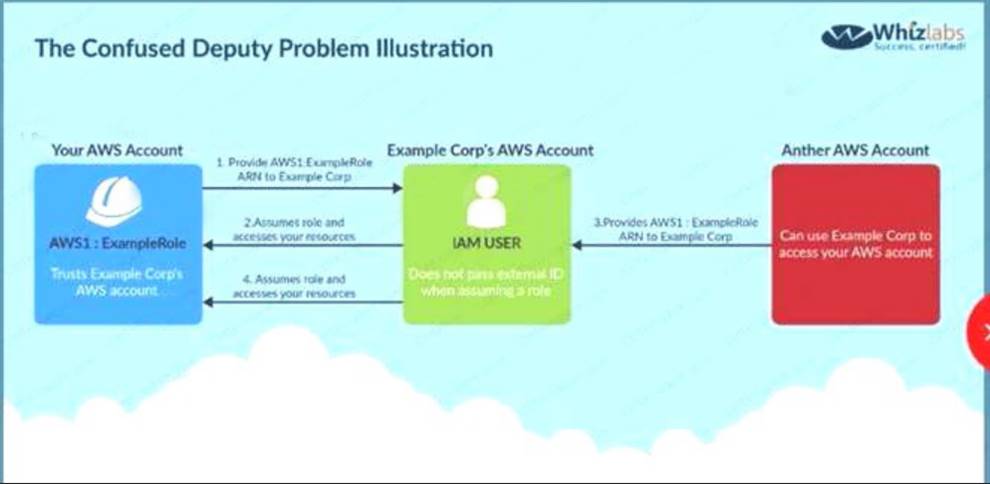
For more information on creating roles for external ID'S please visit the following URL:
The correct answers are: Ensure an 1AM role is created which can be assumed by the partner account. Ensure the partner uses an external id when making the request Provide the ARN for the role to the partner account
Submit your Feedback/Queries to our Experts
NEW QUESTION 21
You need to inspect the running processes on an EC2 Instance that may have a security issue. How can you achieve this in the easiest way possible. Also you need to ensure that the process does not interfere with the continuous running of the instance.
Please select:
- A. Use AWS Cloudtrail to record the processes running on the server to an S3 bucket.
- B. Use AWS Cloudwatch to record the processes running on the server
- C. Use the SSM Run command to send the list of running processes information to an S3 bucket.
- D. Use AWS Config to see the changed process information on the server
Answer: C
Explanation:
The SSM Run command can be used to send OS specific commands to an Instance. Here you can check and see the running processes on an instance and then send the output to an S3 bucket.
Option A is invalid because this is used to record API activity and cannot be used to record running processes. Option B is invalid because Cloudwatch is a logging and metric service and cannot be used to record running processes.
Option D is invalid because AWS Config is a configuration service and cannot be used to record running processes.
For more information on the Systems Manager Run command, please visit the following URL:
https://docs.aws.amazon.com/systems-manaEer/latest/usereuide/execute-remote-commands.htmll
The correct answer is: Use the SSM Run command to send the list of running processes information to an S3 bucket. Submit your Feedback/Queries to our Experts
NEW QUESTION 22
Your company is planning on using AWS EC2 and ELB for deployment for their web applications. The security policy mandates that all traffic should be encrypted. Which of the following options will ensure that this requirement is met. Choose 2 answers from the options below.
Please select:
- A. Ensure the load balancer listens on port 80
- B. Ensure the load balancer listens on port 443
- C. Ensure the HTTPS listener sends requests to the instances on port 443
- D. Ensure the HTTPS listener sends requests to the instances on port 80
Answer: BC
Explanation:
The AWS Documentation mentions the following
You can create a load balancer that listens on both the HTTP (80) and HTTPS (443) ports. If you specify that the HTTPS listener sends requests to the instances on port 80, the load balancer terminates the requests and communication from the load balancer to the instances is not encrypted, if the HTTPS listener sends requests to the instances on port 443, communication from the load balancer to the instances is encrypted.
Option A is invalid because there is a need for secure traffic, so port 80 should not be used Option D is invalid because for the HTTPS listener you need to use port 443
For more information on HTTPS with ELB, please refer to the below Link: https://docs.aws.amazon.com/elasticloadbalancing/latest/classic/elb-create-https-ssl-load-balancer.htmll
The correct answers are: Ensure the load balancer listens on port 443, Ensure the HTTPS listener sends requests to the instances on port 443
Submit your Feedback/Queries to our Experts
NEW QUESTION 23
Which of the following is not a best practice for carrying out a security audit? Please select:
- A. Conduct an audit on a yearly basis
- B. Conduct an audit if application instances have been added to your account
- C. Conduct an audit if you ever suspect that an unauthorized person might have accessed your account
- D. Whenever there are changes in your organization
Answer: A
Explanation:
A year's time is generally too long a gap for conducting security audits The AWS Documentation mentions the following
You should audit your security configuration in the following situations: On a periodic basis.
If there are changes in your organization, such as people leaving.
If you have stopped using one or more individual AWS services. This is important for removing permissions that users in your account no longer need.
If you've added or removed software in your accounts, such as applications on Amazon EC2 instances, AWS OpsWor stacks, AWS CloudFormation templates, etc.
If you ever suspect that an unauthorized person might have accessed your account.
Option B, C and D are all the right ways and recommended best practices when it comes to conducting audits For more information on Security Audit guideline, please visit the below URL:
https://docs.aws.amazon.com/eeneral/latest/gr/aws-security-audit-euide.html
The correct answer is: Conduct an audit on a yearly basis Submit your Feedback/Queries to our Experts
NEW QUESTION 24
A company wants to have an Intrusion detection system available for their VPC in AWS. They want to have complete control over the system. Which of the following would be ideal to implement?
Please select:
- A. Use AWS WAF to catch all intrusions occurring on the systems in the VPC
- B. Use a custom solution available in the AWS Marketplace
- C. Use VPC Flow logs to detect the issues and flag them accordingly.
- D. Use AWS Cloudwatch to monitor all traffic
Answer: B
Explanation:
Sometimes companies want to have custom solutions in place for monitoring Intrusions to their systems. In such a case, you can use the AWS Marketplace for looking at custom solutions.
C:UserswkDesktopmudassarUntitled.jpg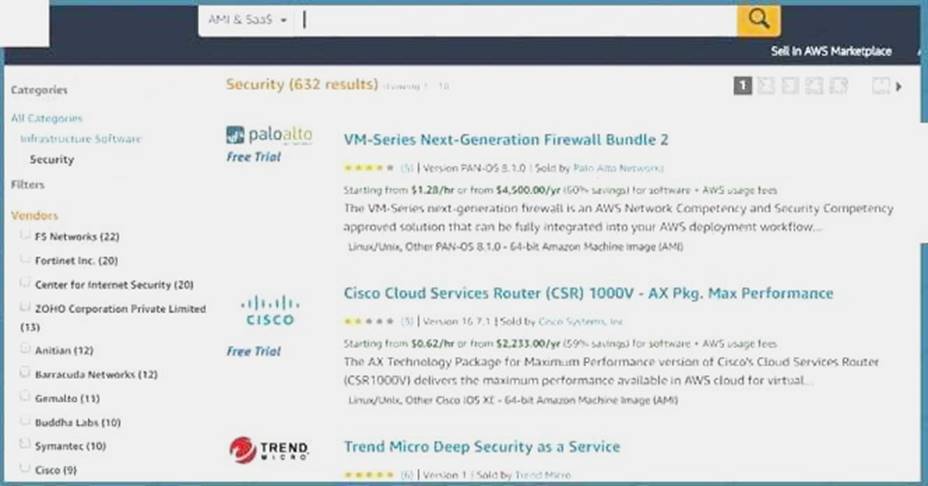
Option A.C and D are all invalid because they cannot be used to conduct intrusion detection or prevention. For more information on using custom security solutions please visit the below URL https://d1.awsstatic.com/Marketplace/security/AWSMP_Security_Solution%200verview.pdf
For more information on using custom security solutions please visit the below URL: https://d1 .awsstatic.com/Marketplace/security/AWSMP Security Solution%20Overview.pd1
The correct answer is: Use a custom solution available in the AWS Marketplace Submit your Feedback/Queries to our Experts
NEW QUESTION 25
You are planning on hosting a web application on AWS. You create an EC2 Instance in a public subnet. This instance needs to connect to an EC2 Instance that will host an Oracle database. Which of the following steps should be followed to ensure a secure setup is in place? Select 2 answers.
Please select:
- A. Place the EC2 Instance with the Oracle database in the same public subnet as the Web server for faster communication
- B. Place the EC2 Instance with the Oracle database in a separate private subnet
- C. Create a database security group and ensure the web security group to allowed incoming access
- D. Ensure the database security group allows incoming traffic from 0.0.0.0/0
Answer: BC
Explanation:
The best secure option is to place the database in a private subnet. The below diagram from the AWS Documentation shows this setup. Also ensure that access is not allowed from all sources but just from the web servers.
C:UserswkDesktopmudassarUntitled.jpg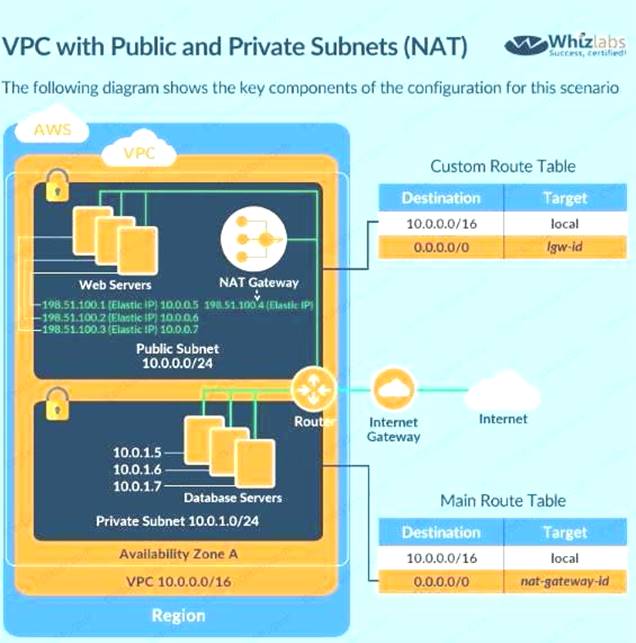
Option A is invalid because databases should not be placed in the public subnet
Option D is invalid because the database security group should not allow traffic from the internet For more information on this type of setup, please refer to the below URL:
https://docs.aws.amazon.com/AmazonVPC/latest/UserGuideA/PC Scenario2.
The correct answers are: Place the EC2 Instance with the Oracle database in a separate private subnet Create a database security group and ensure the web security group to allowed incoming access
Submit your Feedback/Queries to our Experts
NEW QUESTION 26
What is the result of the following bucket policy?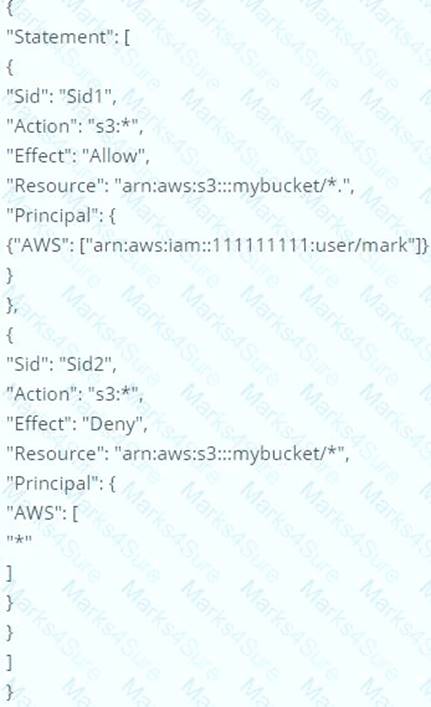
Choose the correct answer
Please select:
- A. It will allow all access to the bucket mybucket
- B. It will allow the user mark from AWS account number 111111111 all access to the bucket but deny everyone else all access to the bucket
- C. It will deny all access to the bucket mybucket
- D. None of these
Answer: C
Explanation:
The policy consists of 2 statements, one is the allow for the user mark to the bucket and the next is the deny
policy for all other users. The deny permission will override the allow and hence all users will not have access to the bucket.
Options A,B and D are all invalid because this policy is used to deny all access to the bucket mybucket For examples on S3 bucket policies, please refer to the below Link: http://docs.aws.amazon.com/AmazonS3/latest/dev/example-bucket-policies.htmll
The correct answer is: It will deny all access to the bucket mybucket Submit your FeedbacK/Quenes to our Experts
NEW QUESTION 27
Which of the following is used as a secure way to log into an EC2 Linux Instance? Please select:
- A. 1AM User name and password
- B. Key pairs
- C. AWS Access keys
- D. AWS SDK keys
Answer: B
Explanation:
The AWS Documentation mentions the following
Key pairs consist of a public key and a private key. You use the private key to create a digital signature, and then AWS uses the corresponding public key to validate the signature. Key pairs are used only for Amazon EC2 and Amazon CloudFront.
Option A.C and D are all wrong because these are not used to log into EC2 Linux Instances For more information on AWS Security credentials, please visit the below URL: https://docs.aws.amazon.com/eeneral/latest/er/aws-sec-cred-types.html
The correct answer is: Key pairs
Submit your Feedback/Queries to our Experts
NEW QUESTION 28
A large organization is planning on AWS to host their resources. They have a number of autonomous departments that wish to use AWS. What could be the strategy to adopt for managing the accounts.
Please select:
- A. Use multiple VPCs in the account each VPC for each department
- B. Use multiple 1AM groups, each group for each department
- C. Use multiple 1AM roles, each group for each department
- D. Use multiple AWS accounts, each account for each department
Answer: D
Explanation:
A recommendation for this is given in the AWS Security best practices C:UserswkDesktopmudassarUntitled.jpg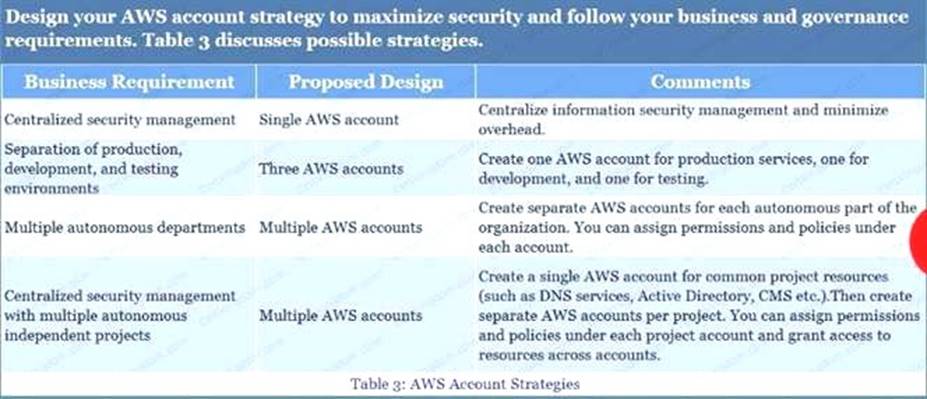
Option A is incorrect since this would be applicable for resources in a VPC Options B and C are incorrect since operationally it would be difficult to manage For more information on AWS Security best practices please refer to the below URL
https://d1.awsstatic.com/whitepapers/Security/AWS Security Best Practices.pdl
The correct answer is: Use multiple AWS accounts, each account for each department Submit your Feedback/Queries to our Experts
NEW QUESTION 29
You have been given a new brief from your supervisor for a client who needs a web application set up on AWS. The a most important requirement is that MySQL must be used as the database, and this database must not be hosted in t« public cloud, but rather at the client's data center due to security risks. Which of the following solutions would be the ^ best to assure that the client's requirements are met? Choose the correct answer from the options below
Please select:
- A. Build the application server on a public subnet and the database at the client's data cente
- B. Connect them with a VPN connection which uses IPsec.
- C. Use the public subnet for the application server and use RDS with a storage gateway to access and synchronize the data securely from the local data center.
- D. Build the application server on a public subnet and the database on a private subnet with a NAT instance between them.
- E. Build the application server on a public subnet and build the database in a private subnet with a secure ssh connection to the private subnet from the client's data center.
Answer: A
Explanation:
Since the database should not be hosted on the cloud all other options are invalid. The best option is to create a VPN connection for securing traffic as shown below. C:UserswkDesktopmudassarUntitled.jpg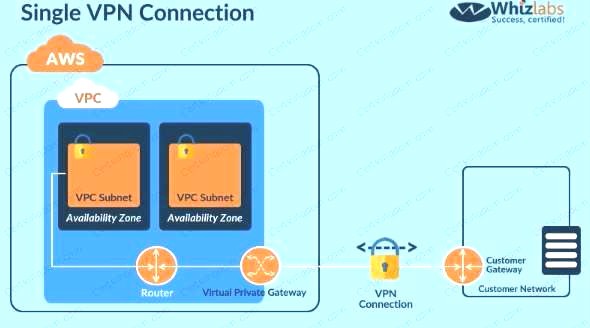
Option B is invalid because this is the incorrect use of the Storage gateway Option C is invalid since this is the incorrect use of the NAT instance Option D is invalid since this is an incorrect configuration For more information on VPN connections, please visit the below URL
http://docs.aws.amazon.com/AmazonVPC/latest/UserGuide/VPC_VPN.htmll
The correct answer is: Build the application server on a public subnet and the database at the client's data center. Connect them with a VPN connection which uses IPsec
Submit your Feedback/Queries to our Experts
NEW QUESTION 30
An organization is using AWS CloudTrail, Amazon CloudWatch Logs, and Amazon CloudWatch to send alerts when new access keys are created. However, the alerts are no longer appearing in the Security Operations mail box.
Which of the following actions would resolve this issue?
- A. In CloudTrail, verify that the trail logging bucket has a log prefix configured.
- B. In Amazon SNS, determine whether the “Account spend limit” has been reached for this alert.
- C. In SNS, ensure that the subscription used by these alerts has not been deleted.
- D. In CloudWatch, verify that the alarm threshold “consecutive periods” value is equal to, or greater than 1.
Answer: B
NEW QUESTION 31
......
Thanks for reading the newest SCS-C01 exam dumps! We recommend you to try the PREMIUM Certshared SCS-C01 dumps in VCE and PDF here: https://www.certshared.com/exam/SCS-C01/ (330 Q&As Dumps)