Approved of CAS-003 free practice questions materials and free practice exam for CompTIA certification for IT engineers, Real Success Guaranteed with Updated CAS-003 pdf dumps vce Materials. 100% PASS CompTIA Advanced Security Practitioner (CASP) exam Today!
Online CompTIA CAS-003 free dumps demo Below:
NEW QUESTION 1
A security manager for a service provider has approved two vendors for connections to the service provider backbone. One vendor will be providing authentication services for its payment card service, and the other vendor will be providing maintenance to the service provider infrastructure sites. Which of the following business agreements is MOST relevant to the vendors and service provider’s relationship?
- A. Memorandum of Agreement
- B. Interconnection Security Agreement
- C. Non-Disclosure Agreement
- D. Operating Level Agreement
Answer: B
Explanation:
The Interconnection Security Agreement (ISA) is a document that identifies the requirements for connecting systems and networks and details what security controls are to be used to protect the systems and sensitive data.
Incorrect Answers:
A: A memorandum of agreement (MOA) is a document composed between parties to cooperate on an agreed upon project or meet an agreed objective.
C: A nondisclosure agreement (NDA) is designed to protect confidential information.
D: An operating level agreement (OLA) defines the responsibilities of each partner's internal support group.
References:
Gregg, Michael, and Billy Haines, CASP CompTIA Advanced Security Practitioner Study Guide, John Wiley & Sons, Indianapolis, 2012, pp. 237, 238
NEW QUESTION 2
A software development manager is running a project using agile development methods. The company cybersecurity engineer has noticed a high number of vulnerabilities have been making it into production code on the project.
Which of the following methods could be used in addition to an integrated development environment to reduce the severity of the issue?
- A. Conduct a penetration test on each function as it is developed
- B. Develop a set of basic checks for common coding errors
- C. Adopt a waterfall method of software development
- D. Implement unit tests that incorporate static code analyzers
Answer: D
NEW QUESTION 3
A multi-national company has a highly mobile workforce and minimal IT infrastructure. The company utilizes a BYOD and social media policy to integrate presence technology into global collaboration tools by individuals and teams. As a result of the dispersed employees and frequent international travel, the company is concerned about the safety of employees and their families when moving in and out of certain countries. Which of the following could the company view as a downside of using presence technology?
- A. Insider threat
- B. Network reconnaissance
- C. Physical security
- D. Industrial espionage
Answer: C
Explanation:
If all company users worked in the same office with one corporate network and using company supplied laptops, then it is easy to implement all sorts of physical security controls. Examples of physical security include intrusion detection systems, fire protection systems, surveillance cameras or simply a lock on the office door.
However, in this question we have dispersed employees using their own devices and frequently traveling internationally. This makes it extremely difficult to implement any kind of physical security. Physical security is the protection of personnel, hardware, programs, networks, and data from physical circumstances and events that could cause serious losses or damage to an enterprise,
agency, or institution. This includes protection from fire, natural disasters, burglary, theft, vandalism, and terrorism.
Incorrect Answers:
A: An insider threat is a malicious hacker (also called a cracker or a black hat) who is an employee or officer of a business, institution, or agency. Dispersed employees using presence technology does not increase the risk of insider threat when compared to employees working together in an office.
B: The risk of network reconnaissance is reduced by having dispersed employees using presence technology. The risk of network reconnaissance would be higher with employees working together in a single location such as an office.
D: Industrial espionage is a threat to any business whose livelihood depends on information. However, this threat is not increased by having dispersed employees using presence technology. The risk would be the same with dispersed employees using presence technology or employees working together in a single location such as an office.
References: http://searchsecurity.techtarget.com/deHYPERLINK
"http://searchsecurity.techtarget.com/definition/physical-security"finition/physical-security
NEW QUESTION 4
Joe, a penetration tester, is tasked with testing the security robustness of the protocol between a mobile web application and a RESTful application server. Which of the following security tools would be required to assess the security between the mobile web application and the RESTful application server? (Select TWO).
- A. Jailbroken mobile device
- B. Reconnaissance tools
- C. Network enumerator
- D. HTTP interceptor
- E. Vulnerability scanner
- F. Password cracker
Answer: DE
Explanation:
Communications between a mobile web application and a RESTful application server will use the
HTTP protocol. To capture the HTTP communications for analysis, you should use an HTTP Interceptor.
To assess the security of the application server itself, you should use a vulnerability scanner.
A vulnerability scan is the automated process of proactively identifying security vulnerabilities of computing systems in a network in order to determine if and where a system can be explogted and/or threatened. While public servers are important for communication and data transfer over the Internet, they open the door to potential security breaches by threat agents, such as malicious hackers.
Vulnerability scanning employs software that seeks out security flaws based on a database of known flaws, testing systems for the occurrence of these flaws and generating a report of the findings that an individual or an enterprise can use to tighten the network's security.
Vulnerability scanning typically refers to the scanning of systems that are connected to the Internet but can also refer to system audits on internal networks that are not connected to the Internet in order to assess the threat of rogue software or malicious employees in an enterprise.
Incorrect Answers:
A: A jailbroken mobile device is a mobile device with an operating system that has any built-in security restrictions removed. This enables you to install software and perform actions that the manufacturer did not intend. However, a jailbroken mobile device is not a suitable security tool to assess the security between the mobile web application and the RESTful application server.
B: Reconnaissance in terms of IT security is the process of learning as much as possible about a target business usually over a long period of time with a view to discovering security flaws. It is not used by security administrators for security assessment of client-server applications.
C: Network enumeration is a computing activity in which usernames and info on groups, shares, and services of networked computers are retrieved. It is not used to assess the security between the mobile web application and the RESTful application server.
F: A password cracker is used to guess passwords. It is not a suitable security tool to assess the security between the mobile web application and the RESTful application server.
References: http://www.webopedia.com/TERM/V/vulneHYPERLINK
"http://www.webopedia.com/TERM/V/vulnerability_scanning.html"rability_scanning.html
NEW QUESTION 5
A systems administrator recently joined an organization and has been asked to perform a security assessment of controls on the organization’s file servers, which contain client data from a number of sensitive systems. The administrator needs to compare documented access requirements to the access implemented within the file system.
Which of the following is MOST likely to be reviewed during the assessment? (Select two.)
- A. Access control list
- B. Security requirements traceability matrix
- C. Data owner matrix
- D. Roles matrix
- E. Data design document
- F. Data access policies
Answer: DF
NEW QUESTION 6
The security administrator finds unauthorized tables and records, which were not present before, on a Linux database server. The database server communicates only with one web server, which connects to the database server via an account with SELECT only privileges. Web server logs show
the following:
90.76.165.40 – - [08/Mar/2014:10:54:04] “GET calendar.php?create%20table%20hidden HTTP/1.1” 200 5724
90.76.165.40 – - [08/Mar/2014:10:54:05] “GET ../../../root/.bash_history HTTP/1.1” 200 5724 90.76.165.40 – - [08/Mar/2014:10:54:04] “GET index.php?user=<script>Create</script> HTTP/1.1” 200 5724
The security administrator also inspects the following file system locations on the database server using the command ‘ls -al /root’
drwxrwxrwx 11 root root 4096 Sep 28 22:45 .
drwxr-xr-x 25 root root 4096 Mar 8 09:30 ..
-rws------ 25 root root 4096 Mar 8 09:30 .bash_history
-rw------- 25 root root 4096 Mar 8 09:30 .bash_history
-rw------- 25 root root 4096 Mar 8 09:30 .profile
-rw------- 25 root root 4096 Mar 8 09:30 .ssh
Which of the following attacks was used to compromise the database server and what can the security administrator implement to detect such attacks in the future? (Select TWO).
- A. Privilege escalation
- B. Brute force attack
- C. SQL injection
- D. Cross-site scripting
- E. Using input validation, ensure the following characters are sanitized: <>
- F. Update crontab with: find / \( -perm -4000 \) –type f –print0 | xargs -0 ls –l | email.sh
- G. Implement the following PHP directive: $clean_user_input = addslashes($user_input)
- H. Set an account lockout policy
Answer: AF
Explanation:
This is an example of privilege escalation.
Privilege escalation is the act of explogting a bug, design flaw or configuration oversight in an operating system or software application to gain elevated access to resources that are normally protected from an application or user.
The question states that the web server communicates with the database server via an account with SELECT only privileges. However, the privileges listed include read, write and execute (rwx). This suggests the privileges have been ‘escalated’.
Now that we know the system has been attacked, we should investigate what was done to the system.
The command “Update crontab with: find / \( -perm -4000 \) –type f –print0 | xargs -0 ls –l | email.sh” is used to find all the files that are setuid enabled. Setuid means set user ID upon execution. If the setuid bit is turned on for a file, the user executing that executable file gets the permissions of the individual or group that owns the file.
Incorrect Answers:
B: A brute force attack is used to guess passwords. This is not an example of a brute force attack. C: SQL injection is a code injection technique, used to attack data-driven applications, in which malicious SQL statements are inserted into an entry field for execution (e.g. to dump the database contents to the attacker). This is not an example of a SQL Injection attack.
D: Cross-site scripting (XSS) is a type of computer security vulnerability typically found in Web
applications. XSS enables attackers to inject client-side script into Web pages viewed by other users. This is not an example of an XSS attack.
E: Sanitizing just the <> characters will not prevent such an attack. These characters should not be sanitized in a web application.
G: Adding slashes to the user input will not protect against the input; it will just add slashes to it.
H: An account lockout policy is useful to protect against password attacks. After a number of incorrect passwords, the account will lockout. However, the attack in this question is not a password attack so a lockout policy won’t help.
NEW QUESTION 7
An administrator is tasked with securing several website domains on a web server. The administrator elects to secure www.example.com, mail.example.org, archive.example.com, and www.example.org with the same certificate. Which of the following would allow the administrator to secure those domains with a single issued certificate?
- A. Intermediate Root Certificate
- B. Wildcard Certificate
- C. EV x509 Certificate
- D. Subject Alternative Names Certificate
Answer: D
Explanation:
Subject Alternative Names let you protect multiple host names with a single SSL certificate. Subject Alternative Names allow you to specify a list of host names to be protected by a single SSL certificate. When you order the certificate, you will specify one fully qualified domain name in the common name field. You can then add other names in the Subject Alternative Names field.
Incorrect Answers:
A: An Intermediate Root Certificate is used to trust an intermediate CA (Certification Authority). The Intermediate root CA can issue certificates but the Intermediate Root Certificate itself cannot be
used to secure multiple domains on a web server.
B: A wildcard certificate can be used to secure multiple domain names within the same higher level domain. For example: a wildcard certificate “*.example.com” can secure an unlimited number of domains that end in ‘example.com’ such as domain1.example.com, domain2.example.com etc. A wildcard certificate cannot be used to secure the domains listed in this question.
C: The certificate used to secure the domains will be an x509 certificate but it will not be a standard EV certificate. EV stands for extended validation. With a non-EV certificate, the issuing CA just ensures that you own the domains that you want to secure. With an EV certificate, further checks are carried out such as checks on your company. EV certificates take longer to issue due to the extra checks but the EV certificate provides extra guarantees to your customers that you are who you say you are. However, a standard EV certificate only secures a single domain.
NEW QUESTION 8
An organization is preparing to develop a business continuity plan. The organization is required to meet regulatory requirements relating to confidentiality and availability, which are well-defined. Management has expressed concern following initial meetings that the organization is not fully aware of the requirements associated with the regulations. Which of the following would be MOST appropriate for the project manager to solicit additional resources for during this phase of the project?
- A. After-action reports
- B. Gap assessment
- C. Security requirements traceability matrix
- D. Business impact assessment
- E. Risk analysis
Answer: B
NEW QUESTION 9
An organization is in the process of integrating its operational technology and information technology areas. As part of the integration, some of the cultural aspects it would like to see include more efficient use of resources during change windows, better protection of critical infrastructure, and the ability to respond to incidents. The following observations have been identified:
The ICS supplier has specified that any software installed will result in lack of support.
There is no documented trust boundary defined between the SCADA and corporate networks.
Operational technology staff have to manage the SCADA equipment via the engineering workstation. There is a lack of understanding of what is within the SCADA network.
Which of the following capabilities would BEST improve the security position?
- A. VNC, router, and HIPS
- B. SIEM, VPN, and firewall
- C. Proxy, VPN, and WAF
- D. IDS, NAC, and log monitoring
Answer: A
NEW QUESTION 10
Exhibit: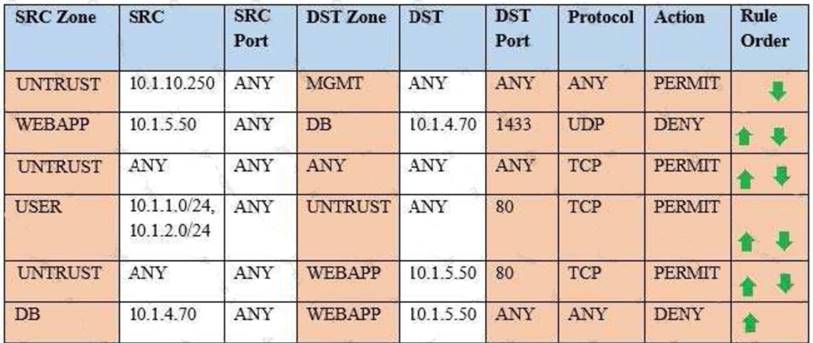
Compliance with company policy requires a quarterly review of firewall rules. You are asked to conduct a review on the internal firewall sitting between several internal networks. The intent of this firewall is to make traffic more secure. Given the following information perform the tasks listed below:
Untrusted zone: 0.0.0.0/0 User zone: USR 10.1.1.0/24 User zone: USR2 10.1.2.0/24 DB zone: 10.1.0/24
Web application zone: 10.1.5.0/24 Management zone: 10.1.10.0/24 Web server: 10.1.5.50
MS-SQL server: 10.1.4.70
MGMT platform: 10.1.10.250
Task 1) A rule was added to prevent the management platform from accessing the internet. This rule is not working. Identify the rule and correct this issue.
Task 2) The firewall must be configured so that the SQL server can only receive requests from the web server.
Task 3) The web server must be able to receive unencrypted requests from hosts inside and outside the corporate network.
Task 4) Ensure the final rule is an explicit deny.
Task 5) Currently the user zone can access internet websites over an unencrypted protocol. Modify a rule so that user access to websites is over secure protocols only.
Instructions: To perform the necessary tasks, please modify the DST port, SRC zone, Protocol, Action, and/or Rule Order columns. Type ANY to include all ports. Firewall ACLs are read from the top down.
Once you have met the simulation requirements, click Save. When you have completed the simulation, please select the Done button to submit. Once the simulation is submitted, please select the Next button to continue.
- A. Task 1: A rule was added to prevent the management platform from accessing the interne
- B. This rule is not workin
- C. Identify the rule and correct this issue.In Rule n
- D. 1 edit the Action to Deny to block internet access from the management platform.SRC Zone SRCSRC Port DST Zone DSTDST Port Protocol Action UNTRUST 10.1.10.250 ANY MGMT ANY ANY ANY DENYTask 2: The firewall must be configured so that the SQL server can only receive requests from the web server.In Rule n
- E. 6 from top, edit the Action to be Permi
- F. SRC ZoneSRCSRC Port DST Zone DSTDST Port Protocol Action DB 10.1.4.70 ANY WEBAPP 10.1.5.50 ANY ANY PERMITTask 3: The web server must be able to receive unencrypted requests from hosts inside and outside the corporate network.In rule n
- G. 5 from top, change the DST port to Any from 80 to allow all unencrypted traffi
- H. SRC ZoneSRCSRC Port DST Zone DSTDST Port Protocol Action UNTRUST ANYANY WEBAPP 10.1.5.50 ANY TCP PERMITTask 4: Ensure the final rule is an explicit denyEnter this at the bottom of the access list i.
- I. the line at the bottom of the rule: SRC ZoneSRCSRC Port DST Zone DSTDST Port Protocol Action ANY ANY ANY ANY ANY ANY TCP DENYTask 5: Currently the user zone can access internet websites over an unencrypted protoco
- J. Modify a rule so that user access to websites is over secure protocols only.In Rule number 4 from top, edit the DST port to 443 from 80 SRC ZoneSRCSRC Port DST Zone DSTDST Port Protocol Action USER10.1.1.0/24 10.1.2.0/24ANY UNTRUST ANY443TCP PERMIT
- K. Task 1: A rule was added to prevent the management platform from accessing the interne
- L. This rule is not workin
- M. Identify the rule and correct this issue.In Rule n
- N. 1 edit the Action to Deny to block internet access from the management platfor
- O. SRC ZoneSRCSRC Port DST Zone DSTDST Port Protocol Action UNTRUST 10.1.10.250 ANY MGMT ANY ANY ANY DENYTask 2: The firewall must be configured so that the SQL server can only receive requests from the web server.In Rule n
- P. 6 from top, edit the Action to be Permi
- Q. SRC ZoneSRCSRC Port DST Zone DSTDST Port Protocol Action DB 10.1.4.70 ANY WEBAPP 10.1.5.50 ANY ANY PERMITTask 3: The web server must be able to receive unencrypted requests from hosts inside and outside the corporate network.In rule n
- R. 5 from top, change the DST port to Any from 80 to allow all unencrypted traffi
- S. SRC ZoneANY ANY ANY TCP DENYTask 5: Currently the user zone can access internet websites over an unencrypted protoco
- T. Modify a rule so that user access to websites is over secure protocols only.In Rule number 4 from top, edit the DST port to 443 from 80 SRC ZoneSRCSRC PortDST Zone DSTDST Port Protocol Action USER10.1.1.0/24 10.1.2.0/24ANY UNTRUST ANY443TCP PERMIT
Answer: A
NEW QUESTION 11
A new cluster of virtual servers has been set up in a lab environment and must be audited before being allowed on the production network. The security manager needs to ensure unnecessary services are disabled and all system accounts are using strong credentials. Which of the following tools should be used? (Choose two.)
- A. Fuzzer
- B. SCAP scanner
- C. Packet analyzer
- D. Password cracker
- E. Network enumerator
- F. SIEM
Answer: BF
NEW QUESTION 12
An organization is currently working with a client to migrate data between a legacy ERP system and a cloud-based ERP tool using a global PaaS provider. As part of the engagement, the organization is
performing data deduplication and sanitization of client data to ensure compliance with regulatory requirements. Which of the following is the MOST likely reason for the need to sanitize the client data?
- A. Data aggregation
- B. Data sovereignty
- C. Data isolation
- D. Data volume
- E. Data analytics
Answer: A
NEW QUESTION 13
Providers at a healthcare system with many geographically dispersed clinics have been fined five times this year after an auditor received notice of the following SMS messages: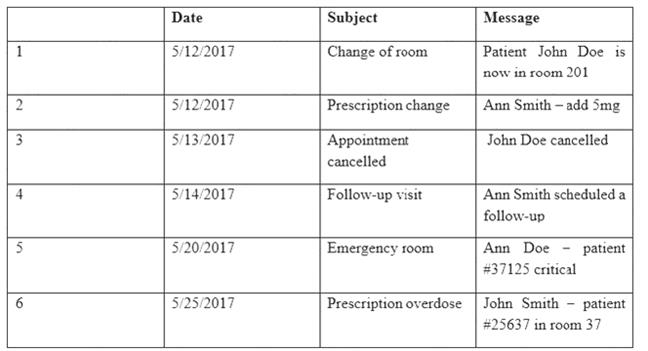
Which of the following represents the BEST solution for preventing future files?
- A. Implement a secure text-messaging application for mobile devices and workstations.
- B. Write a policy requiring this information to be given over the phone only.
- C. Provide a courier service to deliver sealed documents containing public health informatics.
- D. Implement FTP services between clinics to transmit text documents with the information.
- E. Implement a system that will tokenize patient number
Answer: A
NEW QUESTION 14
An organization uses IP address block 203.0.113.0/24 on its internal network. At the border router, the network administrator sets up rules to deny packets with a source address in this subnet from entering the network, and to deny packets with a destination address in this subnet from leaving the network. Which of the following is the administrator attempting to prevent?
- A. BGP route hijacking attacks
- B. Bogon IP network traffic
- C. IP spoofing attacks
- D. Man-in-the-middle attacks
- E. Amplified DDoS attacks
Answer: C
Explanation:
The IP address block 203.0.113.0/24 is used on the internal network. Therefore, there should be no traffic coming into the network claiming to be from an address in the 203.0.113.0/24 range. Similarly, there should be no outbound traffic destined for an address in the 203.0.113.0/24 range. So this has been blocked at the firewall. This is to protect against IP spoofing attacks where an attacker external to the network sends data claiming to be from an internal computer with an address in the 203.0.113.0/24 range.
IP spoofing, also known as IP address forgery or a host file hijack, is a hijacking technique in which a cracker masquerades as a trusted host to conceal his identity, spoof a Web site, hijack browsers, or
gain access to a network. Here's how it works: The hijacker obtains the IP address of a legitimate host and alters packet headers so that the legitimate host appears to be the source.
When IP spoofing is used to hijack a browser, a visitor who types in the URL (Uniform Resource Locator) of a legitimate site is taken to a fraudulent Web page created by the hijacker. For example, if the hijacker spoofed the Library of Congress Web site, then any Internet user who typed in the URL www.loc.gov would see spoofed content created by the hijacker.
If a user interacts with dynamic content on a spoofed page, the hijacker can gain access to sensitive information or computer or network resources. He could steal or alter sensitive data, such as a credit card number or password, or install malware. The hijacker would also be able to take control of a compromised computer to use it as part of a zombie army in order to send out spam.
Incorrect Answers:
A: BGP is a protocol used to exchange routing information between networks on the Internet. BGP route hijacking is the process of using BGP to manipulate Internet routing paths. The firewall configuration in this question will not protect against BGP route hijacking attacks.
B: Bogon is an informal name for an IP packet on the public Internet that claims to be from an area of the IP address space reserved, but not yet allocated or delegated by the Internet Assigned Numbers Authority (IANA) or a delegated Regional Internet Registry (RIR). The firewall configuration in this question will not protect against Bogon IP network traffic.
D: A man-in-the-middle attack is an attack where the attacker secretly relays and possibly alters the communication between two parties who believe they are directly communicating with each other. The firewall configuration in this question will not protect against a man-in-the-middle attack.
E: A distributed denial-of-service (DDoS) attack occurs when multiple systems flood the bandwidth or resources of a targeted system, usually one or more web servers. Amplified DDoS attacks use more systems to ‘amplify’ the attack. The firewall configuration in this question will not protect against a DDoS attack.
References:
http://searchsecurity.techtargHYPERLINK "http://searchsecurity.techtarget.com/definition/IPspoofing" et.com/definition/IP-spoofing
NEW QUESTION 15
A company is developing requirements for a customized OS build that will be used in an embedded environment. The company procured hardware that is capable of reducing the likelihood of successful buffer overruns while executables are processing. Which of the following capabilities must be included for the OS to take advantage of this critical hardware-based countermeasure?
- A. Application whitelisting
- B. NX/XN bit
- C. ASLR
- D. TrustZone
- E. SCP
Answer: B
NEW QUESTION 16
There have been some failures of the company’s internal facing website. A security engineer has found the WAF to be the root cause of the failures. System logs show that the WAF has been unavailable for 14 hours over the past month, in four separate situations. One of these situations was a two hour scheduled maintenance time, aimed at improving the stability of the WAF. Using the MTTR based on the last month’s performance figures, which of the following calculations is the percentage of uptime assuming there were 722 hours in the month?
- A. 92.24 percent
- B. 98.06 percent
- C. 98.34 percent
- D. 99.72 percent
Answer: B
Explanation:
A web application firewall (WAF) is an appliance, server plugin, or filter that applies a set of rules to an HTTP conversation. Generally, these rules cover common attacks such as cross-site scripting (XSS) and SQL injection. By customizing the rules to your application, many attacks can be identified and blocked.
14h of down time in a period of 772 supposed uptime = 14/772 x 100 = 1.939 % Thus the % of uptime = 100% - 1.939% = 98.06%
References:
Gregg, Michael, and Billy Haines, CASP CompTIA Advanced Security Practitioner Study Guide, John Wiley & Sons, Indianapolis, 2012, pp. 43, 116
NEW QUESTION 17
An assessor identifies automated methods for identifying security control compliance through validating sensors at the endpoint and at Tier 2. Which of the following practices satisfy continuous monitoring of authorized information systems?
- A. Independent verification and validation
- B. Security test and evaluation
- C. Risk assessment
- D. Ongoing authorization
Answer: D
Explanation:
Ongoing assessment and authorization is often referred to as continuous monitoring. It is a process
that determines whether the set of deployed security controls in an information system continue to be effective with regards to planned and unplanned changes that occur in the system and its environment over time.
Continuous monitoring allows organizations to evaluate the operating effectiveness of controls on or near a real-time basis. Continuous monitoring enables the enterprise to detect control failures quickly because it transpires immediately or closely after events in which the key controls are utilized.
Incorrect Answers:
A: Independent verification and validation (IV&V) is executed by a third party organization not involved in the development of a product. This is not considered continuous monitoring of authorized information systems.
B: Security test and evaluation is not considered continuous monitoring of authorized information systems.
C: Risk assessment is the identification of potential risks and threats. It is not considered continuous monitoring of authorized information systems.
References:
http://www.fedramp.net/ongoHYPERLINK "http://www.fedramp.net/ongoing-assessment-andauthorization- continuous-monitoring"ing-assessment-andHYPERLINK
"http://www.fedramp.net/ongoing-assessment-and-authorization-continuous-monitoring"- authorization-continuous-monitoring https://www.techopedia.com/definition/24836/independent-verification-and-validation--
iHYPERLINK "https://www.techopedia.com/definition/24836/independent-verification-andvalidation-- iv&v"vHYPERLINK "https://www.techopedia.com/definition/24836/independentverification-
and-validation--iv&v"&HYPERLINK "https://www.techopedia.com/definition/24836/independent-verification-and-validation--iv&v"v
Gregg, Michael, and Billy Haines, CASP CompTIA Advanced Security Practitioner Study Guide, John Wiley & Sons, Indianapolis, 2012, pp. 213, 219
NEW QUESTION 18
......
100% Valid and Newest Version CAS-003 Questions & Answers shared by DumpSolutions.com, Get Full Dumps HERE: https://www.dumpsolutions.com/CAS-003-dumps/ (New 555 Q&As)