Your success in Juniper JN0-104 is our sole target and we develop all our JN0-104 braindumps in a way that facilitates the attainment of this target. Not only is our JN0-104 study material the best you can find, it is also the most detailed and the most updated. JN0-104 Practice Exams for Juniper JN0-104 are written to the highest standards of technical accuracy.
Also have JN0-104 free dumps questions for you:
NEW QUESTION 1
Click the Exhibit button.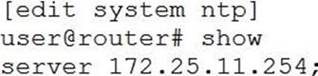
Referring to the exhibit, which action would synchronize the local router’s clock with the NTP server?
- A. Configure the correct NTP trusted key using the net trusted-key <key-value> configuration command under the [edit system ntp] hierarchy.
- B. Issue the set date ntp operational command.
- C. Configure the NTP server using the set boot-server 172.25.11.254 configuration command under the [edit system ntp] hierarchy.
- D. Reboot the router.
Answer: B
NEW QUESTION 2
Which keystroke is used to auto-complete user-defined variables?
- A. Spacebar
- B. Home
- C. Esc
- D. Tab
Answer: D
NEW QUESTION 3
You have configuration groups applied on your router.
Which command would you use to see all components of the interface hierarchy?
- A. show configuration interfaces | display detail
- B. show configuration interfaces | display changed
- C. show configuration interfaces | display set
- D. show configuration interfaces | display inheritance
Answer: D
NEW QUESTION 4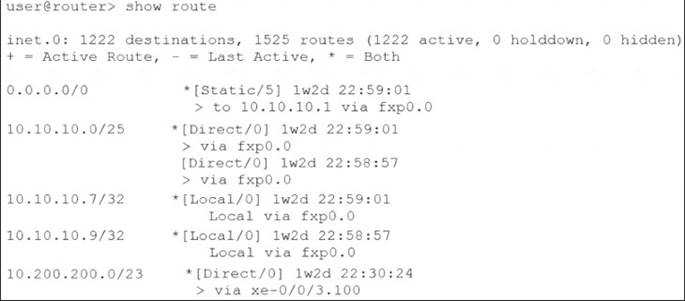
What does the number inside the square bracket represent?
- A. Metric
- B. Local preference
- C. Protocol reference number
- D. Route preference
Answer: D
Explanation:
https://www.juniper.net/documentation/us/en/software/junos/bgp/topics/ref/command/show-route.html#show-ro Module 9 of Juniper Open Learning, Routing Fundamentals describes the [Source/Route Preference]. The metric is 'how' a protocol calculates the best path to a destination. RIP = Hops, OSPF = Cost. Metrics are unique to protocols.
user@host> show route
inet.0: 11 destinations, 12 routes (11 active, 0 holddown, 0 hidden)
+ = Active Route, - = Last Active, * = Both 1:65500:1:10.0.0.20/240
*[MVPN/70] 19:53:41, metric2 1
Indirect
1:65500:1:10.0.0.40/240
*[BGP/170] 19:53:29, localpref 100, from 10.0.0.30 AS path: I
> to 10.0.24.4 via lt-0/3/0.24, label-switched-path toD [BGP/170] 19:53:26, localpref 100, from 10.0.0.33 AS path: I
> to 10.0.24.4 via lt-0/3/0.24, label-switched-path toD inside square brackets -> route preference
metric and localpref are optional and after the date
NEW QUESTION 5
Which CIDR notation is the equivalent of the subnet mask of 255.255.192.0?
- A. /19
- B. /18
- C. /20
- D. /17
Answer: B
NEW QUESTION 6
What is the purpose of the load merge command?
- A. to add or delete variables from the configuration based on the contents of a specified path file.
- B. to completely overwrite the current configuration with the configuration you load.
- C. to combine the current configuration with the configuration you load.
- D. to look for a replace tag in the configuration you load.
Answer: C
NEW QUESTION 7
What is the default route preference for OSPF internal?
- A. 100
- B. 150
- C. 5
- D. 10
Answer: D
NEW QUESTION 8
What is the maximum number of rollback files a Junos device can store?
- A. 5
- B. 10
- C. 49
- D. 50
Answer: D
NEW QUESTION 9
What are three interface prefixes for a 40-gigabit interface? (Choose three.)
- A. et
- B. es
- C. fte
- D. xe
- E. xle
Answer: ABE
NEW QUESTION 10
Click the Exhibit button.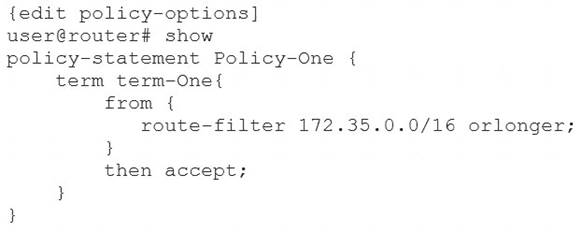
You configured the route filter shown in the exhibit.
In this scenario, which IP addresses would term-One accept?
- A. IP addresses that are part of the 172.35.0.0/16 network and IP addresses that are in the 172.35.0.0/16 and 172.36.0.0/16 subnets.
- B. IP addresses that are part of the 172.35.0.0/16 network only.
- C. IP addresses that are part of the 172.35.0.0/16 network and IP addresses that are in the subnets of 172.35.0.0/16 network.
- D. IP addresses that are part of the 172.35.0.0/16 network, but not IP addresses that are part of the 172.35.0.0/16 network itself.
Answer: C
NEW QUESTION 11
Which two statements describe a routing policy?
- A. Active and inactive routes are available for export from the routing table.
- B. A routing policy allows you to control the flow of information into the routing table.
- C. Routing policy are used to choose which routes are sent to neighbors using dynamic routing Protocols
- D. Attribute changes applied to export policies always affect the local routing table
Answer: BC
NEW QUESTION 12
What are two default password requirements on devices running Junos OS? (Choose two.)
- A. Passwords must be at least six characters in length.
- B. An expiration date must be set.
- C. Passwords must contain at least one special character.
- D. Alphanumeric characters classes must be used.
Answer: AD
NEW QUESTION 13
Which two statements describe the connection between control plane and the forwarding plane?
Choose Two
- A. No rate limiter is configured by default
- B. A rate limiter is configured by default
- C. Exception traffic is preferred over the control traffic during congestion
- D. Control traffic is preferred over the exception traffic during congestion
Answer: AD
NEW QUESTION 14
By default, which Junos directory contains the primary syslog file?
- A. /var/syslog
- B. /var/home
- C. /var/log
- D. /var/tmp
Answer: C
NEW QUESTION 15
Which command prompt indicates that you are in operational mode?
- A. user @ router &
- B. user @ router #
- C. user @ router $
- D. user @ router >
Answer: D
NEW QUESTION 16
Which parameter must be included when executing operational mode commands from within configuration mode?
- A. run
- B. prompt
- C. insert
- D. do
Answer: A
NEW QUESTION 17
......
Thanks for reading the newest JN0-104 exam dumps! We recommend you to try the PREMIUM Dumpscollection.com JN0-104 dumps in VCE and PDF here: https://www.dumpscollection.net/dumps/JN0-104/ (270 Q&As Dumps)