We offers . "Oracle Database 11g: Administration II", also known as 1Z0-053 exam, is a Oracle Certification. This set of posts, Passing the 1Z0-053 exam with , will help you answer those questions. The covers all the knowledge points of the real exam. 100% real and revised by experts!
Online 1Z0-053 free questions and answers of New Version:
NEW QUESTION 1
Over the course of a day, a department performed multiple DML statements (inserts, updates, deletes) on multiple rows of data in multiple tables. The manager would like a report showing the time, table name, and DML type for all changes that were made. Which Flashback technology would be the best choice to produce the list?
- A. Flashback Drop
- B. Flashback Query
- C. Flashback Transaction Query
- D. Flashback Versions Query
- E. Flashback Table
Answer: C
NEW QUESTION 2
Which type of backup contains only the blocks that have changed since the last level 0 incremental backup?
- A. a cumulative level 1 backup
- B. a differential level 1 backup
- C. a full backup
- D. a whole backup
Answer: A
NEW QUESTION 3
Your database instance is running. You are not able to access Oracle Enterprise Manager Database Control because the listener is not started.
Which tool or utility would you use to start the listener?
- A. Oracle Net Manager
- B. Listener Control utility
- C. Database Configuration Assistant
- D. Oracle Net Configuration Assistant
Answer: B
NEW QUESTION 4
You are working on the APPDB database as a DBA. The database has a default Flashback Data Archive DFLA1 created on it.
You issued the following command to drop the Flashback Archive FLA1: DROP FLASHBACK ARCHIVE fla1;
What is the effect of this command?
- A. The Flashback Archive FLA1 is dropped only if it is empty.
- B. The tablespace having Flashback Archive is dropped.
- C. The Flashback Archive FLA1 is dropped after moving the existing data in it to the default Flashback Archive.
- D. The Flashback Data Archive and historical data are dropped.
Answer: D
NEW QUESTION 5
When manually configuring the SGA, which of the following parameter changes requires an instance restart to take effect?
- A. DB_CACHE_SIZE
- B. SHARED_POOL_SIZE
- C. LARGE_POOL_SIZE
- D. JAVA_POOL_SIZE
- E. SGA_MAX_SIZE
- F. SORT_AREA_SIZE
Answer: E
NEW QUESTION 6
You are managing an Oracle Database 11g instance with ASM storage. You lost an ASM disk group DATA. You have RMAN backup of data as well as ASM metadata backup. You want to re-create the missing disk group by using the ASMCMD md_restore command.
Which of these methods would you use to achieve this? (Choose all that apply.)
- A. Restore the disk group with the exact configuration as the backed-up disk group, using the same disk group name, same set of disks, failure group configurations, and data on the disk group.
- B. Restore the disk group with the exact configuration as the backed-up disk group, using the same disk group name, same set of disks, and failure group configurations.
- C. Restore the disk group with changed disk group specification, failure group specification, disk group name, and other disk attributes.
- D. Restore metadata in an existing disk group by passing the existing disk group name as an input parameter.
Answer: BCD
Explanation: Purpose
The md_restore command restores disk groups from a metadata backup file.
Syntax and Description
md_restore backup_file [--silent]
[--full|--nodg|--newdg -o 'old_diskgroup:new_diskgroup [,...]'] [-S sql_script_file] [-G 'diskgroup [,diskgroup...]']
backup_file
Reads the metadata information from backup_file.
--silent
Ignore errors. Typically, if md_restore encounters an error, it stops. Specifying this flag ignores any errors.
--full
Specifies to create a disk group and restore metadata.
--nodg
Specifies to restore metadata only.
--newdg -o old_diskgroup:new_diskgroup]
Specifies to create a disk group with a different name when restoring metadata. The -o option is required with
--newdg.
-S sql_script_file
Write SQL commands to the specified SQL script file instead of executing the commands.
-G diskgroup
Select the disk groups to be restored. If no disk groups are defined, then all disk groups are restored.
NEW QUESTION 7
You issued the following command on the temporary tablespace LMTEMP in your database:
SQL>ALTER TABLESPACE lmtemp SHRINK SPACE KEEP 20M;
Which requirement must be fulfilled for this command to succeed?
- A. The tablespace must be locally managed.
- B. The tablespace must have only one temp file.
- C. The tablespace must be made nondefault and offline.
- D. The tablespace can remain as the default but must have no active sort operations.
Answer: A
NEW QUESTION 8
When you are performing a tablespace point-in-time recovery, which tablespaces will always be restored to the auxiliary instance? (Choose all that apply.)
- A. The SYSTEM tablespace.
- B. The UNDO tablespace.
- C. All tablespaces with tables.
- D. All tablespaces with indexes.
- E. No tablespaces are automatically restored.
Answer: AB
NEW QUESTION 9
Sales details are being stored on a daily basis in the SALES_2007 table. A large amount of data is added to the table daily. To save disk space, you issued the following command:
ALTER TABLE sales_2007 COMPRESS FOR ALL OPERATIONS;
What would be the outcome of this command?
- A. It produces an error because data already exists in the table.
- B. It produces an error because compression can be enabled at table creation only.
- C. It compresses all data added or modified henceforth but the existing data in the table is not compressed immediately.
- D. It immediately compresses all existing data as well as new data, resulting from eitherfresh additions or modifications to existing data.
Answer: C
NEW QUESTION 10
Which steps are mandatory to enable Direct NFS?
1. Mount all required file systems using the kernel NFS driver.
2. Create an oranfstab file containing the attributes for each NFS server to be accessed using Direct NFS.
3. Replace the ODM library libodm11.so_stub with libodm11.so.
- A. 2 and 3
- B. 1 and 3
- C. 1 and 2
- D. 1, 2 and 3
Answer: B
NEW QUESTION 11
Compressed backups work with which of the following commands?
- A. copy as backup
- B. backup as copy
- C. backup
- D. copy
Answer: C
Explanation: The backup compression only works with backup set, NONE of image copies can work with compression.
NEW QUESTION 12
Which statement is true about a Scheduler-generated event?
- A. It can be generated when a file arrives on the file system.
- B. it indicates state changes that occur within the Scheduler itself.
- C. it is raised by an application that is consumed by the Scheduler to start a job.
- D. it requires jobs to be defined with an event condition and a queue specification.
Answer: D
Explanation: Consuming Job State Events with your Application
To consume job state events, your application must subscribe to the Scheduler event queue
SYS.SCHEDULER$_EVENT_QUEUE. This queue is a secure queue and is owned by SYS. To create a subscription to this queue for a user, do the following:
1. Log in to the database as the SYS user or as a user with the MANAGE ANY QUEUE privilege.
2. Subscribe to the queue using a new or existing agent.
3. Run the package procedure DBMS_AQADM.ENABLE_DB_ACCESS as follows: DBMS_AQADM.ENABLE_DB_ACCESS(agent_name, db_username); where agent_name references the agent that you used to subscribe to the events queue, and db_username is the user for whom you want to create a subscription.
There is no need to grant dequeue privileges to the user. The dequeue privilege is granted
on the Scheduler event queue to PUBLIC.
NEW QUESTION 13
The NLS_SORT parameter sets the default sort method for which of the following operations? (Choose all that apply.)
- A. WHERE clause
- B. ORDER BY clause
- C. BETWEEN clause
- D. NLSSORT function
- E. NLS_SORT function
Answer: AD
NEW QUESTION 14
You plan to control the sessions performing a huge number of I/O operations. Your requirement is to kill the session when it exceeds a specified number of I/Os. Which statement describes a solution to the above?
- A. Set a threshold for the default system-defined moving window baseline.
- B. Add directives to the Automatic Database Diagnostic Monitor (ADDM).
- C. Modify the profile for the targeted users for which control needs to be imposed.
- D. Implement the database resource manager to add the SWITCH_IO_REQS and SWITCH_GROUP directives.
Answer: D
NEW QUESTION 15
You executed the following commands in a database session: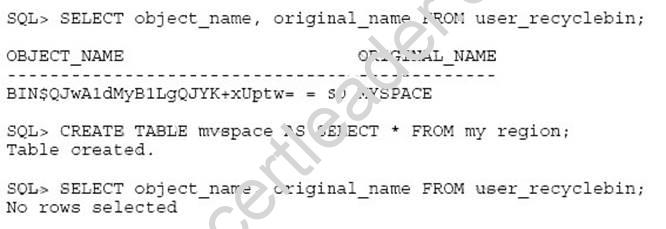
What could have caused the recycle bin to clean up?
- A. There is demand for space from the new table
- B. The undo tablespace does not have sufficient free space
- C. The new table name is the same as the table name in the recycle bin
- D. The temporary tablespace that is assigned to you does not have sufficient free space
Answer: A
NEW QUESTION 16
Which of the following is not a valid linguistic sort element?
- A. Accent expansion
- B. Canonical equivalence
- C. Reverse secondary sorting
- D. Ignorable characters
- E. Character rearrangement
Answer: A
NEW QUESTION 17
Which DBMS_RESOURCE_MANAGER procedure prioritizes consumer-group mappings?
- A. CREATE_MAPPING_PRIORITY
- B. SET_MAPPING_PRIORITY
- C. SET_MAPPING_ORDER
- D. PRIORITIZE_MAPPING_ORDER
- E. This functionality is not available through the DBMS_RESOURCE_MANAGER package.
Answer: B
NEW QUESTION 18
To enable resumable space allocation for the instance, which of the following initialization parameters should you set to a nonzero value?
- A. RESUMABLE_SPACE_TIME
- B. RESUMABLE_SPACE
- C. RESUMABLE_TIME
- D. RESUMABLE_TIMEOUT
- E. TIME_RESUMABLE
Answer: D
Thanks for reading the newest 1Z0-053 exam dumps! We recommend you to try the PREMIUM Dumpscollection 1Z0-053 dumps in VCE and PDF here: http://www.dumpscollection.net/dumps/1Z0-053/ (698 Q&As Dumps)