Proper study guides for 1Z0-053 Oracle Database 11g: Administration II certified begins with preparation products which designed to deliver the by making you pass the 1Z0-053 test at your first time. Try the free right now.
Online 1Z0-053 free questions and answers of New Version:
NEW QUESTION 1
Choose the correct order to package and upload data for an incident to Oracle Support.
- A. Schedule, create new package, view manifest, view contents
- B. Create new package, view manifest, view contents, schedule
- C. Schedule, create new package, view contents, view manifest
- D. Create new package, view contents, view manifest, schedule
- E. None of the above.
Answer: D
Explanation: 
C:UsersalboDesktop1-1.jpg
NEW QUESTION 2
Which of the following are correct about block media recovery? (Choose all that apply.)
- A. Physical and logical block corruption is recorded automatically in V$DATABASE_BLOCK_CORRUPTION.
- B. Logical corruptions are repairable by BMR.
- C. Physical corruptions are repairable by BMR.
- D. RMAN can use any backup for a BMR restore.
- E. ARCHIVELOG mode is not required if you have both a full and incremental backup for restore.
Answer: AC
Explanation: Overview of Block Media Recovery (link)
Basic Concepts of Block Media Recovery
Whenever block corruption has been automatically detected, you can perform block media recovery manually with the RECOVER ... BLOCK command. By default, RMAN first searches for good blocks in the real-time query physical standby database, then flashback logs and then blocks in full or level 0 incremental backups.
Identification of Corrupt Blocks
✑ The V$DATABASE_BLOCK_CORRUPTION view displays blocks marked corrupt by database components such as RMAN, ANALYZE, dbv, and SQL queries. The following types of corruption result in the addition of rows to this view: Physical corruption (sometimes called media corruption) The database does not recognize the block: the checksum is invalid, the block contains all zeros, or the block header is corrupt. Physical corruption checking is enabled by default. You can turn off checksum checking by specifying the NOCHECKSUM option of the BACKUP command, but other physical consistency checks, such as checks of the block headers and footers, cannot be disabled.
✑ Logical corruption:
The block has a valid checksum, the header and footer match, and so on, but the contents are logically inconsistent. Block media recovery may not be able to repair all logical block corruptions. In these cases, alternate recovery methods, such as tablespace point-in-time recovery, or dropping and re-creating the affected objects, may repair the corruption. Logical corruption checking is disabled by default. You can turn it on by specifying the CHECK LOGICAL option of the BACKUP, RESTORE, RECOVER, and VALIDATE
commands.
The database can detect some corruptions by validating relationships between blocks and segments, but cannot detect them by a check of an individual block. The V$DATABASE_BLOCK_CORRUPTION view does not record at this level of granularity. Prerequisites for Block Media Recovery (link)
The following prerequisites apply to the RECOVER ... BLOCK command:
✑ The target database must run in ARCHIVELOG mode and be open or mounted with a current control file.
✑ If the target database is a standby database, then it must be in a consistent state, recovery cannot be in session, and the backup must be older than the corrupted file.
✑ The backups of the data files containing the corrupt blocks must be full or level 0 backups and not proxy copies.
If only proxy copy backups exist, then you can restore them to a nondefault location on disk, in which case RMAN considers them data file copies and searches them for blocks during block media recovery.
✑ RMAN can use only archived redo logs for the recovery. RMAN cannot use level 1 incremental backups. Block media recovery cannot survive a missing or inaccessible archived redo log, although it can sometimes survive missing redo records.
✑ Flashback Database must be enabled on the target database for RMAN to search
the flashback logs for good copies of corrupt blocks.
If flashback logging is enabled and contains older, uncorrupted versions of the corrupt blocks, then RMAN can use these blocks, possibly speeding up the recovery.
✑ The target database must be associated with a real-time query physical standby
database for RMAN to search the database for good copies of corrupt blocks.
NEW QUESTION 3
What privileges must be granted to allow an account to create the recovery catalog? (Choose all that apply.)
- A. RECOVERY_CATALOG_OWNER
- B. DBA
- C. RESOURCE
- D. SELECT ANY DICTIONARY
- E. CONNECT
Answer: AC
NEW QUESTION 4
Which of the following are not disabled by default?
- A. Jobs
- B. Chains
- C. Windows
- D. Window groups
- E. Schedule
Answer: E
NEW QUESTION 5
The following databases are registered in the base recovery catalog: PROD1, PROD2, and PROD3.The database user CATOWNER owns the base recovery catalog. You want a new user VPC1 to have access to only the PROD1 database and create a virtual private catalog.
The RVPC user can do which of the following? (Choose all that apply.)
- A. Register databases if granted the register database privilege
- B. See all databases in the recovery-catalog schema
- C. See all database-related metadata in the recovery catalog if they are granted access to that database
- D. Unregister databases from the RVPC catalog that were not granted to the RVPC catalog owner with the grant command
- E. Not be connected to with the RMAN command-line catalog parameter for backup or recovery purposes
Answer: AC
NEW QUESTION 6
Which client requests to the database can be captured as a part of the workload capture? (Choose all that apply.)
- A. flashback query
- B. distributed transactions
- C. logging in and logging out of sessions
- D. all DDL statements having bind variables
- E. direct path load of data from external files
Answer: CD
NEW QUESTION 7
Which of the following is a benefit of ASM fast disk resync?
- A. Failed disks are taken offline immediately but are not dropped.
- B. Disk data is never lost.
- C. By default, the failed disk is not dropped from the disk group ever, protecting you from loss of that disk.
- D. The failed disk is automatically reformatted and then resynchronized to speed up the recovery process.
- E. Hot spare disks are automatically configured and added to the disk group.
Answer: A
Explanation: ASM Fast Mirror Resync
NEW QUESTION 8
You are performing incomplete recovery using RMAN. You execute the following RUN block:
RUN
{
SET UNTIL SCN 1107600; RESTORE DATABASE; RECOVER DATABASE;
}
Which statement is true about the result?
- A. RMAN restores all datafiles from the most recent backup available since the failure and applies the redo logs necessary to recover the database to SCN 1107600
- B. RMAN restores all datafiles needed to restore the database through SCN 1107599 and applies the redo logs necessary to recover the database through SCN 1107599.
- C. RMAN restores all datafiles and control files from the most recent backup
- D. The RUN block fails because you did not specify an UNTIL clause in your RECOVER DATABASE command
Answer: B
NEW QUESTION 9
The BOOKINGS table contains online booking information. When a booking is confirmed, the details are transferred to an archival table BOOKINGS_HIST and deleted from the
BOOKINGS table. There is no fixed time interval between each online booking and its confirmation. Because sufficient space is not always available from the delete operations the high-water mark (HWM) is moved up and many rows are inserted below the HWM of the table. The BOOKINGS table has Automatic Segment Space Management (ASSM) and row movement enabled. The table is accessible in 24x7 mode.
What is the most efficient method to reclaim the space released by the delete operations in the BOOKINGS table?
- A. Perform EXPORT, DROP, and IMPORT operations on the BOOKINGS table sequentially
- B. Shrink the BOOKINGS table by using the ALTER TABLE... SHRINK SPACE command
- C. Move the BOOKINGS table to a different location by using the ALTER TABLE... MOVE command
- D. Deallocate the space in the BOOKINGS table by using the ALTER TABLE ... DEALLOCATE UNUSED command
Answer: B
NEW QUESTION 10
Which two operations are NOT performed by the DUPLICATE command in Recovery Manager (RMAN) while duplicating a running database? (Choose Two)
- A. Creating the control file for the duplicate database
- B. Restoring the target data files to the duplicate database
- C. Performing complete recovery using all available backups
- D. Generating a new, unique DBID for the duplicate database
- E. Copying the online redo log files from the target database to the duplicate database
Answer: CE
NEW QUESTION 11
Which Scheduler view(s) can be queried to see which jobs are currently executing? (Choose all that apply.)
- A. DBA_SCHEDULER_JOB_RUN_DETAILS
- B. DBA_SCHEDULER_RUNNING_JOBS
- C. DBA_SCHEDULER_CURRENT_JOBS
- D. DBA_SCHEDULER_JOBS
- E. DBA_SCHEDULER_EXECUTING_JOBS
Answer: BD
Explanation: DBA_SCHEDULER_JOB_RUN_DETAILS displays log run details for all Scheduler jobs in the database. DBA_SCHEDULER_RUNNING_JOBS displays information about all running Scheduler jobs in the database.
DBA_SCHEDULER_JOBS displays information about all Scheduler jobs in the database. DBA_SCHEDULER_CURRENT_JOBS is INVALID. DBA_SCHEDULER_EXECUTING_JOBS is INVALID.
NEW QUESTION 12
When creating a SQL tuning set, which of the following steps allows the DBA to reduce the size of the SQL set by selecting specific operators and values?
- A. Filter versions
- B. Filter loads
- C. Filter tasks
- D. Filter options
Answer: D
NEW QUESTION 13
Which of the following describes how a distributed resumable transaction behaves?
- A. The resumable setting on the initiating session determines the resumable conditions for the entire distributed transaction.
- B. The resumable setting for the initiating instance determines the resumable conditions for the entire distributed transaction.
- C. The resumable setting on the initiating session controls only that part of the transaction that occurs within the local instance; remote resumable settings determine the behavior of the distributed parts of the transaction.
- D. None of the above.
Answer: C
NEW QUESTION 14
Which three functions are performed by the SQL Tuning Advisor? (Choose three.)
- A. Building the SQL profile
- B. Recommending optimization of materialized views
- C. Checking query objects for missing and stale statistics
- D. Recommending bitmap, function-based, and B-tree indexes
- E. Recommending restructuring SQL queries that are using bad plans
Answer: ACE
NEW QUESTION 15
For Oracle 11g, Oracle strongly recommends that you configure your database to use which of the following memory management features?
- A. Automatic PGA Memory Management
- B. Automatic SGA Memory Management
- C. Automatic Shared Memory Management
- D. Automatic Memory Management
- E. Manual SGA Memory Management
- F. None of the above
Answer: D
NEW QUESTION 16
You issued the following RMAN command to back up the database:
RMAN> RUN{
ALLOCATE CHANNEL c1 DEVICE TYPE sbt BACKUP DATABASE
TAG quarterly KEEP FOREVER
RESTORE POINT FY06Q4;
}
Which two statements are true regarding the backup performed? (Choose two.)
- A. Archived redo log files are backed up along with data files.
- B. Only data files are backed up and a restore point named FY06Q4 is created.
- C. Archived log files are backed up along with data files, and the archived log files are deleted.
- D. The command creates a restore point named FY06Q4 to match the SCN at which this backup is consistent.
Answer: AD
Explanation: Section: Monitoring and Tuning RMAN Explanation
Refer to here. keepOption
Overrides any configured retention policy for this backup so that the backup is not considered obsolete, as shown in Example 2-26.
You can use the KEEP syntax to generate archival database backups that satisfy business or legal requirements. The KEEP setting is an attribute of the backup set (not individual backup piece) or image copy.
Note: You cannot use KEEP with BACKUP BACKUPSET.
With the KEEP syntax, you can keep the backups so that they are considered obsolete after a specified time (KEEP UNTIL), or make them never obsolete (KEEP FOREVER). As shown in Example 2-27, you must be connected to a recovery catalog when you specify KEEP FOREVER.
Note: You can use CHANGE to alter the status of a backup generated with KEEP. See Also: keepOption for more information about backups made with the KEEP option Creating a Consistent Database Backup for Archival Purposes
This example uses a keepOption to create an archival backup set that cannot be considered obsolete for one year. The example backs up the database, archives the redo in the current online logs to ensure that this new backup is consistent, and backs up only those archived redo log files needed to restore the data file backup to a consistent state. The BACKUP command also creates a restore point to match the SCN at which this backup is consistent. The FORMAT parameter must be capable of creating multiple backup pieces in multiple backup sets.
BACKUP DATABASE
FORMAT '/disk1/archival_backups/db_%U.bck' TAG quarterly
KEEP UNTIL TIME 'SYSDATE + 365' RESTORE POINT Q1FY06;
NEW QUESTION 17
While Monitoring the space usage in your database that is in ARCHIVELOG mode you observed that the flash recovery area does not have enough free space to accommodate any more files and you do not have necessary permissions to add more space to it.
Identify the two events that can occur in the event of a log switch? (Choose two.)
- A. An entry is created in the alert log file and the database instance continues to function normally
- B. The log switch hangs occur for transactions until free space is available in the flash recovery area
- C. The Oracle database server deletes a file that is on the obsolete file list to make free space in the flash recovery area
- D. The database instance status is implicitly changed to RESTRICTED mode and file creations to the flash recovery area are prevented
Answer: BC
NEW QUESTION 18
In your database, the flash recovery area (FRA) is configured as the default for RMAN backups. You executed the following commands to configure the settings in RMAN: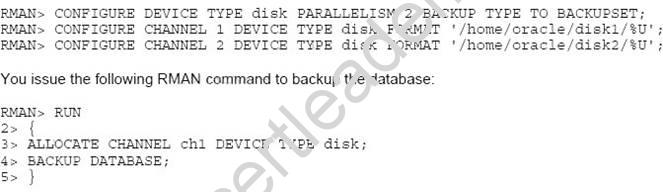
Which statement is true about the outcome?
- A. Only one channel is allocated and the backup is created in the flash recovery area
- B. Only one channel is allocated and the backup is created in the destination specified for channel
- C. Two channels are allocated and backup sets are created in the destinations specified for channels 1 and 2
- D. Three channels are allocated and backup sets are created in the destinations specified for channels 1, 2, and FRA
Answer: A
Recommend!! Get the Full 1Z0-053 dumps in VCE and PDF From Certleader, Welcome to Download: https://www.certleader.com/1Z0-053-dumps.html (New 698 Q&As Version)