We offers . "Oracle Database 11g: Administration II", also known as 1Z0-053 exam, is a Oracle Certification. This set of posts, Passing the 1Z0-053 exam with , will help you answer those questions. The covers all the knowledge points of the real exam. 100% real and revised by experts!
Also have 1Z0-053 free dumps questions for you:
NEW QUESTION 1
Another DBA issues a shutdown abort command on a database on which you were running an online backup.
What will happen when you try to restart the database?
- A. Oracle will automatically take the datafile out of hot backup mode, generate a warning message, and then open the database.
- B. Oracle will automatically take the datafile out of hot backup mode and then open the database.
- C. Oracle will generate an error when trying to open the database, indicating that a datafile is in hot backup mod
- D. You will need to correct this error before you can open the database.
- E. The database will open with the file in hot backup mod
- F. You can restart the backup at any time.
- G. The datafile in hot backup mode will be corrupted and you will have to recover it.
Answer: C
NEW QUESTION 2
You executed the following command in Recovery Manager (RMAN): RMAN> REPORT NEED BACKUP days 3;
What is the output of this command?
- A. a list of files that require a backup within three days
- B. a list of files requiring more than 3 days of archive logs to apply
- C. a list of files that RMAN recommends be backed up only once in every three days, based on low volatility
- D. a list of files for which a backup has already been performed in the last three days and which is required to be backed up again based on the high number of transactions performed on them
Answer: B
Explanation: Using RMAN REPORT NEED BACKUP with Different Retention Policies (link)
You can specify different criteria for REPORT NEED BACKUP, using one of the following forms of the command:
REPORT NEED BACKUP RECOVERY WINDOW OF n DAYS
Displays objects requiring backup to satisfy a recovery window-based retention policy REPORT NEED BACKUP REDUNDANCY n
Displays objects requiring backup to satisfy a redundancy-based retention policy REPORT NEED BACKUP DAYS n
Displays files that require more than n days' worth of archived redo log files for recovery REPORT NEED BACKUP INCREMENTAL n
Displays files that require application of more than n incremental backups for recovery
NEW QUESTION 3
Which statement is true regarding online redefinition for the migration of BasicFile LOBs to SecureFile LOBs?
- A. It cannot be done in parallel.
- B. It can be done at the table level or partition level.
- C. It does not require additional storage because the operation is done online.
- D. Local and global indexes are maintained automatically during the operation.
Answer: B
Explanation: Refer to here
Compatibility and Upgrading
All features described in this document are enabled with compatibility set to 11.2.0.0.0 or higher. There is no downgrade capability after 11.2.0.0.0 is set.
If you want to upgrade BasicFiles LOBs to SecureFiles LOBs, you must use typical methods for upgrading data (CTAS/ITAS, online redefinition, export/import, column to column copy, or using a view and a new column). Most of these solutions require twice the disk space used by the data in the input LOB column. However, partitioning and taking these actions on a partition-by-partition basis lowers the disk space requirements. Migrating Columns from BasicFiles LOBs to SecureFiles LOBs
The method of migrating LOBs columns is presented in this section. Preventing Generation of REDO Space when Migrating to SecureFiles LOBs
Generation of redo space can cause performance problems during the process of migrating BasicFiles LOB columns. Redo changes for the table are logged during the migration process only if the table has LOGGING set.
Redo changes for the column being converted from BasicFiles LOB to SecureFiles LOB are logged only if the storage characteristics of the SecureFiles LOB column indicate LOGGING. The logging setting (LOGGING or NOLOGGING) for the LOB column is inherited from the tablespace in which the LOB is created.
To prevent generation of redo space during migration make sure that you specify the NOLOGGING storage parameter for the new SecureFiles LOB column(s). You can turn LOGGING on once your migration is complete.
Online Redefinition for BasicFiles LOBs
Online redefinition is the only recommended method for migration of BasicFiles LOBs to SecureFiles LOBs. It can be done at the table or partition level.
Online Redefinition Advantages
✑ No requirement to take the table or partition offline
✑ Can be done in parallel
Online Redefinition Disadvantages
✑ Additional storage equal to the entire table or partition and all LOB segments must be available
✑ Global indexes must be rebuilt
NEW QUESTION 4
You have enabled backup optimization for the RMAN environment.
Identify two criteria on which RMAN will skip the file, if it has already been backed up. (Choose two.)
- A. The data file backup is done with multiple channels
- B. The data files is in the read-write mode after being backed up in the read only mode
- C. The backup was taken after the data files was taken offline-normal or is in the read only mode
- D. The data file backup complies with the back retention policy and the backup duplexingfeature
Answer: CD
NEW QUESTION 5
Examine the parameter setting in your database: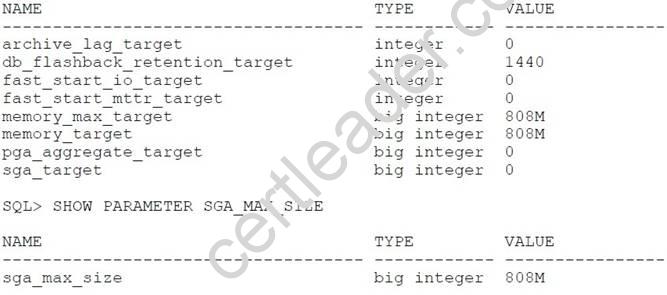
Which statement is correct about the database?
- A. Automatic memory management is disabled because PGA_AGGREGATE_TARGET and SGA_TARGET are not set
- B. The instance is started but the database will not be opened until PGA_AGGREGATE_TARGET and SGA_TARGET are set
- C. The database is opened but users cannot perform transactions until PGA_AGGREGATE_TARGET and SGA_TARGET are set
- D. Automatic memory management is enabled and, as per policy, 60% of the memory for System Global Area (SGA) and 40% of the memory for Program Global Area (PGA) will be distributed at startup
Answer: D
NEW QUESTION 6
What view would you use to determine if a given tablespace is fully self-contained for the execution of a tablespace point-in-time recovery?
- A. TS_CHECK
- B. TPITR_CHECK
- C. TS_PITR_CHECK
- D. CHECK_TSPITR
- E. PITR_TS_CHECK
Answer: C
NEW QUESTION 7
Evaluate the following SQL statement used to create the PRODUCTS table:
CREATE TABLE products (
product_id NUMBER(3) PRIMARY KEY, product_desc VARCHAR2(25),
qty NUMBER(8,2), rate NUMBER(10,2),
total_value AS ( qty * rate)) PARTITION BY RANGE (total_value) (
PARTITION p1 VALUES LESS THAN (100000), PARTITION p2 VALUES LESS THAN (150000), PARTITION p3 VALUES LESS THAN (MAXVALUE)) COMPRESS FOR ALL OPERATIONS;
Which statement is true regarding this command?
- A. It executes successfully but partition pruning cannot happen for this partition key.
- B. It produces an error because the TOTAL_VALUE column cannot be used as a partition key.
- C. It produces an error because compression cannot be used for the TOTAL_VALUE partition key.
- D. It executes successfully but the values in the TOTAL_VALUE column would not be physically stored in the partitions.
Answer: D
NEW QUESTION 8
You are peer reviewing a fellow DBAs backup plan for his NOARCHIVELOG mode database, as shown here:
1. Put the tablespaces in backup mode.
2. Back up the datafiles for all tablespaces.
3. Take the tablespaces out of backup mode.
4. Back up all archived redo logs.
Your colleague asks for you to comment on his plan. Which response would be correct?
- A. The plan will work as is.
- B. The plan needs to be modified to allow for an archive-log switch after step 3.
- C. The plan needs to be modified so that a backup of the archived redo logs occurs before step 1.
- D. The plan needs to be adjusted to shut down the database after step 1 and to restart the database after step 2.
- E. The plan cannot work as presented.
Answer: B
Explanation: Without command ALTER SYSTEM SWITCH LOGFILE, the backup of archive redo logs will be useless.
NEW QUESTION 9
You executed the following command to drop a user: DROP USER scott CASCADE;
Which two statements regarding the above command are correct? (Choose two.)
- A. All the objects of scott are moved to the Recycle Bin.
- B. Any objects in the Recycle Bin belonging to scott are purged.
- C. All the objects owned by scott are permanently dropped from the database.
- D. All the objects of scott in the Recycle Bin must be purged before executing the DROP command.
- E. Any objects in the Recycle Bin belonging to scott will not be affected by the above DROP command.
Answer: BC
NEW QUESTION 10
Your database is running in ARCHIVELOG mode. One of the data files, USERDATA01.dbf, in the USERS tablespace is damaged and you need to recover the file until the point of failure. The backup for the datafile is available.
Which three files would be used in the user-managed recovery process performed by the database administrator (DBA)? (Choose Three)
- A. Redo logs
- B. Control file
- C. The latest backup of only the damaged data file
- D. The latest backup of all the data file in the USERS tablespace
- E. Temporary files of temporary tablespace
- F. Archive Logs since the latest backup to point of failure
Answer: ACF
NEW QUESTION 11
Which of the following represents the correct sequence of events for Database Replay?
- A. Capture, analyze, preprocess, replay
- B. Capture, preprocess, analyze, replay
- C. Capture, preprocess, replay, analyze
- D. Analyze, capture, preprocess, replay
- E. None of the above
Answer: C
Explanation: 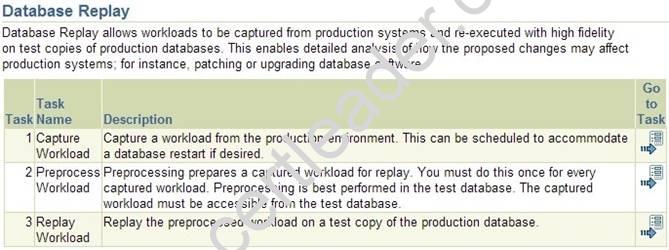
C:UsersalboDesktop1-1.jpg
NEW QUESTION 12
You are managing an Oracle Database 11g instance and an Oracle Database 10g instance on the same machine. Both instances use the ASM instance as storage. Which statement regarding the ASM disk group compatibility attributes are true in this scenario? (Choose all that apply.)
- A. The database-compatibility version settings for each instance must be greater than or equal to the RDBMS compatibility of all ASM disk groups used by that database instances.
- B. RDBMS compatibility and the database version determines whether a database instance can mount the ASM disk group.
- C. The RDBMS compatibility settings for a disk group control the format of data structures for ASM metadata on the disk.
- D. ASM compatibility controls which features for the ASM will be enabled.
Answer: ABD
NEW QUESTION 13
In Recovery Manager (RMAN), you are taking image copies of the datafiles of your production database and rolling them forward as regular intervals. You attempt to restart your database instance after a regular maintenance task, you realize that one of the data files that belongs to the USERS tablespace is damaged and you need to recover the datafile by using the image copy. You could perform the following steps to accomplish this:
1) Mount the database
2) Take the data file offline
3) Bring the data file online
4) Use the RMAN SWITCH TO command to switch the image copy
5) Apply the archived redo logs
6) Open the database
7) Use the RMAN RESTORE TO command to switch to the image copy
Which two options illustrate the correct sequence of steps that you could follow? (Choose two.)
- A. 2, 6, 4, 5, 3
- B. 1, 2, 4, 5, 3, 6
- C. 1, 2, 4, 6, 3
- D. 1, 2, 7, 5, 3, 6
Answer: BD
NEW QUESTION 14
Which two statements are true regarding the SQL Repair Advisor? (Choose two.)
- A. The SQL Repair Advisor can be invoked to tune the performance of the regressed SQL statements.
- B. The SQL Repair Advisor can be invoked even when the incident is not active for a SQL statement crash.
- C. The SQL Repair Advisor is invoked by the Health Monitor when it encounters the problematic SQL statement.
- D. The DBA can invoke the SQL Repair Advisor when he or she receives an alert generated when a SQL statement crashes and an incident is created in the ADR.
Answer: BD
Explanation: You can run SQL Repair Advisor through the EM Support Workbench when an incident raised.
Or You run the SQL Repair Advisor by creating and executing a diagnostic task using the DBMS_SQLDIAG. CREATE_DIAGNOSIS_TASK and DBMS_SQLDIAG. respectively. The SQL Repair Advisor first reproduces the critical error and then tries to produce a workaround in the form of SQL patch.
NEW QUESTION 15
View the Exhibit.
As shown in the diagram, in-memory statistics are transferred to the disk at regular intervals.
Which background process performs this activity?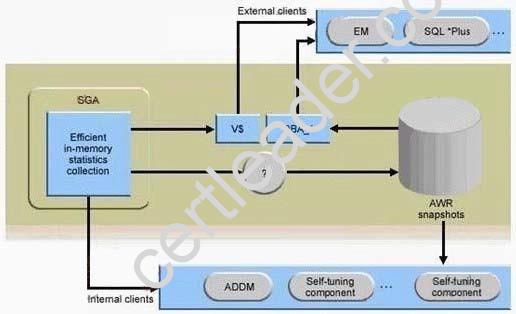
- A. CKPT
- B. SMON
- C. MMON
- D. DBWR
Answer: C
NEW QUESTION 16
Because of a logical corruption in your production database, you wanted to perform Tablespace Point in Time Recovery (TSPITR). But before you start the recovery, you queried the TS_PITR_OBJECTS_TO_BE_DROPPED view and realized that there are a large number of objects that would be dropped when you start the recovery by using this method. You want to preserve these objects. Which option must you use to perform TSPITR and preserve the object?
- A. Perform Export before TSPITR and Import after TSPITR
- B. Move objects to another schema that has the same tablespace assigned
- C. Perform Incomplete Recovery before TSPITR with the Log Sequence Number (LSN)
- D. Perform Incomplete Recovery before TSPITR with the System Change Number (SCN)
Answer: A
NEW QUESTION 17
Which dependent object will get invalidated even if it is not affected by the table redefinition?
- A. packages
- B. triggers
- C. synonyms
- D. views
Answer: B
Explanation: Results of the Redefinition Process
The following are the end results of the redefinition process:
The original table is redefined with the columns, indexes, constraints, grants, triggers, and statistics of the interim table.
Dependent objects that were registered, either explicitly using REGISTER_DEPENDENT_OBJECT or implicitly using COPY_TABLE_DEPENDENTS, are renamed automatically so that dependent object names on the redefined table are the same as before redefinition.
Note:
If no registration is done or no automatic copying is done, then you must manually rename the dependent objects.
The referential constraints involving the interim table now involve the redefined table and
are enabled.
✑ Any indexes, triggers, materialized view logs, grants, and constraints defined on the original table (prior to redefinition) are transferred to the interim table and are dropped when the user drops the interim table. Any referential constraints involving the original table before the redefinition now involve the interim table and are disabled.
✑ Some PL/SQL objects, views, synonyms, and other table-dependent objects may become invalidated. Only those objects that depend on elements of the table that were changed are invalidated. For example, if a PL/SQL procedure queries only columns of the redefined table that were unchanged by the redefinition, the procedure remains valid. See "Managing Object Dependencies" for more information about schema object dependencies.
NEW QUESTION 18
The NLS_LANGUAGE parameter specifies the default conventions to be used for which of the following globalization elements?
- A. Languages for server messages
- B. Day and month names and abbreviations
- C. Symbols to represent a.m., p.m., AD, and BC
- D. Affirmative and negative response strings (YES, NO)
- E. None of the above
- F. All of the above
Answer: F
Explanation: Parameter type String
Syntax NLS_LANGUAGE = language
Default value Operating system-dependent, derived from the NLS_LANG environment variable
Modifiable ALTER SESSION
Range of values Any valid language name Basic Yes
NLS_LANGUAGE specifies the default language of the database. This language is used for messages, day and month names, symbols for AD, BC, a.m., and p.m., and the default sorting mechanism. This parameter also determines the default values of the parameters NLS_DATE_LANGUAGE and NLS_SORT.
P.S. Surepassexam now are offering 100% pass ensure 1Z0-053 dumps! All 1Z0-053 exam questions have been updated with correct answers: https://www.surepassexam.com/1Z0-053-exam-dumps.html (698 New Questions)