Your success in is our sole target and we develop all our in a way that facilitates the attainment of this target. Not only is our material the best you can find, it is also the most detailed and the most updated. for Cisco 300-175 are written to the highest standards of technical accuracy.
Check 300-175 free dumps before getting the full version:
NEW QUESTION 1
Before upgrading a Cisco UCS cluster.you need to verify the high-availability statue and roles of the cluster. In which scenario can you successfully perform the upgrade'?
- A. When you check the Cisco UCS Manager GUI, the Ready field value is Ready and the State field value is O
- B. When you check the Cisco UCS Manager CLI, the Primary and Secondary interconnect state are both ON and the cluster state is HA WAITING.
- C. When you check the Cisco UCS Manager GUI, the Ready field value is Yes and the State field value isU
- D. When you check the Cisco UCS Manager CLI, the Primary and Secondary interconnect state are both UP and the cluster state is HA READY.
- E. When you check the Cisco UCS Manager GUI, the Ready field value is Ready and the State field value is Activ
- F. When you check the Cisco UCS Manager CLI, the Primary and Secondary interconnect state are both READY and the cluster state is HA WAITING.
- G. When you check the Cisco UCS Manager GUI, the Ready field value is Ready and the State field value is U
- H. When you check the Cisco UCS Manager CLI, the Primary and Secondary interconnect state are both UP and the cluster state is HA UP.
Answer: D
Explanation: When you check the Cisco UCS Manager GUI, the Ready field value is Yes and the State field value is Up.
When you check the Cisco UCS Manager CLI, the Primary and Secondary interconnect state are both UP and the cluster state is HA READY.
Reference:
https://www.cisco.com/c/en/us/td/docs/unified_computing/ucs/sw/firmware-mgmt/gui/2-2/ b_GUI_Firmware_Management_22/b_GUI_Firmware_Management_22_chapter_011.pdf
https://www.cisco.com/c/en/us/td/docs/unified_computing/ucs/ucs-manager/CLI-User-Guides/FirmwareMgmt/3
NEW QUESTION 2
Which three components perform the port extension functions for a Cisco UCS domain? (Choose three.)
- A. the multiprotocol port on the Cisco storage
- B. the Device Manager in Cisco Prime Data Center Network Manager
- C. the Cisco UCS 2208XP IOMs
- D. the Cisco UCS Manager
- E. the Cisco Nexus 2232PP FEX
- F. the Cisco UCS VIC adapter that has VM-FEX and Adapter FEX technology
Answer: ACD
NEW QUESTION 3
A service profile is created using vHBAs. What will happen if the profile is applied to a server with a mezzanine card without storage capability?
- A. The blade association will fail.
- B. The storage adapter will not be visible to the operating system.
- C. A virtual storage adapter will be created.
- D. A WWNN or a WWPN will be autoselected from the default pool.
Answer: A
Explanation: https://supportforums.cisco.com/t5/data-center-blogs/c-series-resolve-service-profile-association-failure-when/b https://www.cisco.com/en/US/docs/unified_computing/ucs/sw/gui/config/guide/141/UCSM_GUI_Configuration In addition to any guidelines or recommendations that are specific to policies and pools included in service
profiles and service profile templates, such as the local disk configuration policy, you need to be aware of the following guidelines and recommendations that impact the ability to associate a service profile with a server.
NEW QUESTION 4
Which Cisco UCS backup type results in an XML file that include all system and logical configuration settings?
- A. system configuration
- B. all configuration
- C. full state
- D. logical configuration
Answer: B
NEW QUESTION 5
Which drive combination prevents you from provisioning RAID on Cisco UCS C-Series servers?
- A. SAS HDD and SATA HDD
- B. SAS SSD and SATA SSD
- C. SATA HDD and SATA SSD
- D. SAS HDD only
- E. SATA HDD only
Answer: C
Explanation: Reference: https://www.cisco.com/c/en/us/td/docs/unified_computing/ucs/c/sw/raid/configuration/guide/
RAID_GUIDE.pdf
NEW QUESTION 6
Which consideration must be made when utilizing a WWxN pool?
- A. Only HBA templates can use WWxN pools.
- B. WWNN assignment must be set to derived.
- C. WWPN assignment must be set to derived.
- D. A SAN connectivity policy must be used.
Answer: C
NEW QUESTION 7
Scenario
In this scenario, you will refer to screenshots about Cisco UCS B-Series servers and UCS Manager. Instructions
To access the multiple-choice questions, click on the numbered boxes on the left of the top panel. There are four multiple-choice questions with this task. Be sure to answer all four questions before selecting the Next button.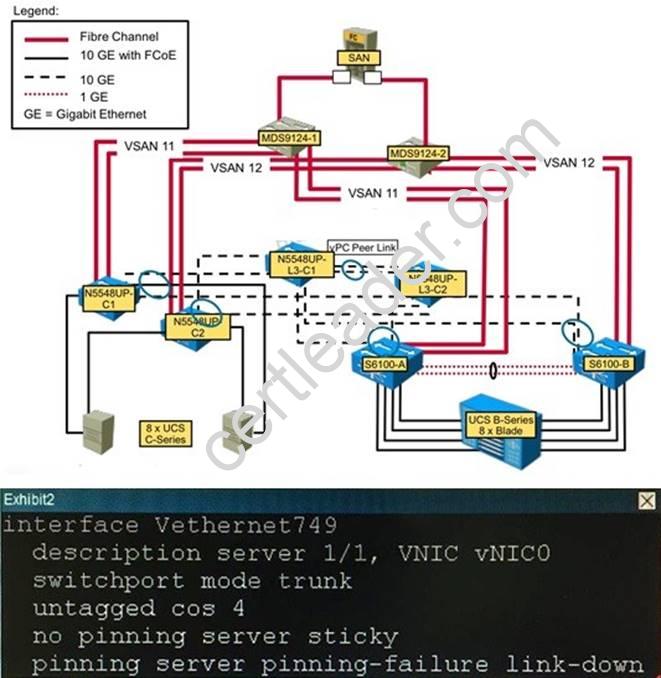
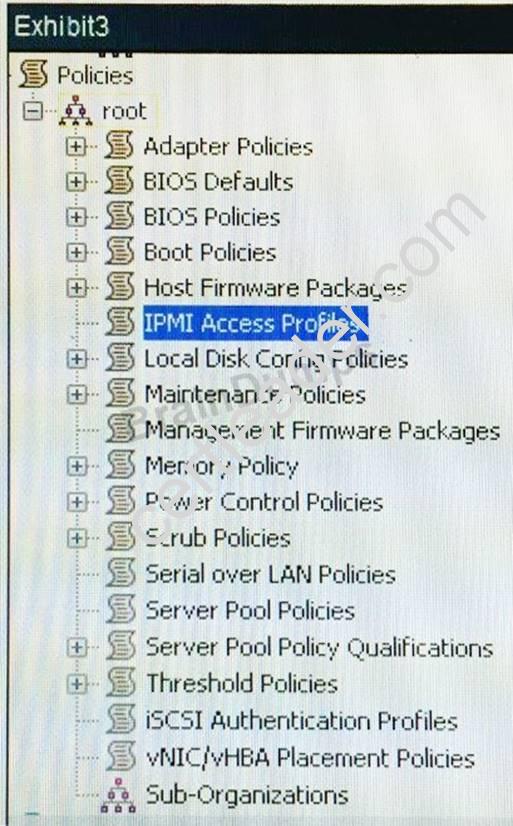
Refer to the Exhibit 3 screenshot of UCS Manager. Which two items are required to configure an IPMI profile? (Choose two.)
- A. IPMI Type
- B. User
- C. Role
- D. Locale
- E. Administrative State
Answer: BC
Explanation: Reference:
http://www.cisco.com/c/en/us/td/docs/unified_computing/ucs/sw/gui/config/guide/20/b_UCSM_GUI_Configura
NEW QUESTION 8
Which three tasks can a user with the ext-lan-policy privileges perform? (Choose three.)
- A. Configure management interfaces on the fabric interconnect.
- B. Configure Ethernet pin groups.
- C. Configure management interfaces monitoring policy.
- D. Create/modify/delete vNIC/vHBA placement policies.
- E. Configure DNS providers and DNS domain.
- F. Specify the allowed range for virtual MAC addresses.
- G. Configure fabric interconnect system name.
- H. This privilege has full access to all operations.
Answer: BDF
NEW QUESTION 9
Which statement about the use of RBAC roles in a Cisco UCS system is true?
- A. RBAC roles define which features are enabled on a Cisco UCS system
- B. RBAC roles create groups of organizations
- C. RBAC roles create groups of local users
- D. RBAC roles define which features users can access.
Answer: D
NEW QUESTION 10
Open the windows by clicking on the minimized at the bottom of the viewing area. Windows can be minimized by clicking on the [X], repositioned by dragging the title bar, and resized by using the handle at the lower right corner to customize the viewing area.
If you are required to access the devices to complete this scenario, the mouse cursor will use a hand symbol when moved over device icons. Clicking the icon will open a device terminal so you can interact with the hardware.
Open the Questions window and begin by clicking a question number. When you have completed answering all questions, click Done to continue.
Scenario
Use your UCS knowledge on Adapter errors ………………………………………configurations.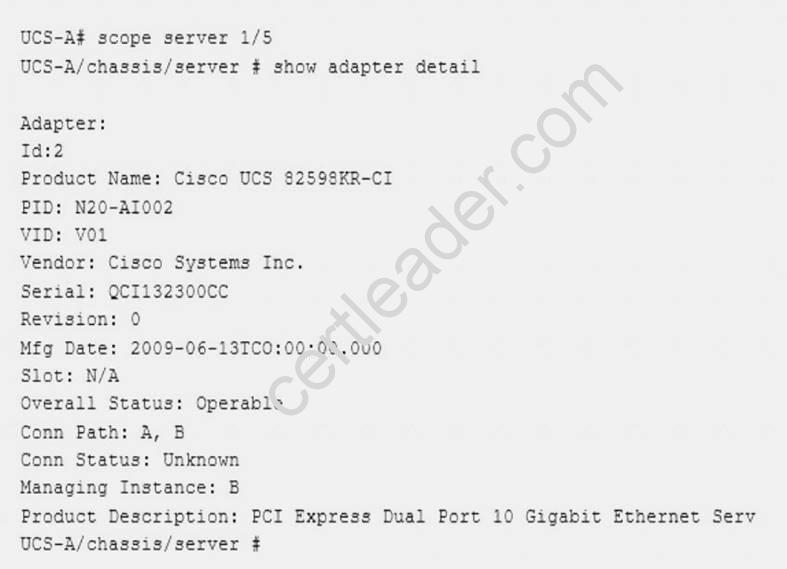
We are working on which server?
- A. 1
- B. 2
- C. 3
- D. 4
- E. 5
Answer: E
NEW QUESTION 11
You are creating service profiles for a Cisco UCS system by using the service profile wizard. You discover that you forgot to create the UUID pool.
What should you do?
- A. From the wizard, click Create UUID Suffix Pool.
- B. Pause the running wizard, and then start a temporary wizard to create a profile with the same name and the missing UUID poo
- C. Resume the wizard, and then select the new UUID pool.
- D. Continue running the wizar
- E. The service profile uses the burned-in UUID in the BIOS of the server.
- F. Stop the wizard, and then restart the wizard.
Answer: A
Explanation: Step 4
(Optional) If you want to create a new UUID Suffix pool to use in this service profile, click Create UUID Suffix
Pool and complete the fields in the Create UUID Suffix Pool wizard. For more information, see Creating a UUID Suffix Pool.
Reference:
https://www.cisco.com/en/US/docs/unified_computing/ucs/sw/gui/config/guide/141/ UCSM_GUI_Configuration_Guide_141_chapter24.html
NEW QUESTION 12
ACustomer wants to know more about managing standalone Cisco UCS C-Series systems through the Cisco lntergrated Management Controller. The customer asks which management protocols are supported. Which three protocols must you include in your respone? (Choose three)
- A. SNMP v3
- B. SNMP v2
- C. SMASH CLP
- D. SoL
- E. Virtual KVM
- F. IPMI v2
Answer: ABF
Explanation: The IMC supports industry-standard protocols, including Redfish version 1.01, Intelligent Platform Monitoring Interface Version 2 (IPMI v2), and Simple Network Management Protocol versions 2 and 3 (SNMP v2 and v3). It also provides an open Extensible Markup Language (XML) API and a
command-line interface (CLI). Reference:
https://www.cisco.com/c/dam/en/us/products/collateral/servers-unified-computing/ucs-c-series-rack-serve
NEW QUESTION 13
While configuring VM-FEX for Hyper-V, the virtual switch does not show up when you add the host with the port-profile management snap-in. Which statement describes the most likely cause?
- A. SR-IOV is not enabled for the virtual switch inside Hyper-V.
- B. Cisco Nexus 1000v is not enabled for the virtual switch.
- C. Hyper-V requires Cisco UCS Manager to utilize Cisco Discovery Protocol on the vNIC profile.
- D. An active VM is not associated with the port profile.
- E. VM-FEX does not work with Hyper-V.
- F. VM-FEX has been configured on the Catalyst switch but not in System Center yet.
Answer: A
NEW QUESTION 14
Which two options occur when a server discovery policy is invoked? (Choose two.)
- A. executes the qualification in the server discovery policy against the server
- B. applies the scrub policy to the server
- C. analyzes the inventory of the server
- D. assigns the server to the selected organization, if configured
- E. creates a service profile for the server with the identity burned into the server at time of manufacture
Answer: AB
Explanation: Configuring Server Discovery Policies Server Discovery Policy
This discovery policy determines how the system reacts when you add a new server. If you create a server discovery policy, you can control whether the system conducts a deep discovery when a server is added to a chassis, or whether a user must first acknowledge the new server. By default, the system conducts a full discovery.
If you create a server discovery policy, the following occurs when a new server starts: The qualification in the server discovery policy is executed against the server.
If the server meets the required qualifications, Cisco UCS Manager applies the following to the server:
Depending upon the option selected for the action, either discovers the new server immediately or waits for a user to acknowledge the new server
Applies the scrub policy to the server Reference:
http://www.cisco.com/c/en/us/td/docs/unified_computing/ucs/sw/gui/config/guide/2-1/b_UCSM_GUI_Configur
NEW QUESTION 15
Which two are true with respect to the switching modes on the Cisco Unified Computing System 62XX Fabric Interconnect? (Choose two.)
- A. End-host mode presents a link to a northbound uplink switch as a host trunk with loop detection that is provided by STP.
- B. For northbound traffic, server MAC addresses are statically pinned to an uplink; the return path is controlled by the unified fabric switches.
- C. A fabric interconnect port in Ethernet switching mode appears to the uplink switch as a host with many MAC addresses.
- D. Server-to-server traffic on a common VLAN are locally switched by the fabric interconnect and not the northbound switches.
- E. A MAC forwarding table is not used to forward traffic to the uplink switch.
- F. A MAC address forwarding table is maintained for server-to-server communications across VLANs.
Answer: DE
NEW QUESTION 16
The system-reserved VLANs within Cisco UCS are 3968 to 4048 by default. Where can a user change the starting value of this range?
- A. VLAN manager
- B. global policies
- C. LAN cloud
- D. cannot be changed
Answer: D
NEW QUESTION 17
You have been tasked with performing a backup through Cisco UCS Manager that can be used to restore the system during disaster recovery. Which type of backup must you perform?
- A. System configuration
- B. Full state
- C. All configuration
- D. Logical configuration
Answer: B
Explanation: Reference:
https://www.cisco.com/c/en/us/td/docs/unified_computing/ucs/ucs-manager/GUI-User-Guides/AdminManagem
NEW QUESTION 18
Which two Cisco UCS C-Series server components are hot-swappable? (Choose two.)
- A. mezzanine card
- B. PCle slot
- C. internal cooling fan
- D. power supply
- E. memory riser
Answer: CD
NEW QUESTION 19
You need to design and implement a Cisco UCS 5108 Blade Server Chassis system for a customer.
Which statement about how half-width blades and full-width blades can be used is true?
- A. Only two full-width blades can be installed in the top two slots, and four half-width blades can be installed in the bottom two slots.
- B. Only one full-width blade can be installed in the top slot, and six half-width blades can be installed in the bottom slots.
- C. Half-width blades and full-width blades can be combined in any order.
- D. Half-width blade types and full-width blade types cannot be combined.
Answer: C
Explanation: Mixed blade configurations Allows up to 8 half-width or 4 full-width blade servers, or any combination thereof, for outstanding flexibility.
When configured with the 6324 Fabric Interconnect, only 8 half-width B200 M3 blades are supported. https://www.cisco.com/c/en/us/td/docs/unified_computing/ucs/hw/chassis-install-guide/ucs5108_install/
ucs5108_install_chapter_01.htm
NEW QUESTION 20
Answer:
Explanation: 
Recommend!! Get the Full 300-175 dumps in VCE and PDF From 2passeasy, Welcome to Download: https://www.2passeasy.com/dumps/300-175/ (New 349 Q&As Version)