We offers AZ-100 Exam Questions and Answers. "Microsoft Azure Infrastructure and Deployment", also known as AZ-100 exam, is a Microsoft Certification. This set of posts, Passing the AZ-100 exam with AZ-100 Dumps, will help you answer those questions. The AZ-100 Exam Questions covers all the knowledge points of the real exam. 100% real AZ-100 Study Guides and revised by experts!
Online AZ-100 free questions and answers of New Version:
NEW QUESTION 1
Note: This question is part of a series of questions that present the same scenario. Each question in the series contains a unique solution that might meet the stated goals. Some question sets might have more than one correct solution, while others might not have a correct solution.
After you answer a question in this section, you will NOT be able to return to it. As a result, these questions will not appear in the review screen.
You have an Azure subscription named Subscription1. Subscription1 contains a resource group named RG1. RG1 contains resources that were deployed by using templates.
You need to view the date and time when the resources were created in RG1. Solution: From the RG1 blade, you click Automation script.
Does this meet the goal?
- A. Yes
- B. No
Answer: B
NEW QUESTION 2
You need to recommend an identify solution that meets the technical requirements. What should you recommend?
- A. federated single-on (SSO) and Active Directory Federation Services (AD FS)
- B. password hash synchronization and single sign-on (SSO)
- C. cloud-only user accounts
- D. Pass-through Authentication and single sign-on (SSO)
Answer: A
Explanation: Active Directory Federation Services is a feature and web service in the Windows Server Operating System that allows sharing of identity information outside a company’s network.
Scenario: Technical Requirements include:
Prevent user passwords or hashes of passwords from being stored in Azure. References: https://www.sherweb.com/blog/active-directory-federation-services/
Topic 3, Mix Questions
NEW QUESTION 3
You need to identify the storage requirements for Contoso.
For each of the following statements, select Yes if the statement is true. Otherwise, select No.
NOTE: Each correct selection is worth one point.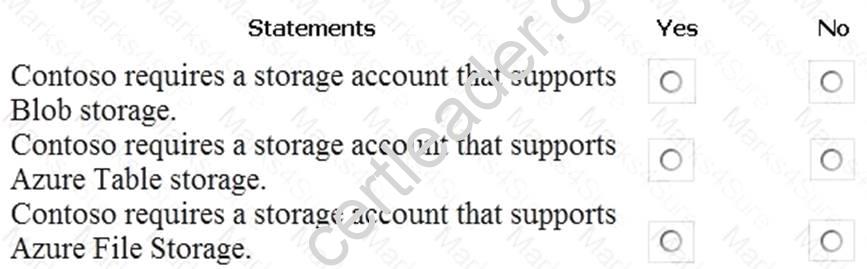
Answer:
Explanation: Box 1: Yes
Contoso is moving the existing product blueprint files to Azure Blob storage.
Use unmanaged standard storage for the hard disks of the virtual machines. We use Page Blobs for these. Box 2: No
Box 3: No
NEW QUESTION 4
You have an Azure policy as shown in the following exhibit.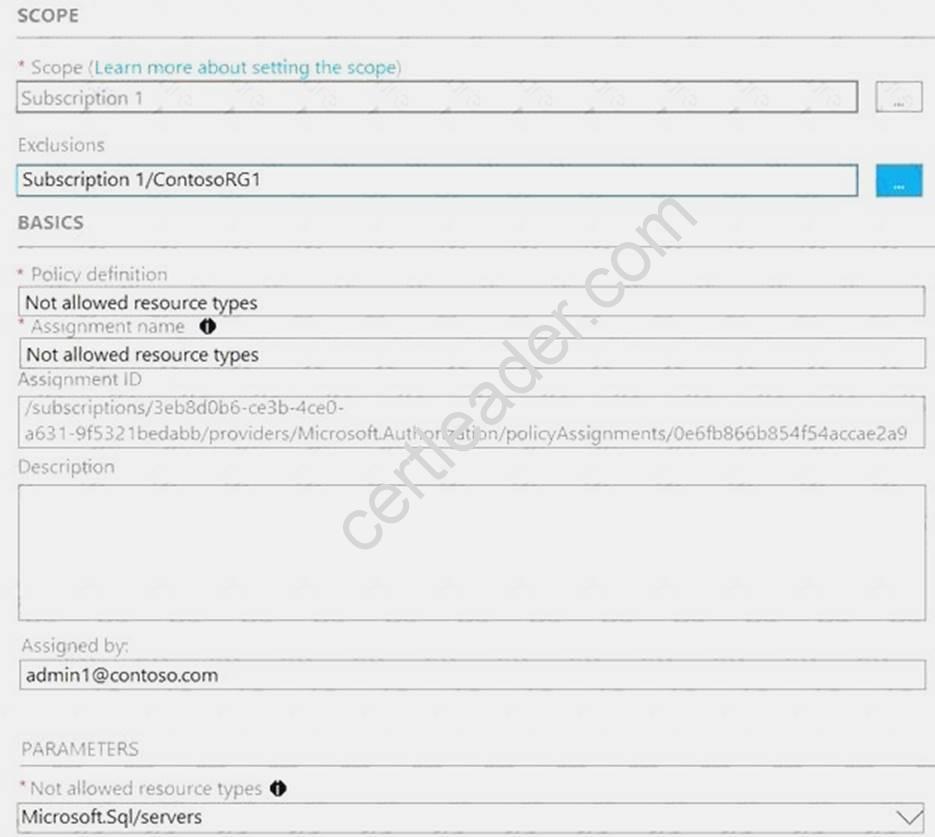
Which of the following statements are true? Which of the following statements are true?
- A. You can create Azure SQL servers in ContosoRG1.
- B. You are prevented from creating Azure SQL servers anywhere in Subscription 1.
- C. You are prevented from creating Azure SQL Servers in ContosoRG1 only.
- D. You can create Azure SQL servers in any resource group within Subscription 1.
Answer: A
Explanation: You are prevented from creating Azure SQL servers anywhere in Subscription 1 with the exception of ContosoRG1
NEW QUESTION 5
You purchase a new Azure subscription named Subscription1.
You create a virtual machine named VM1 in Subscription1. VM1 is not protected by Azure Backup.
You need to protect VM1 by using Azure Backup. Backups must be created at 01:00 and stored for 30 days. What should you do? To answer, select the appropriate options in the answer area.
NOTE: Each correct selection is worth one point.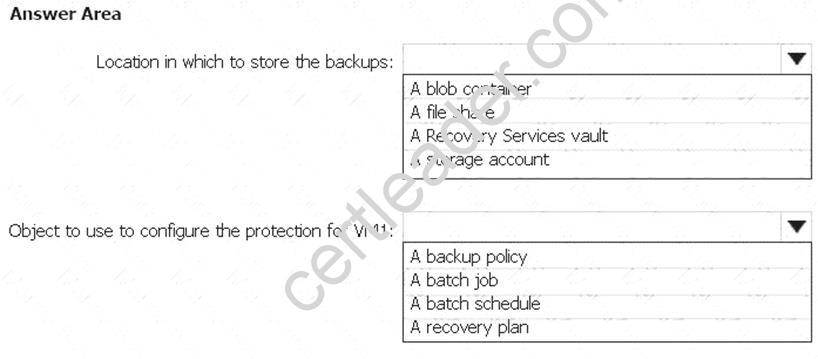
Answer:
Explanation: Box 1: A Recovery Services vault
A Recovery Services vault is an entity that stores all the backups and recovery points you create over time. Box 2: A backup policy
What happens when I change my backup policy?
When a new policy is applied, schedule and retention of the new policy is followed. References:
https://docs.microsoft.com/en-us/azure/backup/backup-configure-vault
https://docs.microsoft.com/en-us/azure/backup/backup-azure-backup-faq
NEW QUESTION 6
You plan to back up an Azure virtual machine named VM1.
You discover that the Backup Pre-Check status displays a status of Warning. What is a possible cause of the Warning status?
- A. VM1 does not have the latest version of WaAppAgent.exe installed.
- B. VM1 has an unmanaged disk.
- C. VM1 is stopped.
- D. A Recovery Services vault is unavailable.
Answer: A
Explanation: The Warning state indicates one or more issues in VM’s configuration that might lead to backup failures and provides recommended steps to ensure successful backups. Not having the latest VM Agent installed, for example, can cause backups to fail intermittently and falls in this class of issues.
References:
https://azure.microsoft.com/en-us/blog/azure-vm-backup-pre-checks/
NEW QUESTION 7
You have an Azure subscription that contains the resources in the following table.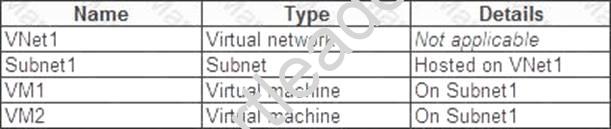
VM1 and VM2 are deployed from the same template and host line-of-business applications accessed by using Remote Desktop. You configure the network security group (NSG) shown in the exhibit. (Click the Exhibit button.)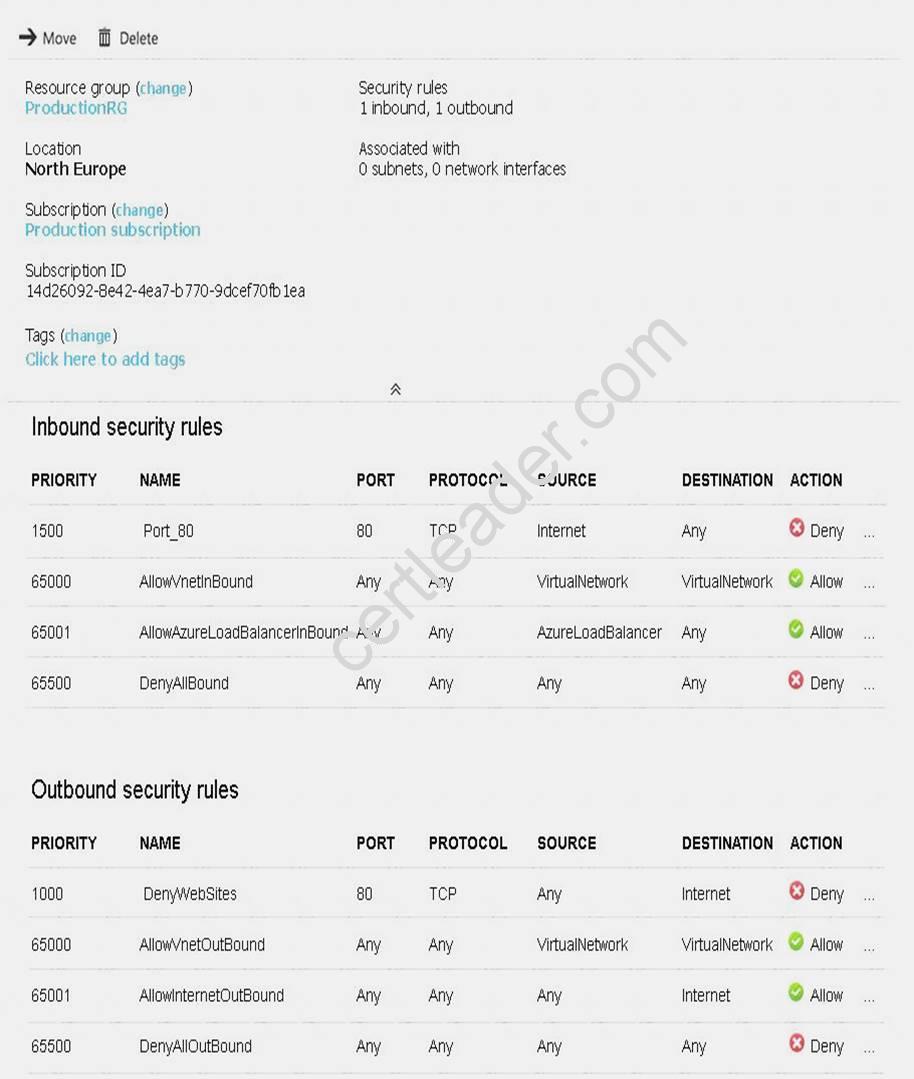
You need to prevent users of VM1 and VM2 from accessing websites on the Internet.
What should you do?
- A. Associate the NSG to Subnet1.
- B. Disassociate the NSG from a network interface.
- C. Change the DenyWebSites outbound security rule.
- D. Change the Port_80 inbound security rule.
Answer: A
Explanation: You can associate or dissociate a network security group from a network interface or subnet.
The NSG has the appropriate rule to block users from accessing the Internet. We just need to associate it with Subnet1.
References: https://docs.microsoft.com/en-us/azure/virtual-network/manage-network-security-group
NEW QUESTION 8
You have an Azure subscription named Subscription1.
In Subscription1, you create an Azure file share named share1.
You create a shared access signature (SAS) named SAS1 as shown in the following exhibit.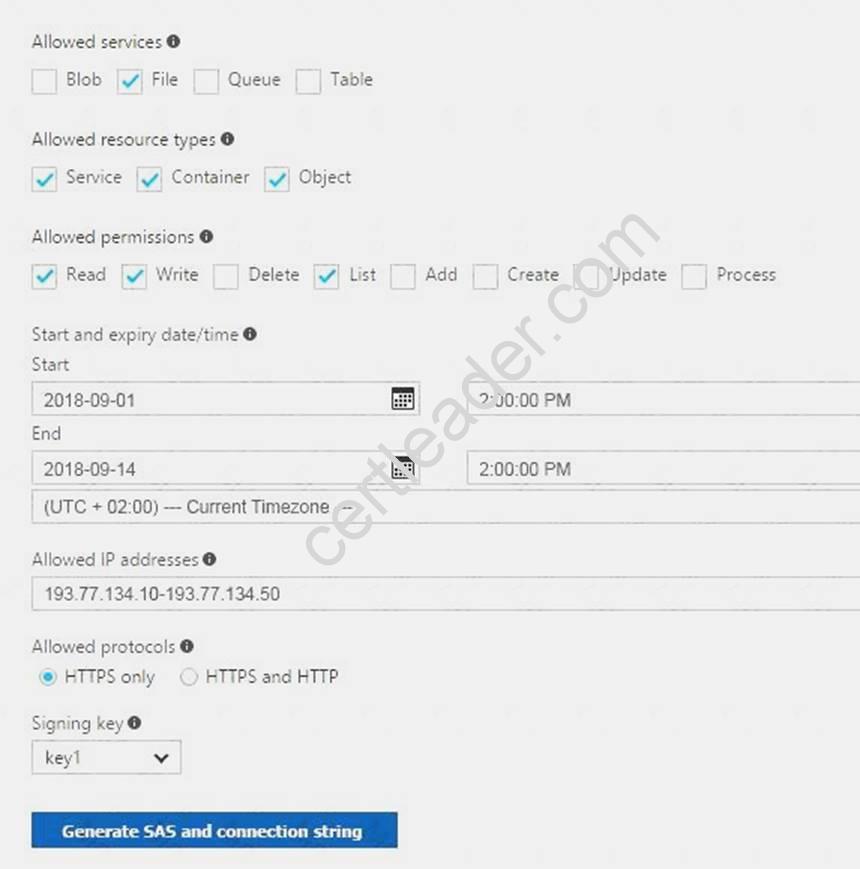
To answer, select the appropriate options in the answer area. NOTE: Each correct selection is worth one point.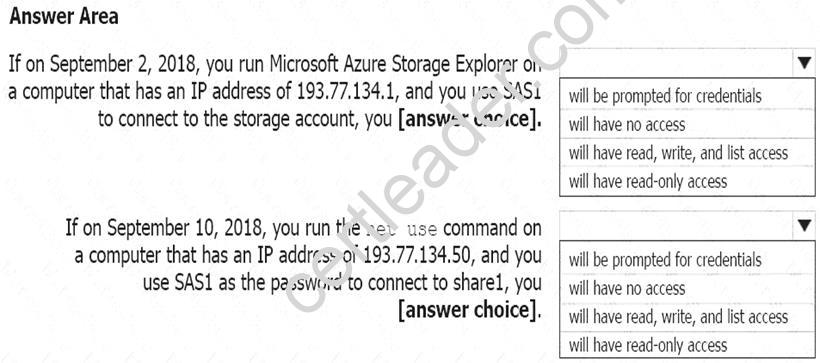
Answer:
Explanation: Box 1: Will be prompted for credentials
Azure Storage Explorer is a standalone app that enables you to easily work with Azure Storage data on Windows, macOS, and Linux. It is used for connecting to and managing your Azure storage accounts.
Box 2: Will have read, write, and list access
The net use command is used to connect to file shares. References:
https://docs.microsoft.com/en-us/azure/storage/common/storage-dotnet-shared-access-signature-part-1 https://docs.microsoft.com/en-us/azure/vs-azure-tools-storage-manage-with-storage-explorer?tabs=windows
NEW QUESTION 9
Note: This question is part of a series of questions that present the same scenario. Each question in the series contains a unique solution that might meet the stated goals. Some question sets might have more than one correct solution, while others might not have a correct solution.
After you answer a question in this section, you will NOT be able to return to it. As a result, these questions will not appear in the review screen.
You have an Azure virtual machine named VM1. VM1 was deployed by using a custom Azure Resource Manager template named ARM1.json.
You receive a notification that VM1 will be affected by maintenance. You need to move VM1 to a different host immediately.
Solution: Solution: From the Overview blade, you move the virtual machine to a different subscription. Does this meet the goal?
- A. Yes
- B. No
Answer: B
Explanation: You would need to Redeploy the VM. References:
https://docs.microsoft.com/en-us/azure/virtual-machines/windows/redeploy-to-new-node
NEW QUESTION 10
You have an Azure subscription that contains a virtual machine named VM1. VM1 hosts a line-of-business application that is available 24 hours a day. VM1 has one network interface and one managed disk. VM1 uses the D4s v3 size.
You plan to make the following changes to VM1:  Change the size to D8s v3. Add a 500-GB managed disk. Add the Puppet Agent extension. Attach an additional network interface. Which change will cause downtime for VM1?
- A. Add a 500-GB managed disk.
- B. Attach an additional network interface.
- C. Add the Puppet Agent extension.
- D. Change the size to D8s v3.
Answer: D
Explanation: While resizing the VM it must be in a stopped state.
References: https://azure.microsoft.com/en-us/blog/resize-virtual-machines/
NEW QUESTION 11
You download an Azure Resource Manager template based on an existing virtual machine. The template will be used to deploy 100 virtual machines.
You need to modify the template to reference an administrative password. You must prevent the password from being stored in plain text.
What should you create to store the password?
- A. Azure Active Directory (AD) Identity Protection and an Azure policy
- B. a Recovery Services vault and a backup policy
- C. an Azure Key Vault and an access policy
- D. an Azure Storage account and an access policy
Answer: C
Explanation: You can use a template that allows you to deploy a simple Windows VM by retrieving the password that is stored in a Key Vault. Therefore the password is never put in plain text in the template parameter file.
References: https://azure.microsoft.com/en-us/resources/templates/101-vm-secure-password/
NEW QUESTION 12
Click to expand each objective. To connect to the Azure portal, type https://portal.azure.com in the browser address bar.
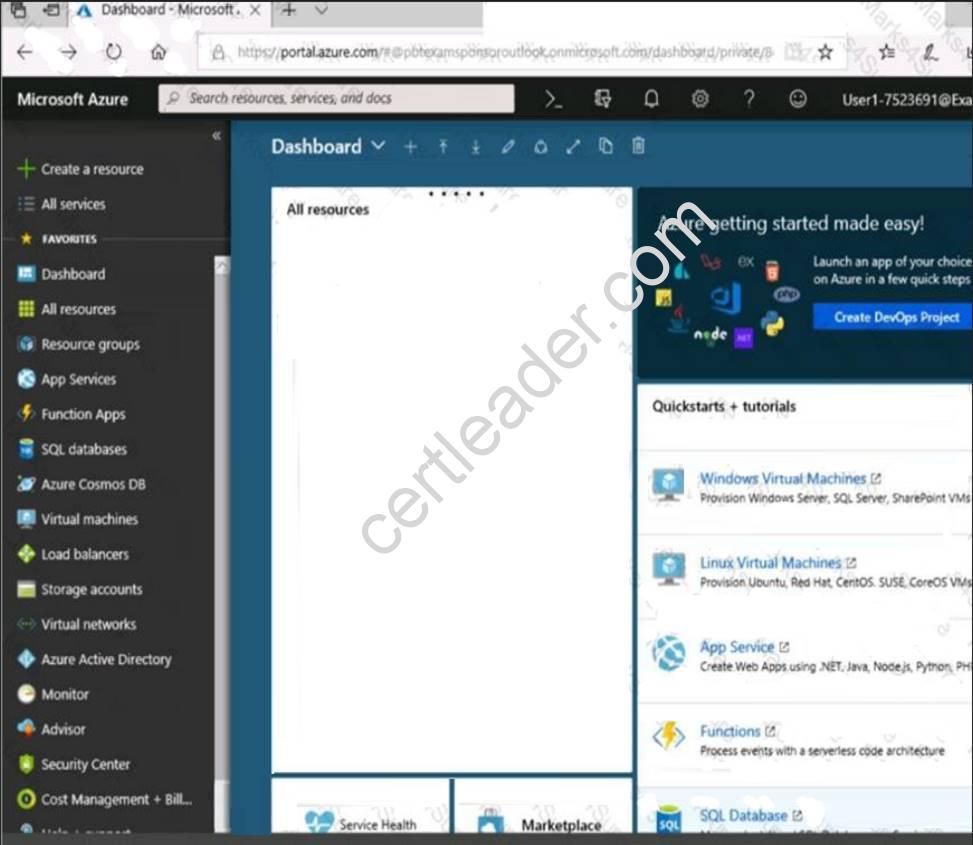
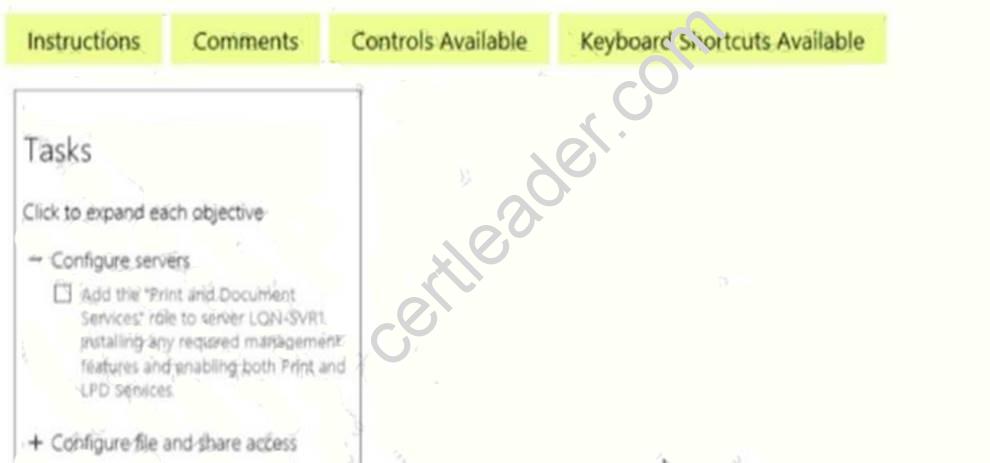
When you are finished performing all the tasks, click the ‘Next’ button.
Note that you cannot return to the lab once you click the ‘Next’ button. Scoring occur in the background while you complete the rest of the exam.
Overview
The following section of the exam is a lab. In this section, you will perform a set of tasks in a live environment. While most functionality will be available to you as it would be in a live environment, some functionality (e.g., copy and paste, ability to navigate to external websites) will not be possible by design. Scoring is based on the outcome of performing the tasks stated in the lab. In other words, it doesn’t matter how you accomplish the task, if you successfully perform it, you will earn credit for that task.
Labs are not timed separately, and this exam may have more than one lab that you must complete. You can use as much time as you would like to complete each lab. But, you should manage your time appropriately to ensure that you are able to complete the lab(s) and all other sections of the exam in the time provided.
Please note that once you submit your work by clicking the Next button within a lab, you will NOT be able to return to the lab.
To start the lab
You may start the lab by clicking the Next button.
Your on-premises network uses an IP address range of 131.107.2.0 to 131.107.2.255.
You need to ensure that only devices from the on-premises network can connect to the rg1lod7523691n1 storage account.
What should you do from the Azure portal?
Answer:
Explanation: Step 1: Navigate to the rg1lod7523691n1 storage account.
Step 2: Click on the settings menu called Firewalls and virtual networks.
Step 3: Ensure that you have elected to allow access from 'Selected networks'.
Step 4: To grant access to an internet IP range, enter the address range of 131.107.2.0 to 131.107.2.255 (in CIDR format) under Firewall, Address Ranges.
References: https://docs.microsoft.com/en-us/azure/storage/common/storage-network-security
NEW QUESTION 13
You have an Azure Active Directory (Azure AD) tenant named contosocloud.onmicrosoft.com. Your company has a public DNS zone for contoso.com.
You add contoso.com as a custom domain name to Azure AD. You need to ensure that Azure can verify the domain name. Which type of DNS record should you create?
- A. RRSIG
- B. PTR
- C. DNSKEY
- D. TXT
Answer: D
Explanation: Create the TXT record. App Services uses this record only at configuration time to verify that you own the custom domain. You can delete this TXT record after your custom domain is validated and configured in App Service.
References: https://docs.microsoft.com/en-us/azure/dns/dns-web-sites-custom-domain
NEW QUESTION 14
You have an Azure subscription named Subscription1 that is used be several departments at your company. Subscription1 contains the resources in the following table: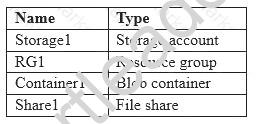
Another administrator deploys a virtual machine named VM1 and an Azure Storage account named Storage2 by using a single Azure Resource Manager template.
You need to view the template used for the deployment.
From which blade can you view the template that was used for the deployment?
- A. RG1
- B. VM1
- C. Storage1
- D. Container1
Answer: A
Explanation: 1. View template from deployment history
Go to the resource group for your new resource group. Notice that the portal shows the result of the last
deployment. Select this link.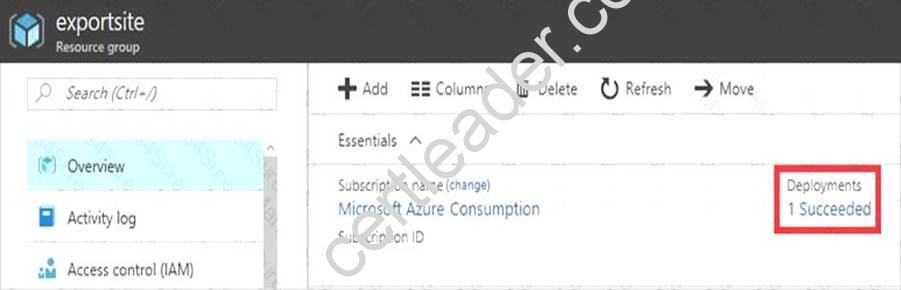
2. You see a history of deployments for the group. In your case, the portal probably lists only one deployment. Select this deployment.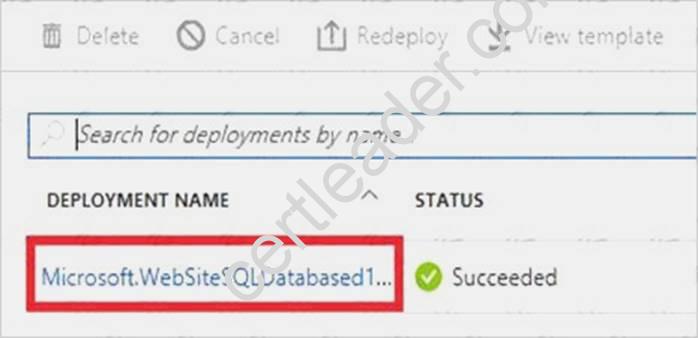
The portal displays a summary of the deployment. The summary includes the status of the deployment and its operations and the values that you provided for parameters. To see the template that you used for the deployment, select View template.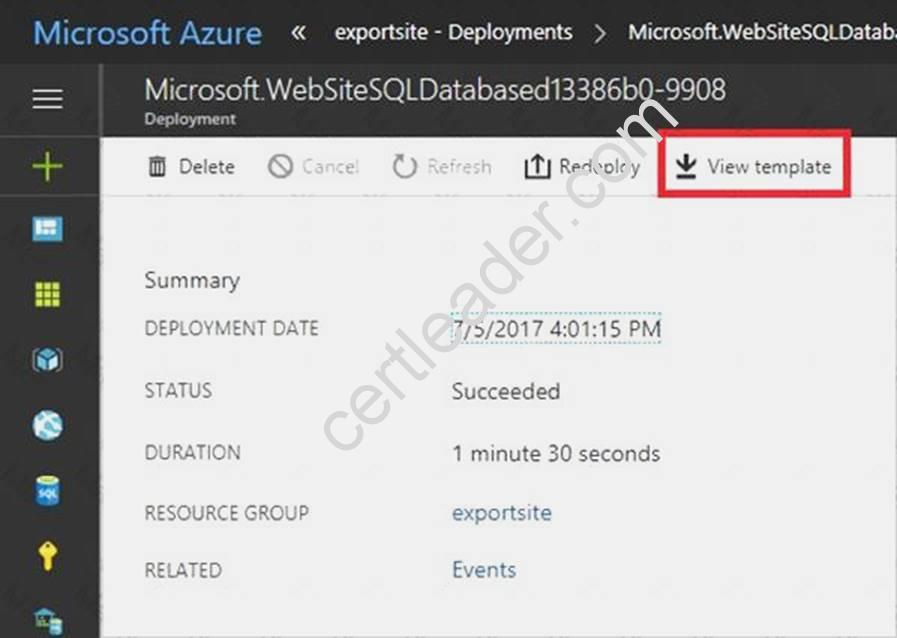
References:
https://docs.microsoft.com/en-us/azure/azure-resource-manager/resource-manager-export-template
NEW QUESTION 15
You plan to deploy five virtual machines to a virtual network subnet.
Each virtual machine will have a public IP address and a private IP address. Each virtual machine requires the same inbound and outbound security rules.
What is the minimum number of network interfaces and network security groups that you require? To answer, select the appropriate options in the answer area.
NOTE: Each correct selection is worth one point.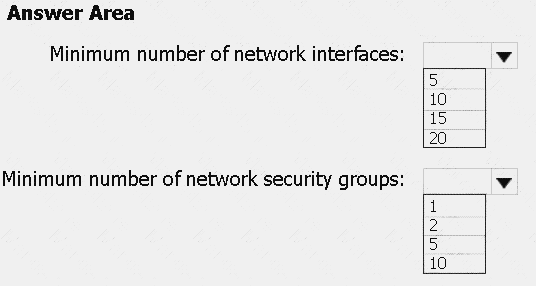
Answer:
Explanation: Box 1: 10
One public and one private network interface for each of the five VMs. Box 2: 1
You can associate zero, or one, network security group to each virtual network subnet and network interface in a virtual machine. The same network security group can be associated to as many subnets and network interfaces as you choose.
References:
https://docs.microsoft.com/en-us/azure/virtual-network/security-overview
NEW QUESTION 16
You have an Azure subscription that contains 10 virtual machines.
You need to ensure that you receive an email message when any virtual machines are powered off, restarted, or deallocated.
What is the minimum number of rules and action groups that you require?
- A. three rules and three action groups
- B. one rule and one action group
- C. three rules and one action group
- D. one rule and three action groups
Answer: C
Explanation: An action group is a collection of notification preferences defined by the user. Azure Monitor and Service
Health alerts are configured to use a specific action group when the alert is triggered. Various alerts may use the same action group or different action groups depending on the user's requirements.
References: https://docs.microsoft.com/en-us/azure/monitoring-and-diagnostics/monitoring-action-groups
NEW QUESTION 17
Your company registers a domain name of contoso.com.
You create an Azure DNS named contoso.com and then you add an A record to the zone for a host named www that has an IP address of 131.107.1.10.
You discover that Internet hosts are unable to resolve www.contoso.com to the 131.107.1.10 IP address. You need to resolve the name resolution issue.
Solution: You add an NS record to the contoso.com zone. Does this meet the goal?
- A. Yes
- B. No
Answer: A
Explanation: Before you can delegate your DNS zone to Azure DNS, you need to know the name servers for your zone. The NS record set contains the names of the Azure DNS name servers assigned to the zone.
References: https://docs.microsoft.com/en-us/azure/dns/dns-delegate-domain-azure-dns
NEW QUESTION 18
You need to prepare the environment to meet the authentication requirements.
Which two actions should you perform? Each correct answer presents part of the solution.
NOTE Each correct selection is worth one point.
- A. Azure Active Directory (AD) Identity Protection and an Azure policy
- B. a Recovery Services vault and a backup policy
- C. an Azure Key Vault and an access policy
- D. an Azure Storage account and an access policy
Answer: BD
Explanation: D: Seamless SSO works with any method of cloud authentication - Password Hash Synchronization or Pass-through Authentication, and can be enabled via Azure AD Connect.
B: You can gradually roll out Seamless SSO to your users. You start by adding the following Azure AD URL to all or selected users' Intranet zone settings by using Group Policy in Active Directory: https://autologon.microsoftazuread-sso.com
Topic 2, Contoso Ltd
Overview
Contoso, Ltd. is a manufacturing company that has offices worldwide. Contoso works with partner organizations to bring products to market.
Contoso products are manufactured by using blueprint files that the company authors and maintains.
Existing Environment
Currently, Contoso uses multiple types of servers for business operations, including the following:
File servers
Domain controllers
Microsoft SQL Server servers
Your network contains an Active Directory forest named contoso.com. All servers and client computers are joined to Active Directory.
You have a public-facing application named App1. App1 is comprised of the following three tiers:
A SQL database
A web front end
A processing middle tier
Each tier is comprised of five virtual machines. Users access the web front end by using HTTPS only.
Requirements Planned Changes
Contoso plans to implement the following changes to the infrastructure: Move all the tiers of App1 to Azure.
Move the existing product blueprint files to Azure Blob storage.
Create a hybrid directory to support an upcoming Microsoft Office 365 migration project.
Technical Requirements
Contoso must meet the following technical requirements:
Move all the virtual machines for App1 to Azure.
Minimize the number of open ports between the App1 tiers.
Ensure that all the virtual machines for App1 are protected by backups.
Copy the blueprint files to Azure over the Internet.
Ensure that the blueprint files are stored in the archive storage tier.
Ensure that partner access to the blueprint files is secured and temporary.
Prevent user passwords or hashes of passwords from being stored in Azure.
Use unmanaged standard storage for the hard disks of the virtual machines.
Ensure that when users join devices to Azure Active Directory (Azure AD), the users use a mobile phone to verify their identity.
Minimize administrative effort whenever possible.
User Requirements
Contoso identifies the following requirements for users:
Ensure that only users who are part of a group named Pilot can join devices to Azure AD. Designate a new user named Admin1 as the service administrator of the Azure subscription. Ensure that a new user named User3 can create network objects for the Azure subscription.
Recommend!! Get the Full AZ-100 dumps in VCE and PDF From DumpSolutions, Welcome to Download: https://www.dumpsolutions.com/AZ-100-dumps/ (New 106 Q&As Version)