Cause all that matters here is passing exam with AZ-102 Study Guides. Cause all that you need is a high score of AZ-102 Dumps. The only one thing you need to do is downloading AZ-102 Dumps free now. We will not let you down with our money-back guarantee.
Also have AZ-102 free dumps questions for you:
NEW QUESTION 1
SIMULATION
Click to expand each objective. To connect to the Azure portal, type https://portal.azure.com in the browser address bar.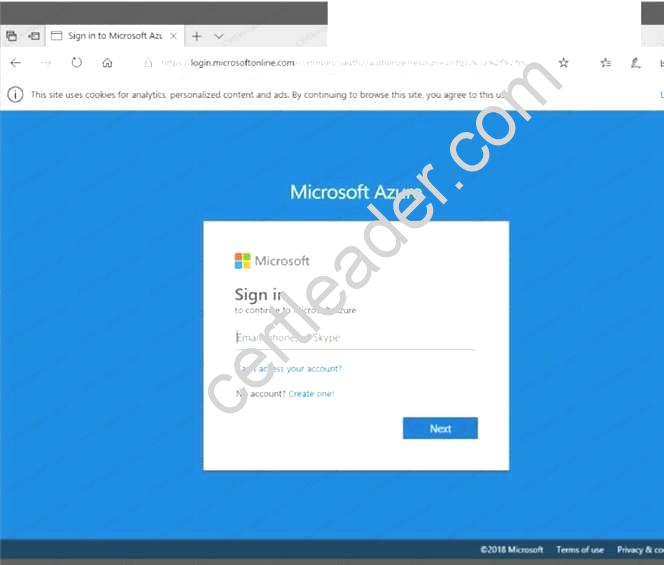
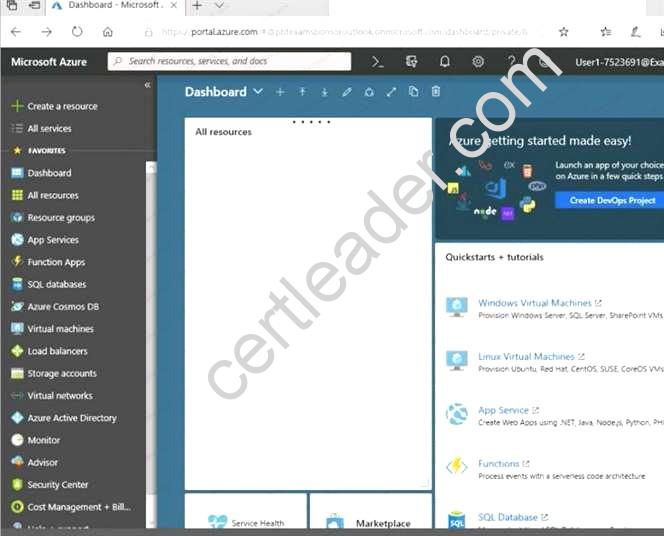
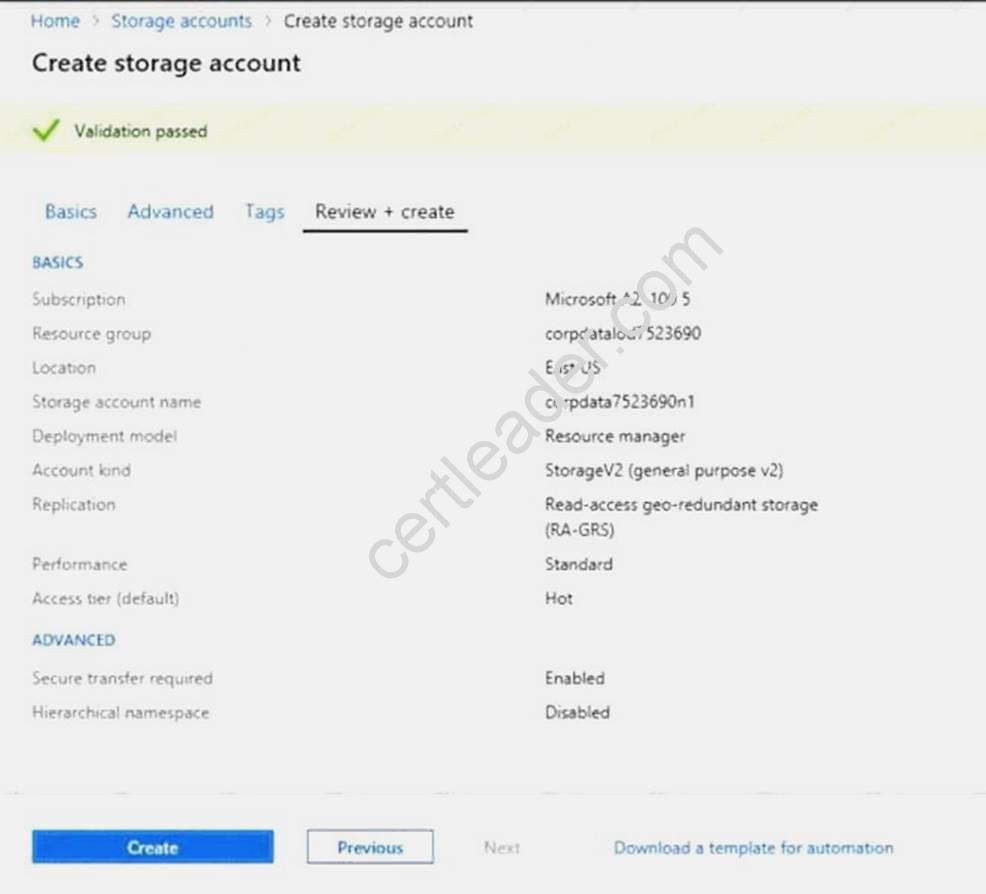
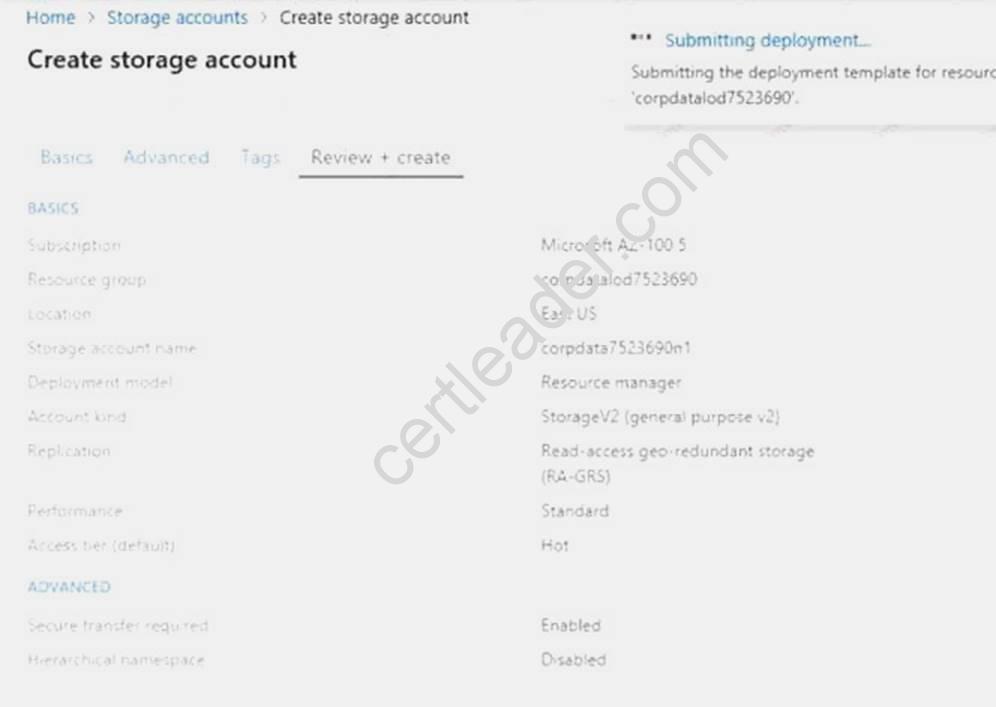
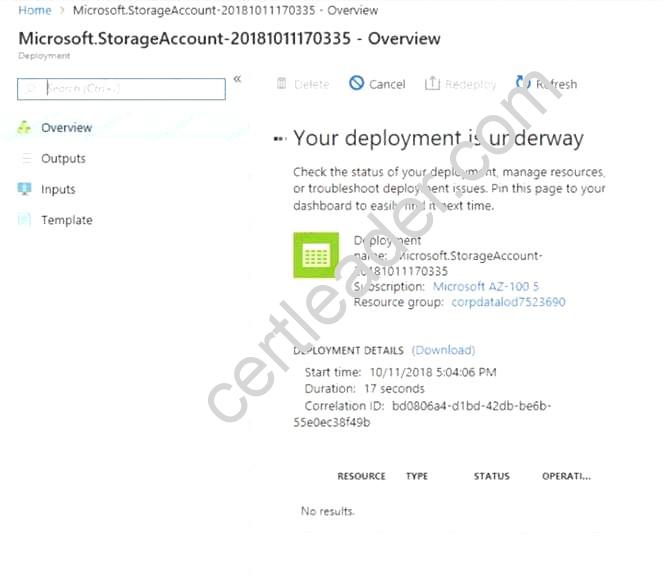
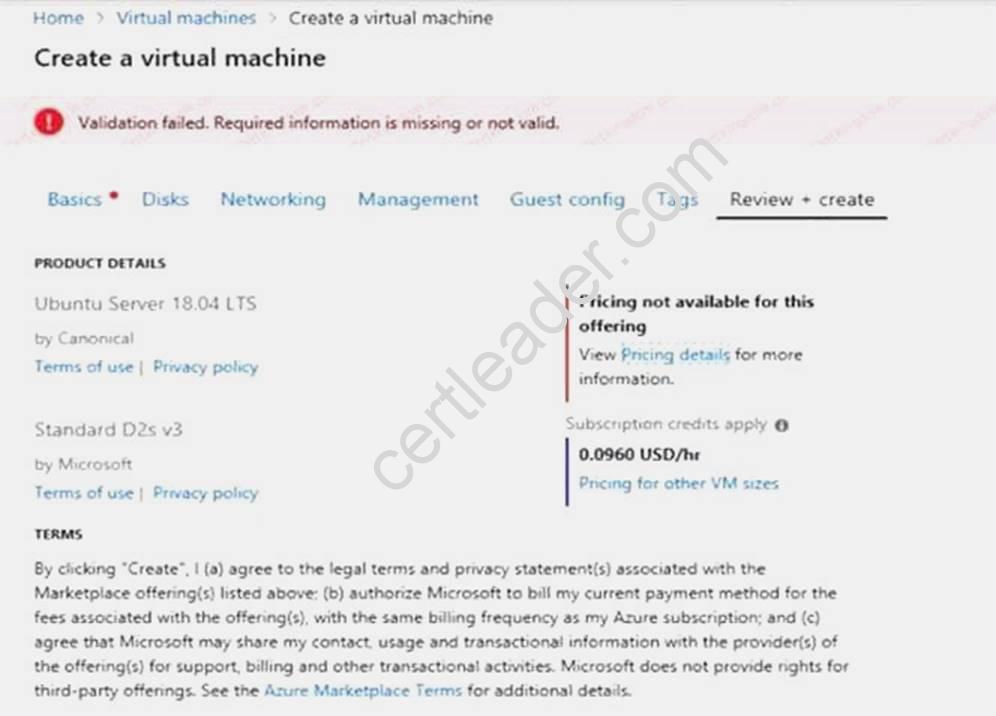
When you are finished performing all the tasks, click the ‘Next’ button.
Note that you cannot return to the lab once you click the ‘Next’ button. Scoring occur in the background while you complete the rest of the exam.
Overview
The following section of the exam is a lab. In this section, you will perform a set of tasks in a live environment. While most functionality will be available to you as it would be in a live environment, some functionality (e.g., copy and paste, ability to navigate to external websites) will not be possible by design. Scoring is based on the outcome of performing the tasks stated in the lab. In other words, it doesn’t matter how you accomplish the task, if you successfully perform it, you will earn credit for that task.
Labs are not timed separately, and this exam may have more than one lab that you must complete. You can use as much time as you would like to complete each lab. But, you should manage your time appropriately to ensure that you are able to complete the lab(s) and all other sections of the exam in the time provided.
Please note that once you submit your work by clicking the Next button within a lab, you will NOT be able to return to the lab.
To start the lab
You may start the lab by clicking the Next button.
You need to deploy two Azure virtual machines named VM1003a and VM1003b based on the Ubuntu Server 17.10 image. The deployment must meet the following requirements:
Provide a Service Level Agreement (SLA) of 99.95 percent availability. Use managed disks.
What should you do from the Azure portal?
Answer:
Explanation: 1. Open the Azure portal.
2. On the left menu, select All resources. You can sort the resources by Type to easily find your images.
3. Select the image you want to use from the list. The image Overview page opens.
4. Select Create VM from the menu.
5. Enter the virtual machine information.
Select VM1003a as the name for the first Virtual machine.
The user name and password entered here will be used to log in to the virtual machine. When complete, select OK. You can create the new VM in an existing resource group, or choose Create new to create a new resource group to store the VM.
6. Select a size for the VM. To see more sizes, select View all or change the Supported disk type filter.
7. Under Settings, make changes as necessary and select OK.
8. On the summary page, you should see your image name listed as a Private image. Select Ok to start the virtual machine deployment.
Repeat the procedure for the second VM and name it VM1003b.
References: https://docs.microsoft.com/en-us/azure/virtual-machines/windows/create-vmgeneralized- managed
NEW QUESTION 2
You have an Azure subscription.
You enable multi-factor authentication for all users.
Some users report that the email applications on their mobile device cannot co browser and from Microsoft Outlook 2021 on their computer.
You need to ensure that the users can use the email applications on their mobile device. What should you instruct the users to do?
The users can access Exchange Online by using a web
- A. Enable self-service password reset.
- B. Create an app password.
- C. Reset the Azure Active Directory (Azure AD) password.
- D. Reinstall the Microsoft Authenticator app.
Answer: A
Explanation: References:
https://docs.microsoft.com/en-us/azure/active-directory/authentication/concept-sspr-howitworks
NEW QUESTION 3
Which blade should you instruct the finance department auditors to use?
- A. invoices
- B. partner information
- C. cost analysis
- D. External services
Answer: A
NEW QUESTION 4
You have two subscriptions named Subscription1 and Subscription2. Each subscription is associated to a different Azure AD tenant.
Subscription1 contains a virtual network named VNet1.VNet1 contains an Azure virtual machine named VM1 and has an IP address space of 10.0.0.0/16.
Subscription2 contains a virtual network named VNet2. VNet2 contains an Azure virtual machine named VM2 and has an IP address space of 10.10.0.0/24.
You need to connect VNet1 to VNet2. What should you do first?
- A. Move VNet1 to Subscription2.
- B. Modify the IP address space of VNet2.
- C. Provision virtual network gateways.
- D. Move VM1 to Subscription2.
Answer: C
Explanation: The virtual networks can be in the same or different regions, and from the same or different subscriptions. When connecting VNets from different subscriptions, the subscriptions do not need to
be associated with the same Active Directory tenant.
Configuring a VNet-to-VNet connection is a good way to easily connect VNets. Connecting a virtual network to another virtual network using the VNet-to-VNet connection type (VNet2VNet) is similar to creating a Site-to-Site IPsec connection to an on-premises location. Both connectivity types use a VPN gateway to provide a secure tunnel using IPsec/IKE, and both function the same way when communicating.
The local network gateway for each VNet treats the other VNet as a local site. This lets you specify additional address space for the local network gateway in order to route traffic.
References: https://docs.microsoft.com/en-us/azure/vpn-gateway/vpn-gateway-howto-vnet-vnetresource- manager-portal
NEW QUESTION 5
HOT SPOT
You need to prepare the environment to implement the planned changes for Server2. What should you do? To answer, select the appropriate options in the answer area. NOTE: Each correct selection is worth one point.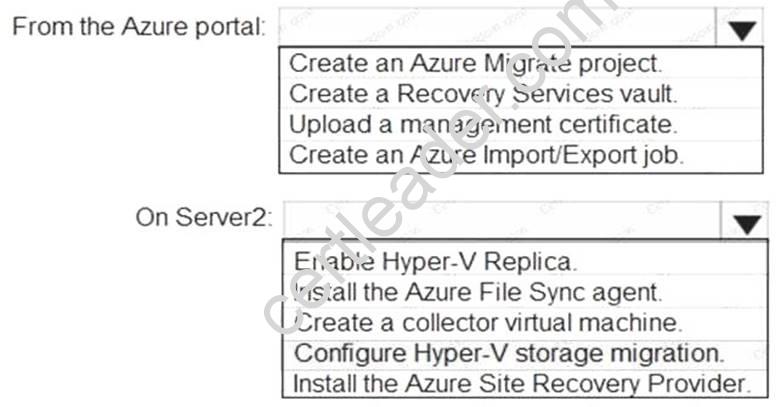
Answer:
Explanation: Box 1: Create a Recovery Services vault
Create a Recovery Services vault on the Azure Portal. Box 2: Install the Azure Site Recovery Provider
Azure Site Recovery can be used to manage migration of on-premises machines to Azure. Scenario: Migrate the virtual machines hosted on Server1 and Server2 to Azure.
Server2 has the Hyper-V host role. References:
https://docs.microsoft.com/en-us/azure/site-recovery/migrate-tutorial-on-premises-azure
Case Study: 8
Mix Questions Set C (Evaluate and perform server migration to Azure)
NEW QUESTION 6
Your company recently hired a user named janet-7509087@ExamUsers.com.
You need to ensure that janet-7509087@ ExamUsers.com can connect to load balancer named Web- LAB. The solution must ensure that janet-7509087@ ExamUsers.com can modify the backend pools. What should you do from the Azure portal?
Answer:
Explanation: Step 1:
In the navigation list, choose Load Balancer.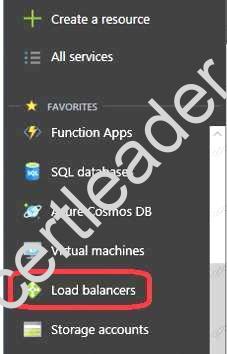
Step 2:
Locate the load balancer named Web-ALB, and click the Access icon. Step3:
In the Users blade, click Roles. In the Roles blade, click Add to add permissions for the user Janet- 7509087@ExamUsers.com.
Step 4:
Add permission to modify backend pools References:
https://docs.microsoft.com/en-us/azure/azure-stack/azure-stack-manage-permissions
NEW QUESTION 7
You have an Azure subscription that contains 100 virtual machines. You regularly create and delete virtual machines.
You need to identify unused disks that can be deleted. What should you do?
- A. From Microsoft Azure Storage Explorer, view the Account Management properties.
- B. From the Azure portal, configure the Advisor recommendations.
- C. From Cloudyn, open the Optimizer tab and create a report.
- D. From Cloudyn, create a Cost Management repor
Answer: A
Explanation: You can find unused disks in the Azure Storage Explorer console. Once you drill down to the Blob containers under a storage account, you can see the lease state of the residing VHD (the lease state determines if the VHD is being used by any resource) and the VM to which it is leased out. If you find that the lease state and the VM fields are blank, it means that the VHD in question is unused.
Note: The ManagedBy property stores the Id of the VM to which Managed Disk is attached to. If the ManagedBy property is $null then it means that the Managed Disk is not attached to a VM References:
https://cloud.netapp.com/blog/reduce-azure-storage-costs
NEW QUESTION 8
You have an Azure subscription named Subscription1. Subscription1 contains a virtual machine named VM1.
You have a computer named Computer1 that runs Windows 10. Computer1 is connected to the Internet.
You add a network interface named Interface1 to VM1 as shown in the exhibit (Click the Exhibit button.)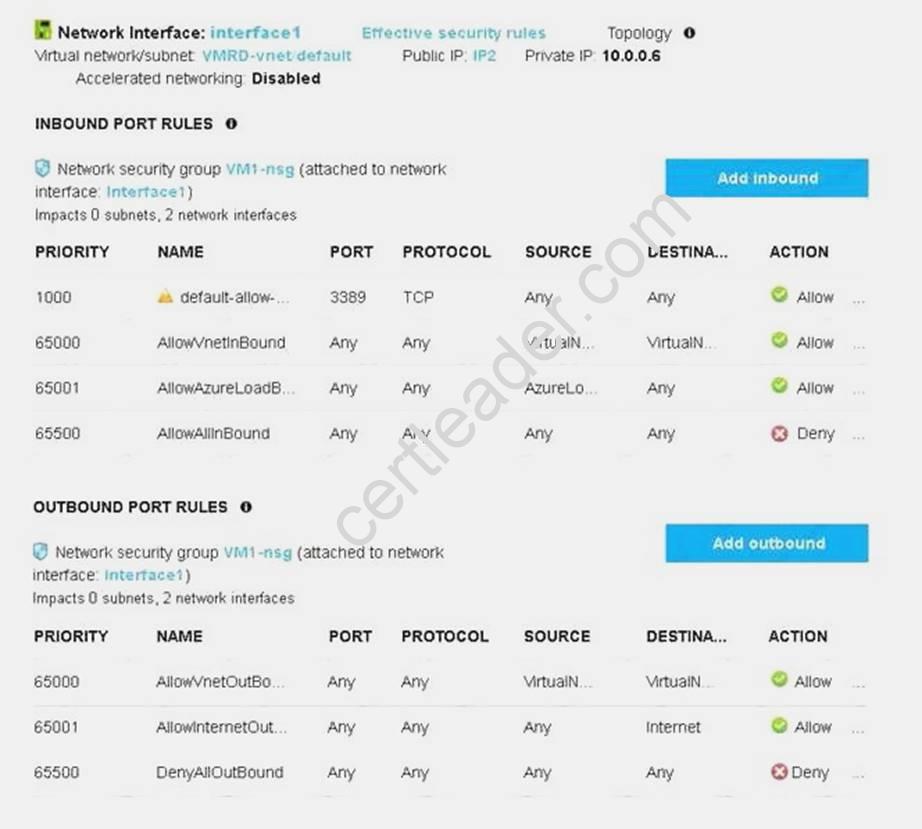
From Computer1, you attempt to connect to VM1 by using Remote Desktop, but the connection fails. You need to establish a Remote Desktop connection to VM1.
What should you do first?
- A. Start VM1.
- B. Attach a network interface.
- C. Delete the DenyAllOutBound outbound port rule.
- D. Delete the DenyAllInBound inbound port rul
Answer: A
Explanation: Incorrect Answers:
B: The network interface has already been added to VM. C: The Outbound rules are fine.
D: The inbound rules are fine. Port 3389 is used for Remote Desktop.
Note: Rules are processed in priority order, with lower numbers processed before higher numbers, because lower numbers have higher priority. Once traffic matches a rule, processing stops. As a result, any rules that exist with lower priorities (higher numbers) that have the same attributes as rules with higher priorities are not processed.
References: https://docs.microsoft.com/en-us/azure/virtual-network/security-overview
NEW QUESTION 9
HOT SPOT
You plan to use Azure Network Watcher to perform the following tasks:
Task1: Identify a security rule that prevents a network packet from reaching an Azure virtual machine.
Task2: Validate outbound connectivity from an Azure virtual machine to an external host.
Which feature should you use for each task? To answer, select the appropriate options in the answer area.
NOTE: Each correct selection is worth one point.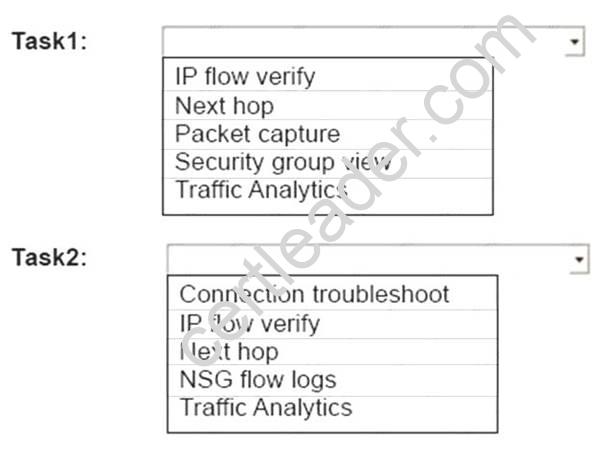
Answer:
Explanation: Task 1: IP flow verify
IP flow verify checks if a packet is allowed or denied to or from a virtual machine. The information consists of direction, protocol, local IP, remote IP, local port, and remote port. If the packet is denied by a security group, the name of the rule that denied the packet is returned. While any source or destination IP can be chosen, IP flow verify helps administrators quickly diagnose connectivity issues from or to the internet and from or to the on-premises environment.
Task 2:
With the addition of Connection Troubleshoot, Network Watcher will see an incremental increase in its capabilities and ways for you to utilize it in your day to day operations. You can now, for example, check connectivity between source (VM) and destination (VM, URI, FQDN, IP Address). References:
https://docs.microsoft.com/en-us/azure/network-watcher/network-watcher-ip-flow-verify-overview https://azure.microsoft.com/en-us/blog/network-watcher-connection-troubleshoot-now-generallyavailable/
NEW QUESTION 10
Your company registers a domain name of contoso.com.
You create an Azure DNS named contoso.com and then you add an A record to the zone for a host named www that has an IP address of 131.107.1.10.
You discover that Internet hosts are unable to resolve www.contoso.com to the 131.107.1.10 IP address.
You need to resolve the name resolution issue.
Solution: You add an NS record to the contoso.com zone. Does this meet the goal?
- A. Yes
- B. No
Answer: A
Explanation: Before you can delegate your DNS zone to Azure DNS, you need to know the name servers for your
zone. The NS record set contains the names of the Azure DNS name servers assigned to the zone. References: https://docs.microsoft.com/en-us/azure/dns/dns-delegate-domain-azure-dns
NEW QUESTION 11
HOT SPOT
You have an Azure subscription named Subscription1.
You have a virtualization environment that contains the virtualization servers in the following table.
The virtual machines are configured as shown in the following table.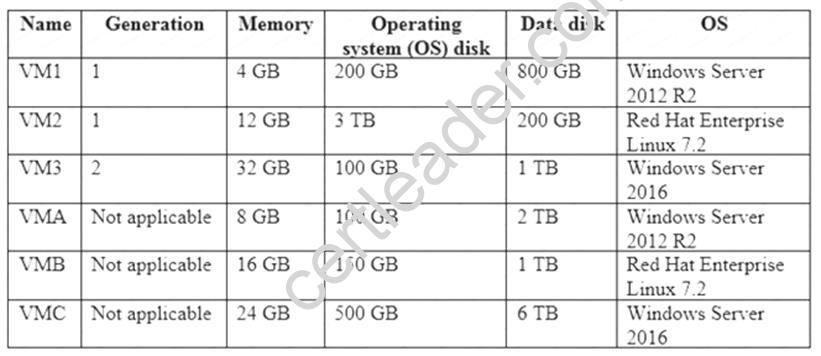
All the virtual machines use basic disks. VM1 is protected by using BitLocker Drive Encryption (BitLocker).
You plan to use Azure Site Recovery to migrate the virtual machines to Azure.
Which virtual machines can you migrate? To answer, select the appropriate options in the answer area. NOTE: Each correct selection is worth one point.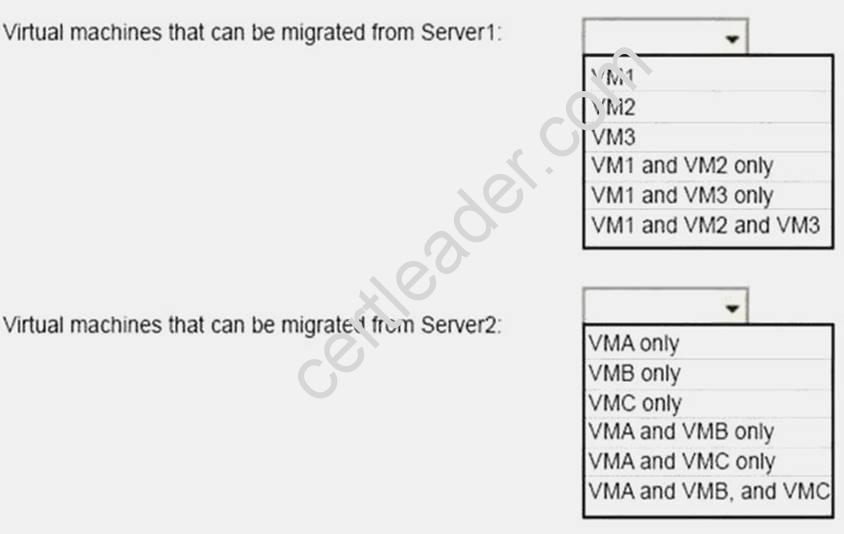
Answer:
Explanation: Box 1: VM3
Not VM1 as Bitlocker is not supported. BitLocker must be disabled before you enable replication for a VM.
Not VM2 as maximum Operating system disk size for a generation VM is 2,048 GB. Box 2: VMA and VMB only
Not VMC as the max data disk size is 4,095 GB References:
https://docs.microsoft.com/en-us/azure/site-recovery/hyper-v-azure-support-matrix https://docs.microsoft.com/en-us/azure/site-recovery/vmware-physical-azure-supportmatrix# azure-vm-requirements
NEW QUESTION 12
HOT SPOT
Your company has offices in New York and Los Angeles.
You have an Azure subscription that contains an Azure virtual network named VNet1. Each office has a site-to-site VPN connection to VNet1.
Each network uses the address spaces shown in the following table.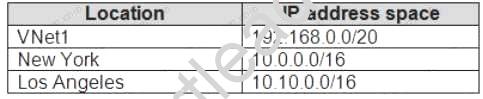
You need to ensure that all Internet-bound traffic from VNet1 is routed through the New York office. What should you do? To answer, select the appropriate options in the answer area.
NOTE: Each correct selection is worth one point.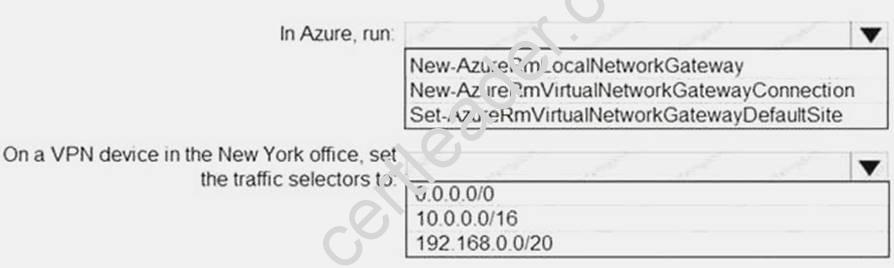
Answer:
Explanation: Incorrect Answers:
Not: New-AzureRmVirtualNetworkGatewayConnection
This command creates the Site-to-Site VPN connection between the virtual network gateway and the on-prem VPN device. We already have Site-to-Site VPN connections.
Box 2: 192.168.0.0/20
Specify the VNET1 address. References:
https://docs.microsoft.com/en-us/powershell/module/azurerm.network/setazurermvirtualnetworkgatewaydefaultsite
NEW QUESTION 13
You have an Azure DNS zone named adatum.com. You need to delegate a subdomain named research.adatum.com to a different DNS server in Azure. What should you do?
- A. Create an PTR record named research in the adatum.com zone.
- B. Create an NS record named research in the adatum.com zone.
- C. Modify the SOA record of adatum.com.
- D. Create an A record named “.research in the adatum.com zon
Answer: D
Explanation: Configure A records for the domains and sub domains.
References: http://www.stefanjohansson.org/2012/12/how-to-configure-custom-dns-names-formultiple- subdomain-based-azure-web-sites/
NEW QUESTION 14
You have an Azure Active Directory (Azure AD) tenant named contosocloud.onmicrosoft.com. Your company has a public DNS zone for contoso.com.
You add contoso.com as a custom domain name to Azure AD. You need to ensure that Azure can verify the domain name.
Which type of DNS record should you create?
- A. RRSIG
- B. PTR
- C. DNSKEY
- D. TXT
Answer: D
Explanation: Create the TXT record. App Services uses this record only at configuration time to verify that you own the custom domain. You can delete this TXT record after your custom domain is validated and configured in App Service.
References: https://docs.microsoft.com/en-us/azure/dns/dns-web-sites-custom-domain
NEW QUESTION 15
Your company has an Azure subscription named Subscription1.
The company also has two on-premises servers named Server1 and Server2 that run Windows Server 2021. Server1 is configured as a DNS server that has a primary DNS zone named adatum.com. Adatum.com contains 1,000 DNS records.
You manage Server1 and Subscription1 from Server2. Server2 has the following tools installed: The DNS Manager console
Azure PowerShell Azure CLI 2.0
You need to move the adatum.com zone to Subscription1. The solution must minimize administrative effort.
What should you use?
- A. Azure PowerShell
- B. Azure CLI
- C. the Azure portal
- D. the DNS Manager console
Answer: B
Explanation: Azure DNS supports importing and exporting zone files by using the Azure command-line interface (CLI). Zone file import is not currently supported via Azure PowerShell or the Azure portal. References: https://docs.microsoft.com/en-us/azure/dns/dns-import-export
NEW QUESTION 16
You plan to support many connections to your company's automatically uses up to five instances when CPU utilization on the instances exceeds 70 percent for 10 minutes. When CPU utilization decreases, the solution must automatically reduce the number of instances.
What should you do from the Azure portal?
Answer:
Explanation: Step 1:
Locate the Homepage App Service plan Step 2:
Click Add a rule, and enter the appropriate fields, such as below, and the click Add. Time aggregation: average
Metric Name: Percentage CPU Operator: Greater than Threshold 70
Duration: 10 minutes Operation: Increase count by Instance count: 4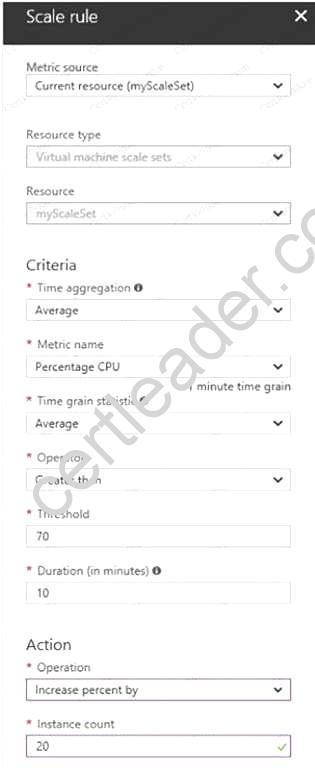
Step 3:
We must add a scale in rule as well. Click Add a rule, and enter the appropriate fields, such as below, then click Add.
Operator: Less than
Threshold 70
Duration: 10 minutes Operation: Decrease count by Instance count: 4 References:
https://docs.microsoft.com/en-us/azure/virtual-machine-scale-sets/virtual-machine-scale-setsautoscale- portal
https://docs.microsoft.com/en-us/azure/monitoring-and-diagnostics/insights-autoscale-bestpractices
NEW QUESTION 17
DRAG DROP
You are developing an Azure web app named WebApp1. WebApp1 uses an Azure App Service plan named Plan1 that uses the B1 pricing tier.
You need to configure WebApp1 to add additional instances of the app when CPU usage exceeds 70 percent for 10 minutes.
Which three actions should you perform in sequence? To answer, move the appropriate actions from the list of actions to the answer area and arrange them in the correct order.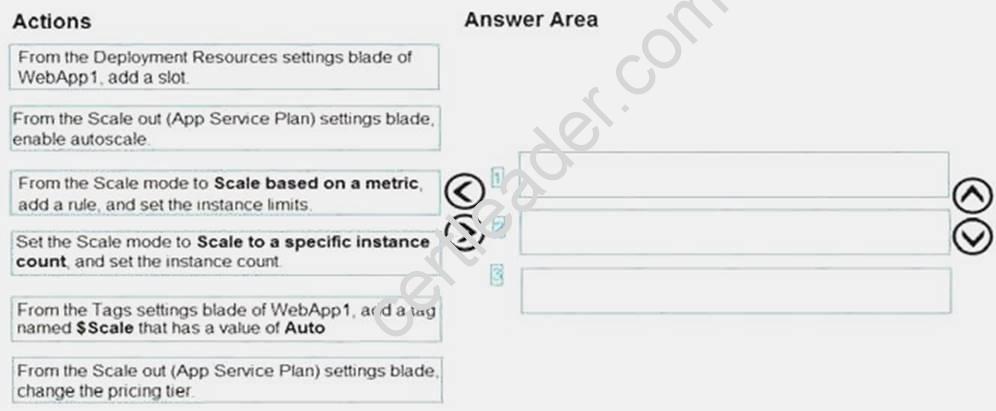
Answer:
Explanation: Box 1: From the Scale out (App Service Plan) settings blade, change the pricing tier The B1 pricing tier only allows for 1 core. We must choose another pricing tier. Box 2: From the Scale out (App Service Plan) settings blade, enable autoscale
Log in to the Azure portal at http://portal.azure.com Navigate to the App Service you would like to autoscale. Select Scale out (App Service plan) from the menu
Click on Enable autoscale. This activates the editor for scaling rules.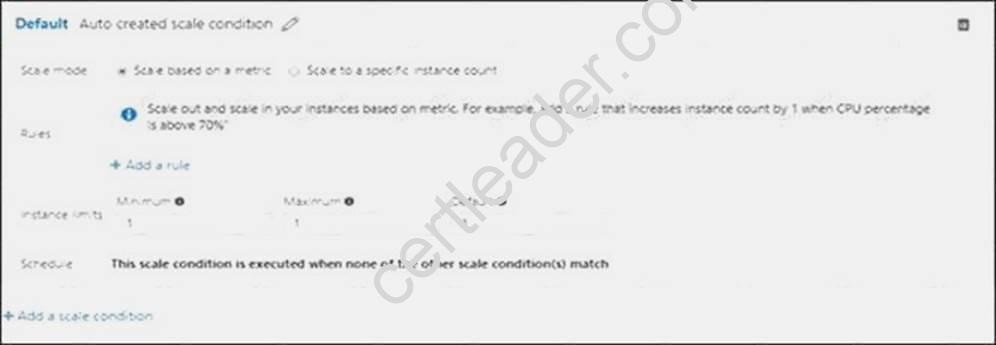
Box 3: From the Scale mode to Scale based on metric, add a rule, and set the instance limits.
Click on Add a rule. This shows a form where you can create a rule and specify details of the scaling. References:
https://azure.microsoft.com/en-us/pricing/details/app-service/windows/ https://blogs.msdn.microsoft.com/hsirtl/2021/07/03/autoscaling-azure-web-apps/
NEW QUESTION 18
You have two Azure virtual networks named VNet1 and VNet2. VNet1 contains an Azure virtual
machine named VM1. VNet2 contains an Azure virtual machine named VM2. VM1 hosts a frontend application that connects to VM2 to retrieve data. Users report that the frontend application is slower than usual.
You need to view the average round-trip time (RTT) of the packets from VM1 to VM2. Which Azure Network Watcher feature should you use?
- A. NSG flow logs
- B. Connection troubleshoot
- C. IP flow verify
- D. Connection monitor
Answer: D
Explanation: The Connection Monitor feature in Azure Network Watcher is now generally available in all public regions. Connection Monitor provides you RTT values on a per-minute granularity. You can monitor a direct TCP connection from a virtual machine to a virtual machine, FQDN, URI, or IPv4 address. References:
https://azure.microsoft.com/en-us/updates/general-availability-azure-network-watcher-connectionmonitor- in-all-public-regions/
NEW QUESTION 19
You have an Azure subscription that contains 10 virtual machines.
You need to ensure that you receive an email message when any virtual machines are powered off, restarted, or deallocated.
What is the minimum number of rules and action groups that you require?
- A. three rules and three action groups
- B. one rule and one action group
- C. three rules and one action group
- D. one rule and three action groups
Answer: C
Explanation: An action group is a collection of notification preferences defined by the user. Azure Monitor and Service
Health alerts are configured to use a specific action group when the alert is triggered. Various alerts may use the same action group or different action groups depending on the user's requirements. References: https://docs.microsoft.com/en-us/azure/monitoring-and-diagnostics/monitoring-actiongroups
P.S. Easily pass AZ-102 Exam with 195 Q&As Certleader Dumps & pdf Version, Welcome to Download the Newest Certleader AZ-102 Dumps: https://www.certleader.com/AZ-102-dumps.html (195 New Questions)