Master the SOA-C01 AWS Certified SysOps Administrator - Associate content and be ready for exam day success quickly with this Pass4sure SOA-C01 exam. We guarantee it!We make it a reality and give you real SOA-C01 questions in our Amazon-Web-Services SOA-C01 braindumps.Latest 100% VALID Amazon-Web-Services SOA-C01 Exam Questions Dumps at below page. You can use our Amazon-Web-Services SOA-C01 braindumps and pass your exam.
Free demo questions for Amazon-Web-Services SOA-C01 Exam Dumps Below:
NEW QUESTION 1
A media company produces new video files on-premises every day with a total size of around 100GBS after compression All files have a size of 1 - 2 GB and need to be uploaded to Amazon S3 every night in a fixed time window between 3am and 5am Current upload takes almost 3 hours, although less than half of the available bandwidth is used.
What step(s) would ensure that the file uploads are able to complete in the allotted time window?
- A. Increase your network bandwidth to provide faster throughput to S3
- B. Upload the files in parallel to S3
- C. Pack all files into a single archive, upload it to S3, then extract the files in AWS
- D. Use AWS Import/Export to transfer the video files
Answer: B
Explanation:
Reference:
https://aws.amazon.com/blogs/aws/amazon-s3-multipart-upload/
NEW QUESTION 2
A user has configured a VPC with a new subnet. The user has created a security group. The user wants to configure that instances of the same subnet communicate with each other. How can the user configure this with the security group?
- A. There is no need for a security group modification as all the instances can communicate with each other inside the same subnet
- B. Configure the subnet as the source in the security group and allow traffic on all the protocols and ports
- C. Configure the security group itself as the source and allow traffic on all the protocols and ports
- D. The user has to use VPC peering to configure this
Answer: C
Explanation:
A Virtual Private Cloud (VPC. is a virtual network dedicated to the user??s AWS account. AWS provides two features that the user can use to increase security in VPC: security groups and network ACLs. Security groups work at the instance level. If the user is using the default security group it will have a rule which allows the instances to communicate with other. For a new security group the user has to specify the rule, add it to define the source as the security group itself, and select all the protocols and ports for that source.
NEW QUESTION 3
A user has configured an EC2 instance in the US-East-1a zone. The user has enabled detailed monitoring of the instance. The user is trying to get the data from CloudWatch using a CLI. Which of the below mentioned CloudWatch endpoint URLs should the user use?
- A. monitoring.us-east-1.amazonaws.com
- B. monitoring.us-east-1-a.amazonaws.com
- C. monitoring.us-east-1a.amazonaws.com
- D. cloudwatch.us-east-1a.amazonaws.com
Answer: A
Explanation:
The CloudWatch resources are always region specific and they will have the end point as region specific. If the user is trying to access the metric in the US-East-1 region, the endpoint URL will be: monitoring.us-east- 1.amazonaws.com
NEW QUESTION 4
A user has created an ELB with the availability zone US-East-1
- A. The user wants to add more zones to ELB to achieve High Availabilit
- B. How can the user add more zones to the existing ELB?
- C. It is not possible to add more zones to the existing ELB
- D. The only option is to launch instances in different zones and add to ELB
- E. The user should stop the ELB and add zones and instances as required
- F. The user can add zones on the fly from the AWS console
Answer: D
Explanation:
The user has created an Elastic Load Balancer with the availability zone and wants to add more zones to the existing ELB. The user can do so in two ways:
From the console or CLI, add new zones to ELB;
Launch instances in a separate AZ and add instances to the existing ELB.
NEW QUESTION 5
A SysOps Administrator must run a script on production servers to fix an issue. The company has a policy block all remote interface access to production servers. The Based on this situation how should the Administrator execute the script?
- A. Share and use the Amazon EC2 key pairs to gain access to the servers and run the script
- B. Put the script into the user data of the instances
- C. Configure the script to run as a cron job or scheduled task on the EC2 instances
- D. Use Amazon EC2 Systems Manager to run the script
Answer: A
Explanation:
https://aws.amazon.com/getting-started/tutorials/deploy-code-vm/
NEW QUESTION 6
A user is measuring the CPU utilization of a private data centre machine every minute. The machine provides the aggregate of data every hour, such as Sum of data??, ??Min value??, ??Max value, and ??Number of Data points??.
The user wants to send these values to CloudWatch. How can the user achieve this?
- A. Send the data using the put-metric-data command with the aggregate-values parameter
- B. Send the data using the put-metric-data command with the average-values parameter
- C. Send the data using the put-metric-data command with the statistic-values parameter
- D. Send the data using the put-metric-data command with the aggregate ?Vdata parameter
Answer: C
Explanation:
AWS CloudWatch supports the custom metrics. The user can always capture the custom data and upload the data to CloudWatch using CLI or APIs. The user can publish the data to CloudWatch as single data points or as an aggregated set of data points called a statistic set using the command put- metric-data. When sending the aggregate data, the user needs to send it with the parameter statistic-values:
awscloudwatch put-metric-data --metric-name <Name> --namespace <Custom namespace -- timestamp
<UTC Format> --statistic-values Sum=XX,Minimum=YY,Maximum=AA,SampleCount=BB --unit Milliseconds
NEW QUESTION 7
A user has created a VPC with two subnets: one public and one private. The user is planning to run the patch update for the instances in the private subnet. How can the instances in the private subnet connect to theinternet?
- A. Use the internet gateway with a private IP
- B. Allow outbound traffic in the security group for port 80 to allow internet updates
- C. The private subnet can never connect to the internet
- D. Use NAT with an elastic IP
Answer: D
Explanation:
A Virtual Private Cloud (VPC. is a virtual network dedicated to the user??s AWS account. A user can create a subnet with VPC and launch instances inside that subnet. If the user has created two subnets (one private and one public., he would need a Network Address Translation (NAT. instance with the elastic IP address. This enables the instances in the private subnet to send requests to the internet (for example, to perform software updates..
NEW QUESTION 8
Which of the following statements about this S3 bucket policy is true?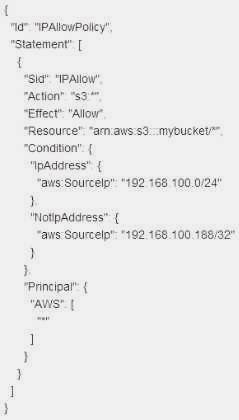
- A. Denies the server with the IP address 192 168 100 0 full access to the "mybucket" bucket
- B. Denies the server with the IP address 192 168 100 188 full access to the "mybucket" bucket
- C. Grants all the servers within the 192 168 100 0/24 subnet full access to the "mybucket" bucket
- D. Grants all the servers within the 192 168 100 188/32 subnet full access to the "mybucket" bucket
Answer: B
NEW QUESTION 9
A user has created a subnet in VPC and launched an EC2 instance within it. The user has not selected the option to assign the IP address while launching the instance. The user has 3 elastic IPs and is trying to assign one of the Elastic IPs to the VPC instance from the console. The console does not show any instance in the IP assignment screen. What is a possible reason that the instance is unavailable in the assigned IP console?
- A. The IP address may be attached to one of the instances
- B. The IP address belongs to a different zone than the subnet zone
- C. The user has not created an internet gateway
- D. The IP addresses belong to EC2 Classic; so they cannot be assigned to VPC
Answer: D
Explanation:
A Virtual Private Cloud (VPC. is a virtual network dedicated to the user??s AWS account. A user can create a subnet with VPC and launch instances inside that subnet. When the user is launching an instance he needs toselect an option which attaches a public IP to the instance. If the user has not selected the option to attach the public IP then it will only have a private IP when launched. If the user wants to connect to an instance from the internet he should create an elastic IP with VPC. If the elastic IP is a part of EC2 Classic it cannot be assigned to a VPC instance.
NEW QUESTION 10
An organization must reduce unexpected overages in spending, and a SysOps administrator has been asked to automate a report of the AWS environment.
How can this be accomplished with MINIMAL effort?
- A. Set spending limits in AWS Trusted Advisor and enable weekly email reports.
- B. Set up an AWS Lambda function to send AWS Cost and Usage reports through email
- C. Use Amazon Inspector to alert if predefined spending threshold are exceeded.
- D. Configure a customer budget with email alter through API actions for AWS Budgets.
Answer: D
Explanation:
https://docs.aws.amazon.com/sdk-for-go/api/service/budgets/
NEW QUESTION 11
A user is planning to use AWS CloudFormation. Which of the below mentioned functionalities does not help him to correctly understand CloudFormation?
- A. CloudFormation follows the DevOps model for the creation of Dev & Test
- B. AWS CloudFormation does not charge the user for its service but only charges for the AWS resources created with it.
- C. CloudFormation works with a wide variety of AWS services, such as EC2, EBS, VPC, IAM, S3, RDS, ELB, etc.
- D. CloudFormation provides a set of application bootstrapping scripts which enables the user to install Software.
Answer: A
Explanation:
AWS CloudFormation is an application management tool which provides application modelling, deployment, configuration, management and related activities. It supports a wide variety of AWS services, such as EC2, EBS, AS, ELB, RDS, VPC, etc. It also provides application bootstrapping scripts which enable the user to install software packages or create folders. It is free of the cost and only charges the user for the services created with it. The only challenge is that it does not follow any model, such as DevOps; instead customers can define templates and use them to provision and manage the AWS resources in an orderly way.
NEW QUESTION 12
A user has created a VPC with public and private subnets using the VPC wizard. Which of the below mentioned statements is true in this scenario?
- A. The AWS VPC will automatically create a NAT instance with the micro size
- B. VPC bounds the main route table with a private subnet and a custom route table with a public subnet
- C. The user has to manually create a NAT instance
- D. VPC bounds the main route table with a public subnet and a custom route table with a private subnet
Answer: B
Explanation:
A Virtual Private Cloud (VPC. is a virtual network dedicated to the user??s AWS account. A user can create a subnet with VPC and launch instances inside that subnet. If the user has created a public private subnet, the instances in the public subnet can receive inbound traffic directly from the internet, whereas the instances in the private subnet cannot. If these subnets are created with Wizard, AWS will create a NAT instance of a smaller or higher size, respectively. The VPC has an implied router and the VPC wizard updates the main route table used with the private subnet, creates a custom route table and associates it with the public subnet.
NEW QUESTION 13
A user is launching an EC2 instance in the US East region. Which of the below mentioned options is recommended by AWS with respect to the selection of the availability zone?
- A. Always select the US-East-1-a zone for HA
- B. Do not select the AZ; instead let AWS select the AZ
- C. The user can never select the availability zone while launching an instance
- D. Always select the AZ while launching an instance
Answer: B
Explanation:
When launching an instance with EC2, AWS recommends not to select the availability zone (AZ. AWS specifies that the default Availability Zone should be accepted. This is because it enables AWS to select the best Availability Zone based on the system health and available capacity. If the user launches additional instances, only then an Availability Zone should be specified. This is to specify the same or different AZ from the running instances.
NEW QUESTION 14
An organization has setup multiple IAM users. The organization wants that each IAM user accesses the IAM console only within the organization and not from outside. How can it achieve this?
- A. Create an IAM policy with the security group and use that security group for AWS console login
- B. Create an IAM policy with a condition which denies access when the IP address range is not from the organization
- C. Configure the EC2 instance security group which allows traffic only from the organization??s IP range
- D. Create an IAM policy with VPC and allow a secure gateway between the organization and AWS Console
Answer: B
Explanation:
AWS Identity and Access Management is a web service which allows organizations to manage users and user permissions for various AWS services. The user can add conditions as a part of the IAM policies. The condition can be set on AWS Tags, Time, and Client IP as well as on many other parameters. If the organization wants the user to access only from a specific IP range, they should set an IAM policy condition which denies access when the IP is not in a certain range. E.g. The sample policy given below denies all traffic when the IP is not in a certain range.
"Statement": [{
"Effect": "Deny",
"Action": "*",
"Resource": "*", "Condition": { "NotIpAddress": {
"aws:SourceIp": ["10.10.10.0/24", "20.20.30.0/24"]
}
}
}]
NEW QUESTION 15
A user has setup an EBS backed instance and a CloudWatch alarm when the CPU utilization is more than 65%. The user has setup the alarm to watch it for 5 periods of 5 minutes each. The CPU utilization is 60% between 9 AM to 6 PM. The user has stopped the EC2 instance for 15 minutes between 11 AM to 11:15 AM. What will be the status of the alarm at 11:30 AM?
- A. Alarm
- B. OK
- C. Insufficient Data
- D. Error
Answer: B
Explanation:
Amazon CloudWatch alarm watches a single metric over a time period the user specifies and performs one or more actions based on the value of the metric relative to a given threshold over a number of time periods. The state of the alarm will be OK for the whole day. When the user stops the instance for three periods the alarm may not receive the data
NEW QUESTION 16
Your organization is preparing for a security assessment of your use of AWS.
In preparation for this assessment, which two IAM best practices should you consider implementing? Choose 2 answers
- A. Create individual IAM users for everyone in your organization
- B. Configure MFA on the root account and for privileged IAM users
- C. Assign IAM users and groups configured with policies granting least privilege access
- D. Ensure all users have been assigned and are frequently rotating a password, access ID/secret key, and X.509 certificate
Answer: BC
Explanation:
Reference:
http://docs.aws.amazon.com/AmazonS3/latest/dev/example-bucket-policies.html
NEW QUESTION 17
Which of the following are characteristics of Amazon VPC subnets? Choose 2 answers
- A. Each subnet maps to a single Availability Zone
- B. A CIDR block mask of /25 is the smallest range supported
- C. Instances in a private subnet can communicate with the internet only if they have an Elastic IP.
- D. By default, all subnets can route between each other, whether they are private or public
- E. Each subnet spans at least 2 Availability zones to provide a high-availability environment
Answer: AD
Explanation:
You can create a VPC that spans multiple Availability Zones. For more information, see Creating a VPC. After creating a VPC, you can add one or more subnets in each Availability Zone. Each subnet must reside entirely within one Availability Zone and cannot span zones. Availability Zones are distinct locations that are engineered to be isolated from failures in other Availability Zones. By launching instances in separate Availability Zones, you can protect your applications from the failure of a single location. AWS assigns a unique ID to each subnet.
?V B is wrong: /28 is the smallest
?V C is wrong: private subnet should go via NAT (EIP only in public subnet)
?V E is wrong: subnet can only map to ONE AZ (not span multiple)
NEW QUESTION 18
You have a web application leveraging an Elastic Load Balancer (ELB) In front of the web servers deployed using an Auto Scaling Group. Your database is running on Relational Database Service (RDS) The application serves out technical articles and responses to them in general there are more views of an article than there are responses to the article. On occasion, an article on the site becomes extremely popular resulting in significant traffic Increases that causes the site to go down.
What could you do to help alleviate the pressure on the infrastructure while maintaining availability during these events?
Choose 3 answers
- A. Leverage CloudFront for the delivery of the articles.
- B. Add RDS read-replicas for the read traffic going to your relational database
- C. Leverage ElastiCache for caching the most frequently used data.
- D. Use SQS to queue up the requests for the technical posts and deliver them out of the queue.
- E. Use Route53 health checks to fail over to an S3 bucket for an error page.
Answer: ABC
Explanation:
The questions mention RDS so an answer that includes that as part of the solution makes sense. Also, Route53 does nothing to alleviate pressure on the infrastructure, it??s for failover. E is counterproductive. It talks about failing over to an error page on S3.
NEW QUESTION 19
A user has launched an EC2 instance and deployed a production application in it. The user wants to prohibit any mistakes from the production team to avoid accidental termination. How can the user achieve this?
- A. The user can the set DisableApiTermination attribute to avoid accidental termination
- B. It is not possible to avoid accidental termination
- C. The user can set the Deletion termination flag to avoid accidental termination
- D. The user can set the InstanceInitiatedShutdownBehavior flag to avoid accidental termination
Answer: A
Explanation:
It is always possible that someone can terminate an EC2 instance using the Amazon EC2 console, command line interface or API by mistake. If the admin wants to prevent the instance from being accidentally terminated, he can enable termination protection for that instance. The DisableApiTermination attribute controls whether the instance can be terminated using the console, CLI or API. By default, termination protection is disabled for an EC2 instance. When it is set it will not allow the user to terminate the instance from CLI, API or the console.
NEW QUESTION 20
An Amazon EC2 instance is unable to connect to an SMTP server in a different subnet. Other instances are successfully communication with the SMTP servers, however Flow Logs have been enabled on the SMTP server's network interface and show the following information
- A. Add the instance to the security group for the SMTP server and ensure that it is permitted to communicate over TCP port 25.
- B. Disable the iptables server on the SMTP server so that the instance can properly communicate over the network.
- C. Install an email on the instance to ensure that it communicates correctly on TCP port 25 to theSMTP server.
- D. Add a rule to the security group for the instance to explicit permit TCP port 25 outbound to any address.
Answer: D
NEW QUESTION 21
An organization created an Amazon Elastic File System (Amazon EFS) volume with a file system ID of fs-85baf1fc, and it is actively used by 10 Amazon EC2 hosts.
The organization has become concerned that the file system is not encrypted. How can this be resolved?
- A. Enable encryption on each hosts connection to the Amazon EFS volume Each connection must be recreated for encryption to take effect
- B. Enable encryption on the existing EFS volume by using the AWS Command Line Interface
- C. Enable encryption on each host's local drive Restart each host to encrypt the drive
- D. Enable encryption on a newly created volume and copy all data from the original volume Reconnect each host to the new volume
Answer: A
Explanation:
https://docs.aws.amazon.com/efs/latest/ug/encryption.html https://aws.amazon.com/premiumsupport/knowledge-center/encrypt-data-efs/
NEW QUESTION 22
An AWS account wants to be part of the consolidated billing of his organization??s payee account. How can the owner of that account achieve this?
- A. The payee account has to request AWS support to link the other accounts with his account
- B. The owner of the linked account should add the payee account to his master account list from the billing console
- C. The payee account will send a request to the linked account to be a part of consolidated billing
- D. The owner of the linked account requests the payee account to add his account to consolidated billing
Answer: C
Explanation:
AWS consolidated billing enables the organization to consolidate payments for multiple Amazon Web Services (AWS. accounts within a single organization by making a single paying account. To add a particular account (linked. to the master (payee. account, the payee account has to request the linked account to join consolidated billing. Once the linked account accepts the request henceforth all charges incurred by the linked account will be paid by the payee account.
NEW QUESTION 23
A user has created a VPC with public and private subnets using the VPC wizard. The user has not launched any instance manually and is trying to delete the VPC. What will happen in this scenario?
- A. It will not allow to delete the VPC as it has subnets with route tables
- B. It will not allow to delete the VPC since it has a running route instance
- C. It will terminate the VPC along with all the instances launched by the wizard
- D. It will not allow to delete the VPC since it has a running NAT instance
Answer: D
Explanation:
A Virtual Private Cloud (VPC. is a virtual network dedicated to the user??s AWS account. A user can create a subnet with VPC and launch instances inside that subnet. If the user has created a public private subnet, the instances in the public subnet can receive inbound traffic directly from the Internet, whereas the instances in the private subnet cannot. If these subnets are created with Wizard, AWS will create a NAT instance with an elastic IP. If the user is trying to delete the VPC it will not allow as the NAT instance is still running.
NEW QUESTION 24
......
Recommend!! Get the Full SOA-C01 dumps in VCE and PDF From Certshared, Welcome to Download: https://www.certshared.com/exam/SOA-C01/ (New 639 Q&As Version)