Proper study guides for Refresh Amazon-Web-Services AWS Certified SysOps Administrator - Associate certified begins with Amazon-Web-Services SOA-C01 preparation products which designed to deliver the High value SOA-C01 questions by making you pass the SOA-C01 test at your first time. Try the free SOA-C01 demo right now.
Check SOA-C01 free dumps before getting the full version:
NEW QUESTION 1
A user is trying to send custom metrics to CloudWatch using the PutMetricData APIs. Which of the below mentioned points should the user needs to take care while sending the data to CloudWatch?
- A. The size of a request is limited to 8KB for HTTP GET requests and 40KB for HTTP POST requests
- B. The size of a request is limited to 128KB for HTTP GET requests and 64KB for HTTP POST requests
- C. The size of a request is limited to 40KB for HTTP GET requests and 8KB for HTTP POST requests
- D. The size of a request is limited to 16KB for HTTP GET requests and 80KB for HTTP POST requests
Answer: A
Explanation:
With AWS CloudWatch, the user can publish data points for a metric that share not only the same time stamp, but also the same namespace and dimensions. CloudWatch can accept multiple data points in the same PutMetricData call with the same time stamp. The only thing that the user needs to take care of is that the size of a PutMetricData request is limited to 8KB for HTTP GET requests and 40KB for HTTP POST requests.
NEW QUESTION 2
Exhibit: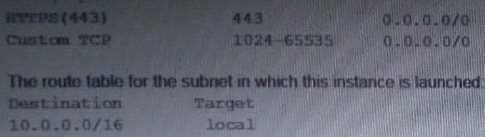
Based on the information provided what is causing the lack of access to S3 from the instance?
- A. The instance profile does not have explicit permissions to write objects to the S3 bucket.
- B. The route table does not have a rule tor all traffic to pass through a NAT gateway.
- C. The route table does not have a rule for all traffic to pass through an internet gateway
- D. The security group does not allow all TCP and all UDP traffic.
Answer: C
Explanation:
In practice, to cover the different types of clients that might initiate traffic to public-facing instances in your VPC, you can open ephemeral ports 1024-65535. However, you can also add rules to the ACL to deny traffic on any malicious ports within that range. Ensure that you place the DENY rules earlier in the table than the ALLOW rules that open the wide range of ephemeral ports.
NEW QUESTION 3
If you want to launch Amazon Elastic Compute Cloud (EC2) Instances and assign each Instance a predetermined private IP address you should:
- A. Assign a group or sequential Elastic IP address to the instances
- B. Launch the instances in a Placement Group
- C. Launch the instances in the Amazon virtual Private Cloud (VPC).
- D. Use standard EC2 instances since each instance gets a private Domain Name Service (DNS) already
- E. Launch the Instance from a private Amazon Machine image (Mil)
Answer: C
Explanation:
When you launch an instance into a VPC, a primary private IP address from the address range of the subnet is assigned to the default network interface (eth0) of the instance. If you don??t specify a primary private IP address, we select an available IP address in the subnet range for you http://docs.aws.amazon.com/AmazonVPC/latest/UserGuide/vpc-ip-addressing.html
NEW QUESTION 4
A user wants to make so that whenever the CPU utilization of the AWS EC2 instance is above 90%, the redlight of his bedroom turns on. Which of the below mentioned AWS services is helpful for this purpose?
- A. AWS CloudWatch + AWS SES
- B. AWS CloudWatch + AWS SNS
- C. Non
- D. It is not possible to configure the light with the AWS infrastructure services
- E. AWS CloudWatch and a dedicated software turning on the light
Answer: B
Explanation:
Amazon Simple Notification Service (Amazon SNS. is a fast, flexible, and fully managed push messaging service. Amazon SNS can deliver notifications by SMS text message or email to the Amazon Simple Queue Service (SQS. queues or to any HTTP endpoint. The user can configure some sensor devices at his home which receives data on the HTTP end point (REST calls. and turn on the red light. The user can configure the CloudWatch alarm to send a notification to the AWS SNS HTTP end point (the sensor device. and it will turn the light red when there is an alarm condition.
NEW QUESTION 5
What would happen to an RDS (Relational Database Service) multi-Availability Zone deployment of the primary OB instance fails?
- A. The IP of the primary DB instance is switched to the standby OB instance
- B. The RDS (Relational Database Service) DB instance reboots
- C. A new DB instance is created in the standby availability zone
- D. The canonical name record (CNAME) is changed from primary to standby
Answer: D
Explanation:
https://aws.amazon.com/rds/faqs/
NEW QUESTION 6
A user has recently started using EC2. The user launched one EC2 instance in the default subnet in EC2-VPC Which of the below mentioned options is not attached or available with the EC2 instance when it is launched?
- A. Public IP address
- B. Internet gateway
- C. Elastic IP
- D. Private IP address
Answer: C
Explanation:
A Virtual Private Cloud (VPC. is a virtual network dedicated to a user??s AWS account. A subnet is a range of IP addresses in the VPC. The user can launch the AWS resources into a subnet. There are two supported platforms into which a user can launch instances: EC2-Classic and EC2-VPC (default subnet. A default VPC has all the benefits of EC2-VPC and the ease of use of EC2-Classic. Each instance that the user launches into a default subnet has a private IP address and a public IP address. These instances can communicate with the internet through an internet gateway. An internet gateway enables the EC2 instances to connect to the internet through the Amazon EC2 network edge.
NEW QUESTION 7
A user has created a VPC with CIDR 20.0.0.0/16 with only a private subnet and VPN connection using the VPC wizard. The user wants to connect to the instance in a private subnet over SSH. How should the user define the security rule for SSH?
- A. Allow Inbound traffic on port 22 from the user??s network
- B. The user has to create an instance in EC2 Classic with an elastic IP and configure the security group of a private subnet to allow SSH from that elastic IP
- C. The user can connect to a instance in a private subnet using the NAT instance
- D. Allow Inbound traffic on port 80 and 22 to allow the user to connect to a private subnet over the Internet
Answer: A
Explanation:
The user can create subnets as per the requirement within a VPC. If the user wants to connect VPC from his own data center, the user can setup a case with a VPN only subnet (private. which uses VPN access to connect with his data center. When the user has configured this setup with Wizard, all network connections to the instances in the subnet will come from his data center. The user has to configure the security group of the private subnet which allows the inbound traffic on SSH (port 22. from the data center??s network range.
NEW QUESTION 8
A user has launched 10 instances from the same AMI ID using Auto Scaling. The user is trying to see the average CPU utilization across all instances of the last 2 weeks under the CloudWatch console. How can the user achieve this?
- A. View the Auto Scaling CPU metrics
- B. Aggregate the data over the instance AMI ID
- C. The user has to use the CloudWatchanalyser to find the average data across instances
- D. It is not possible to see the average CPU utilization of the same AMI ID since the instance ID is different
Answer: A
Explanation:
Auto Scaling has its own aggregated CPU Utilization metric.
NEW QUESTION 9
A user has created a VPC with public and private subnets using the VPC wizard. The VPC has CIDR 20.0.0.0/16. The private subnet uses CIDR 20.0.0.0/24 . The NAT instance ID is i-a12345. Which of the below mentioned entries are required in the main route table attached with the private subnet to allow instances to connect with the internet?
- A. Destination: 0.0.0.0/0 and Target: i-a12345
- B. Destination: 20.0.0.0/0 and Target: 80
- C. Destination: 20.0.0.0/0 and Target: i-a12345
- D. Destination: 20.0.0.0/24 and Target: i-a12345
Answer: A
Explanation:
A user can create a subnet with VPC and launch instances inside that subnet. If the user has created a public private subnet, the instances in the public subnet can receive inbound traffic directly from the Internet, whereas the instances in the private subnet cannot. If these subnets are created with Wizard, AWS will create two route tables and attach to the subnets. The main route table will have
the entry ??Destination: 0.0.0.0/0 and Target: ia12345??, which allows all the instances in the private subnet to connect to the internet using NAT.
NEW QUESTION 10
What is a placement group?
- A. A collection of Auto Scaling groups in the same Region
- B. Feature that enables EC2 instances to interact with each other via nigh bandwidth, low latency connections
- C. A collection of Elastic Load Balancers in the same Region or Availability Zone
- D. A collection of authorized Cloud Front edge locations for a distribution
Answer: B
Explanation:
Reference:
http://aws.amazon.com/ec2/faqs/
A placement group is a logical grouping of instances within a single Availability Zone. Using placement groups enables applications to participate in a low-latency, 10 Gigabits per second (Gbps) network. Placement groups are recommended for applications that benefit from low network latency, high network throughput, or both
NEW QUESTION 11
Which of the below mentioned AWS RDS logs cannot be viewed from the console for MySQL?
- A. Error Log
- B. Slow Query Log
- C. Transaction Log
- D. General Log
Answer: C
Explanation:
The user can view, download, and watch the database logs using the Amazon RDS console, the Command Line Interface (CLI., or the Amazon RDS API. For the MySQL RDS, the user can view the error log, slow querylog, and general logs. RDS does not support viewing the transaction logs.
NEW QUESTION 12
A user has setup Auto Scaling with ELB on the EC2 instances. The user wants to configure that
whenever the CPU utilization is below 10%, Auto Scaling should remove one instance. How can the user configure this?
- A. The user can get an email using SNS when the CPU utilization is less than 10%. The user can use the desired capacity of Auto Scaling to remove the instance
- B. Use CloudWatch to monitor the data and Auto Scaling to remove the instances using scheduled actions
- C. Configure CloudWatch to send a notification to Auto Scaling Launch configuration when the CPU utilization is less than 10% and configure the Auto Scaling policy to remove the instance
- D. Configure CloudWatch to send a notification to the Auto Scaling group when the CPU Utilization is less than 10% and configure the Auto Scaling policy to remove the instance
Answer: D
Explanation:
Amazon CloudWatch alarms watch a single metric over a time period that the user specifies and performs one or more actions based on the value of the metric relative to a given threshold over a number of time periods. The user can setup to receive a notification on the Auto Scaling group with the CloudWatch alarm when the CPU utilization is below a certain threshold. The user can configure the Auto Scaling policy to take action for removing the instance. When the CPU utilization is below 10% CloudWatch will send an alarm to the Auto Scaling group to execute the policy.
NEW QUESTION 13
A user has granted read/write permission of his S3 bucket using ACL. Which of the below mentioned options is a valid ID to grant permission to other AWS accounts (grantee. using ACL?
- A. IAM User ID
- B. S3 Secure ID
- C. Access ID
- D. Canonical user ID
Answer: D
Explanation:
An S3 bucket ACL grantee can be an AWS account or one of the predefined Amazon S3 groups. The user can grant permission to an AWS account by the email address of that account or by the canonical user ID. If the user provides an email in the grant request, Amazon S3 finds the canonical user ID for that account and adds it to the ACL. The resulting ACL will always contain the canonical user ID for the AWS account, and not the AWS account's email address.
NEW QUESTION 14
An organization is planning to create 5 different AWS accounts considering various security requirements. The organization wants to use a single payee account by using the consolidated billing option. Which of the below mentioned statements is true with respect to the above information?
- A. Master (Paye
- B. account will get only the total bill and cannot see the cost incurred by each account
- C. Master (Paye
- D. account can view only the AWS billing details of the linked accounts
- E. It is not recommended to use consolidated billing since the payee account will have access to the linked accounts
- F. Each AWS account needs to create an AWS billing policy to provide permission to the payee account
Answer: B
Explanation:
AWS consolidated billing enables the organization to consolidate payments for multiple Amazon Web Services (AWS. accounts within a single organization by making a single paying account. Consolidated billing enables the organization to see a combined view of the AWS charges incurred by each account as well as obtain a detailed cost report for each of the individual AWS accounts associated with the paying account. The payee account will not have any other access than billing data of linked accounts.
NEW QUESTION 15
Which two AWS services provide out-of-the-box user configurable automatic backup-as-a-service and backup rotation options? Choose 2 answers
- A. Amazon S3
- B. Amazon RDS
- C. Amazon EBS
- D. Amazon Redshift
Answer: BD
Explanation:
By default: at no additional charge, Amazon RDS enables automated backups of your DB Instance with a 1-day retention period. By default: Amazon Redshift enables automated backups of your data warehouse cluster with a 1- day retention period.
NEW QUESTION 16
You are tasked with setting up a cluster of EC2 Instances for a NoSQL database. The database requires random read IO disk performance up to a 100,000 IOPS at 4KB block side per node.
Which of the following EC2 instances will perform the best for this workload?
- A. A High-Memory Quadruple Extra Large (m2.4xlarge) with EBS-Optimized set to true and a PIOPs EBS volume
- B. A Cluster Compute Eight Extra Large (cc2.8xlarge) using instance storage
- C. High I/O Quadruple Extra Large (hi1.4xlarge) using instance storage
- D. A Cluster GPU Quadruple Extra Large (cg1.4xlarge) using four separate 4000 PIOPS EBS volumes in a RAID 0 configuration
Answer: C
Explanation:
Reference:
http://aws.amazon.com/ec2/instance-types/
NEW QUESTION 17
A company is running an Oracle database engine that handles heavy online transaction processing (OLTP) structured data traffic.
How can a SysOps administrator ensure that the database has high availability?
- A. Use Amazon DynamoOB to store the data
- B. Use Amazon RDS Multi -AZ deployment to store the data
- C. Use Amazon RDS read replicas in a different region to store the data
- D. Use an Amazon Redshift cluster to store the data
Answer: B
NEW QUESTION 18
An organization has configured Auto Scaling with ELB. There is a memory issue in the application which is causing CPU utilization to go above 90%. The higher CPU usage triggers an event for Auto Scaling as per the scaling policy. If the user wants to find the root cause inside the application without triggering a scaling activity, how can he achieve this?
- A. Stop the scaling process until research is completed
- B. It is not possible to find the root cause from that instance without triggering scaling
- C. Delete Auto Scaling until research is completed
- D. Suspend the scaling process until research is completed
Answer: D
Explanation:
Auto Scaling allows the user to suspend and then resume one or more of the Auto Scaling processes in the Auto Scaling group. This is very useful when the user wants to investigate a configuration problem or some other issue, such as a memory leak with the web application and then make changes to the application, without triggering the Auto Scaling process.
NEW QUESTION 19
A user has enabled the Multi AZ feature with the MS SQL RDS database server. Which of the below mentioned statements will help the user understand the Multi AZ feature better?
- A. In a Multi AZ, AWS runs two DBs in parallel and copies the data asynchronously to the replica copy
- B. In a Multi AZ, AWS runs two DBs in parallel and copies the data synchronously to the replica copy
- C. In a Multi AZ, AWS runs just one DB but copies the data synchronously to the standby replica
- D. AWS MS SQL does not support the Multi AZ feature
Answer: C
Explanation:
Amazon RDS provides high availability and failover support for DB instances using Multi-AZ deployments. In a Multi-AZ deployment, Amazon RDS automatically provisions and maintains a synchronous standby replica in a different Availability Zone. The primary DB instance is synchronously replicated across Availability Zones to a standby replica to provide data redundancy, eliminate I/O freezes, and minimize latency spikes during system backups. Running a DB instance with high availability can enhance availability during planned system maintenance, and help protect your databases against DB instance failure and Availability Zone disruption.Note that the high-availability feature is not a scaling solution for read-only scenarios; you cannot use a standby replica to serve read traffic. To service read-only traffic, you should use a read replica.
NEW QUESTION 20
A user has created a VPC with CIDR 20.0.0.0/16. The user has created one subnet with CIDR 20.0.0.0/16 by mistake. The user is trying to create another subnet of CIDR 20.0.0.1/24. How can the user create the second subnet?
- A. There is no need to update the subnet as VPC automatically adjusts the CIDR of the first subnet based on the second subnet??s CIDR
- B. The user can modify the first subnet CIDR from the console
- C. It is not possible to create a second subnet as one subnet with the same CIDR as the VPC has been created
- D. The user can modify the first subnet CIDR with AWS CLI
Answer: D
Explanation:
A Virtual Private Cloud (VPC. is a virtual network dedicated to the user??s AWS account. A user can create a subnet with VPC and launch instances inside the subnet. The user can create a subnet with the same size of VPC. However, he cannot create any other subnet since the CIDR of the second subnet will conflict with the first subnet. The user cannot modify the CIDR of a subnet once it is created. Thus, in this case if required, the user has to delete the subnet and create new subnets.
NEW QUESTION 21
A user has launched an EC2 Windows instance from an instance store backed AMI. The user has also set the Instance initiated shutdown behavior to stop. What will happen when the user shuts down the OS?
- A. It will not allow the user to shutdown the OS when the shutdown behaviour is set to Stop
- B. It is not possible to set the termination behaviour to Stop for an Instance store backed AMI instance
- C. The instance will stay running but the OS will be shutdown
- D. The instance will be terminated
Answer: B
Explanation:
When the EC2 instance is launched from an instance store backed AMI, it will not allow the user to configure the shutdown behaviour to ??Stop??. It gives a warning that the instance does not have the EBS root volume.
NEW QUESTION 22
A user has launched an EC2 instance. However, due to some reason the instance was terminated. If the user wants to find out the reason for termination, where can he find the details?
- A. It is not possible to find the details after the instance is terminated
- B. The user can get information from the AWS console, by checking the Instance description under the State transition reason label
- C. The user can get information from the AWS console, by checking the Instance description under the Instance Status Change reason label
- D. The user can get information from the AWS console, by checking the Instance description under the Instance Termination reason label
Answer: D
Explanation:
An EC2 instance, once terminated, may be available in the AWS console for a while after termination. The user can find the details about the termination from the description tab under the label State transition reason. If the instance is still running, there will be no reason listed. If the user has explicitly stopped or terminated the instance, the reason will be ??User initiated shutdown??.
NEW QUESTION 23
A user has created a VPC with public and private subnets. The VPC has CIDR 20.0.0.0/16. The private subnet uses CIDR 20.0.1.0/24 and the public subnet uses CIDR 20.0.0.0/24. The user is planning to host a web server in the public subnet (port 80. and a DB server in the private subnet (port 3306.. The user is configuring a security group of the NAT instance. Which of the below mentioned entries is not required for the NAT security group?
- A. For Inbound allow Source: 20.0.1.0/24 on port 80
- B. For Outbound allow Destination: 0.0.0.0/0 on port 80
- C. For Inbound allow Source: 20.0.0.0/24 on port 80
- D. For Outbound allow Destination: 0.0.0.0/0 on port 443
Answer: C
Explanation:
A user can create a subnet with VPC and launch instances inside that subnet. If the user has created a public private subnet to host the web server and DB server respectively, the user should configure that the instances in the private subnet can connect to the internet using the NAT instances. The user should first configure that NAT can receive traffic on ports 80 and 443 from the private subnet. Thus, allow ports 80 and 443 in Inbound for the private subnet 20.0.1.0/24. Now to route this traffic to the internet configure ports 80 and 443 in Outbound with destination 0.0.0.0/0. The NAT should not have an entry for the public subnet CIDR.
NEW QUESTION 24
......
P.S. Allfreedumps.com now are offering 100% pass ensure SOA-C01 dumps! All SOA-C01 exam questions have been updated with correct answers: https://www.allfreedumps.com/SOA-C01-dumps.html (639 New Questions)